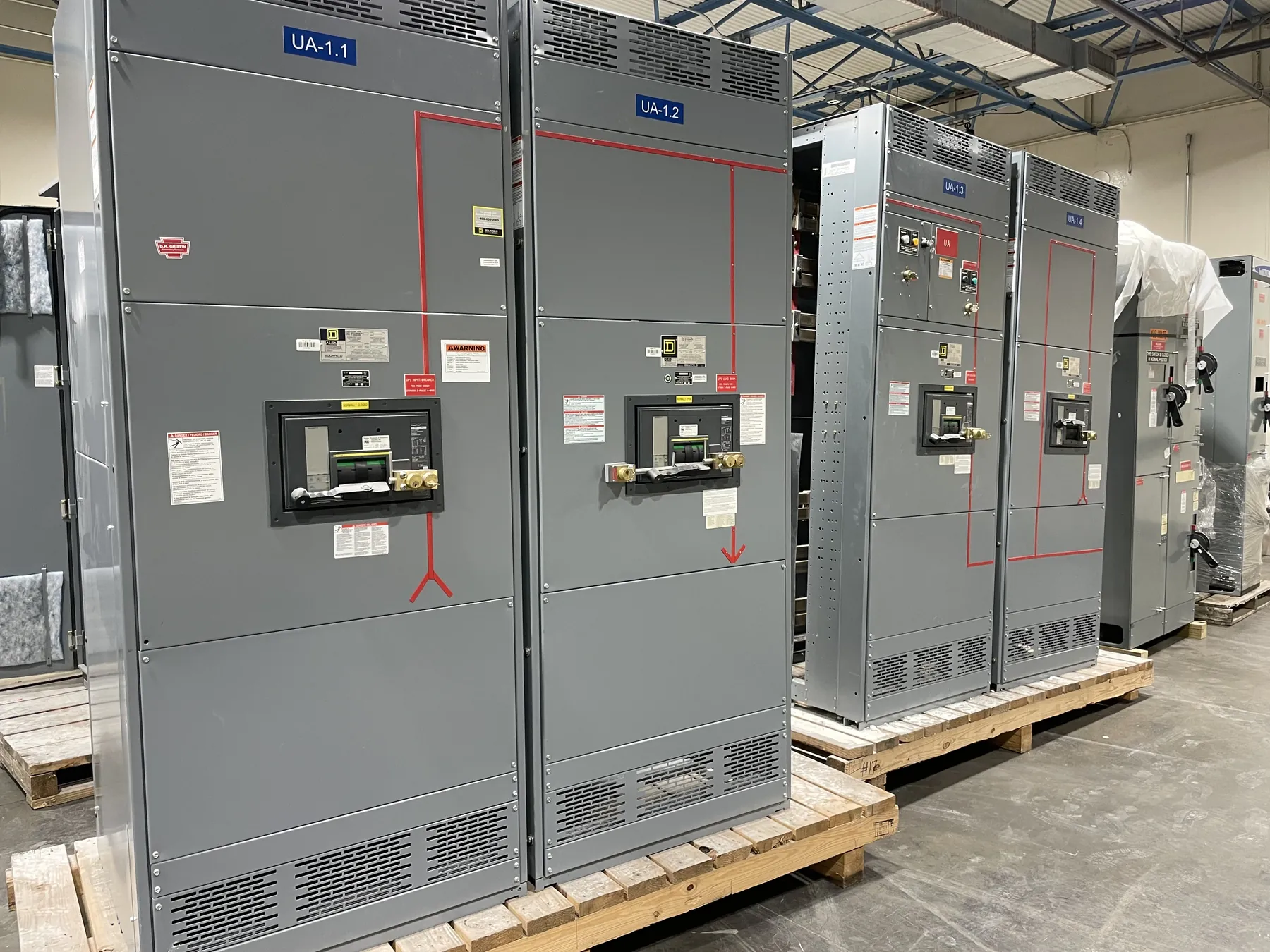
Low-Voltage Switchboards for Yerington Projects
Yerington facilities may need a new low-voltage switchboard for a building addition, equipment replacement, service change, or planned increase in electrical demand. The right arrangement depends on the project’s electrical design and the conditions at the installation site—not on the city name alone. We manufacture new custom switchboards in the United States using all-American components and can ship equipment to Nevada. Project schedules, shipping arrangements, and equipment requirements should be confirmed during quotation and engineering review.
Early planning should capture the intended loads, how power enters and leaves the board, and whether future expansion is expected. A switchboard is part of a coordinated electrical system; its configuration and ratings must suit the source, conductors, downstream equipment, and applicable project requirements. Qualified electrical professionals should establish the design and verify that the proposed equipment fits the site.
Service and Feeder Arrangements — Low-Voltage Switchboards in Yerington, NV
The service arrangement identifies how the switchboard connects to its power source and where service equipment requirements apply. Feeder sections distribute power to downstream panels, machinery, HVAC equipment, or other loads. Their number, placement, and protective-device provisions affect the board’s layout, footprint, and connection points. A quotation is more useful when it identifies the source arrangement and describes each major feeder destination rather than providing only a general equipment label.
Provide the electrical one-line diagram, when available, along with source and feeder information, protective-device preferences or specifications, and any required metering or control interfaces. The design team can then review section sequencing, cable or bus connections, and access needs. Any service configuration must be checked against the project design and applicable requirements; a manufacturer should not infer it from a location or building description.
Bus Sizing, Ratings, and Available Fault Current — Low-Voltage Switchboards in Yerington, NV
Bus sizing is a design decision tied to the calculated load, demand assumptions, conductor interfaces, temperature and enclosure conditions, and the specified equipment ratings. Planned load growth matters: a design based only on current demand may leave little room for a later addition, while selecting capacity without engineering support can create avoidable cost or coordination problems. Share current and anticipated loads, expected operating patterns, and known expansion plans for qualified review.
Available fault current at the switchboard’s point of connection is also essential. It informs the required short-circuit rating and coordination of the equipment and protective devices. Do not treat a switchboard’s current rating as its short-circuit rating, or either value as a statement of system voltage. The project engineer or other qualified party should provide and verify the applicable system data. Ratings must be confirmed for the specific configuration and installation.
Plan Yerington Load Growth and Future Space
For a Yerington project, record planned load growth, spare circuits, and available space for future extensions before finalizing the arrangement. “Spare” can mean different things: an unused circuit provision, physical space for future devices, or capacity reserved in the design. These provisions are not interchangeable. Identify which future work is anticipated, what equipment it may serve, and whether extensions must connect to a particular section.
Room conditions can constrain the practical design. Document the intended electrical-room or equipment-area dimensions, access route, door clearances, floor or housekeeping-pad conditions, and nearby obstructions. Nevada delivery planning should account for the receiving location, unloading responsibility, site access, and construction sequence. These details help identify handling or layout questions early, but the installation team must confirm field conditions before equipment placement.
UL 891 and Project-Specific Documentation — Low-Voltage Switchboards in Yerington, NV
UL 891 applies to applicable low-voltage switchboards; it should not be assumed to cover every switchgear product or every configuration. Whether it applies to a proposed assembly depends on the product and project requirements. Listing status must be confirmed for the specific equipment being quoted, and project-specific listing documentation should be reviewed before approval. Do not assume that a general product description establishes a listing or that a listing resolves every installation requirement.
Provide the project specification’s listing language and any required documentation, along with the one-line diagram and rating schedule. The engineering review can identify questions about the requested construction, interfaces, and submittal requirements. Final ratings, listing scope, and suitability remain subject to confirmation against the actual design and installation conditions.
Information for a Switchboard Quotation
To develop a useful proposal, share the project location in Yerington, requested schedule, drawings, system and load data, available fault-current information, feeder schedule, preferred device details, enclosure or room constraints, and documentation requirements. Include anticipated load growth, spare circuits, and extension space in the scope rather than treating them as assumptions. Where data is preliminary, label it clearly so unresolved items can be identified for engineering review.
We manufacture new custom power-distribution equipment and ship nationwide. Lead time depends on the approved design, components, documentation, and project coordination, so timing must be confirmed for the specific order. A qualified engineer and the project team should resolve design, code, protection, and site questions before equipment is released for manufacture.