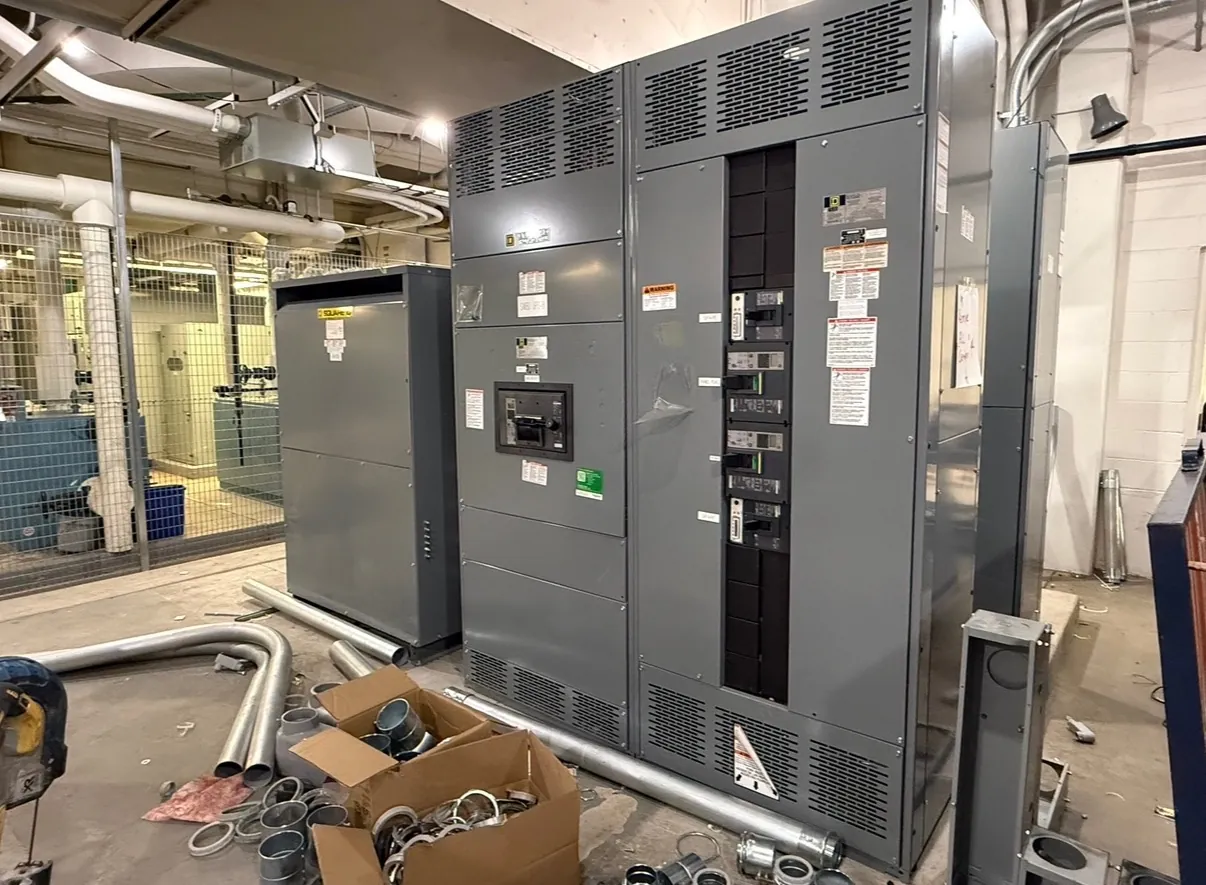
Automatic transfer switches for Winnemucca projects
Automatic transfer switches (ATS) move designated electrical loads between normal and alternate sources when control logic detects a qualifying change in source conditions. For a Winnemucca facility, the right arrangement depends on what the alternate source is, which loads must transfer, and how the system should behave during a disturbance or return to normal power. A generator, a second utility source, and other source arrangements can call for different controls and equipment interfaces; the project documents need to define the intended sequence rather than assume that every ATS operates the same way.
We manufacture new custom power-distribution equipment in the United States using all-American components, and ship nationwide, including to Nevada. Early discussion of the one-line diagram, source characteristics, load priorities, and site constraints helps establish a practical equipment scope. Ratings, listing status, construction, and compatibility must be confirmed for the actual application by qualified project professionals.
Transition behavior and source sensing — Automatic Transfer Switches in Winnemucca, NV
Transfer behavior describes how the switch moves a load from one source to another. An open-transition arrangement disconnects one source before connecting the other, creating a brief interruption. A closed-transition arrangement overlaps sources momentarily under specified conditions and requires careful coordination with the source equipment and the applicable utility or system requirements. Delayed or in-phase transition strategies may also be considered when the load or system sequence calls for them. These terms describe different operating approaches, not a guarantee that a particular load will ride through a transfer.
Control settings determine what the ATS recognizes as an unacceptable source condition and when it initiates a transfer or retransfer. Project engineers should identify which voltage, frequency, phase, or other monitored conditions matter, along with acceptable delays and sequencing. Too little delay can cause unnecessary transfers during brief disturbances; excessive delay may conflict with the facility’s operational priorities. The generator controller, protective devices, building controls, and any remote annunciation should be reviewed as a coordinated system.
Load, ampere, and withstand ratings — Automatic Transfer Switches in Winnemucca, NV
ATS selection must account for the load served, the electrical system, and available fault current—not just a nominal system-voltage label. The switch’s ampere rating is a equipment rating and is distinct from the system voltage. Engineers also need to evaluate the switch’s short-circuit withstand and closing capability in the context of the available protective device and installation. A rating that appears adequate in isolation may not be suitable for the fault-current conditions at the proposed location.
Load character matters as well. Motor starting, transformer energization, nonlinear loads, and the mix of essential and nonessential circuits can affect selection and transfer sequence. A project may use one ATS for a defined load group or several switches arranged by priority. The design team should state whether loads transfer together or in stages, whether load shedding is required, and how the alternate source is expected to respond. Final ratings and protection coordination require review of project-specific electrical information.
Neutral switching and grounding interfaces — Automatic Transfer Switches in Winnemucca, NV
Whether the ATS switches the neutral is an application decision, not a default feature to choose without reviewing the grounding design. The answer depends in part on source configuration, how the generator or alternate source is grounded, and whether the source is treated as a separately derived system. The grounding and bonding arrangement, neutral path, and protective-device scheme must work together under the applicable project requirements.
For a Winnemucca installation, the equipment schedule and one-line diagram should make the intended neutral configuration explicit. The project team should also identify control power, generator start contacts, remote status points, communications needs, and any required interlocks. These interfaces affect enclosure layout, terminals, wiring scope, and coordination with the generator package or other source equipment.
UL 1008 and applicable equipment documentation
UL 1008 is a standard associated with transfer switch equipment. Whether it applies to a proposed ATS, and what listing or other documentation is required, depends on the equipment type, project specification, and governing authority’s requirements. Do not infer that an entire distribution assembly—or unrelated switchgear—is covered simply because transfer equipment is part of the system. The specified product, ratings, configuration, and documentation should be confirmed for the exact application.
When requesting a quotation, provide the one-line diagram, system voltage and phase, source details, required switch rating, fault-current information, protective-device details, transition preference, neutral requirements, enclosure conditions, and control or communication interfaces. Identify any specification language concerning UL 1008 or listing so it can be reviewed against the requested equipment. Where information is preliminary, mark it as such; unresolved engineering choices should not be treated as confirmed selections.
Winnemucca receiving, unloading, and installation planning — Automatic Transfer Switches in Winnemucca, NV
Shipping coordination is part of a workable equipment schedule. Before release, confirm the delivery location, receiving hours, site contact, access route, unloading equipment, staging area, and any restrictions on truck access. A receiving team should know whether the shipment contains multiple sections and how each piece is identified. Site conditions in and around the electrical room—including door clearances, floor access, available staging space, and the planned movement path—can influence how equipment is shipped and brought to its final position.
Ask early whether the installation plan can accommodate the shipping sections and their handling limits. If access requires smaller sections or a particular delivery sequence, that constraint should be reviewed during design rather than discovered at arrival. Coordinate equipment shipment with foundation or housekeeping-pad readiness, conduit and cable planning, generator availability, and the electrical contractor’s installation sequence. A schedule can then account for manufacture, transport to Winnemucca, receiving, unloading, and final installation without assuming an unconfirmed delivery date.