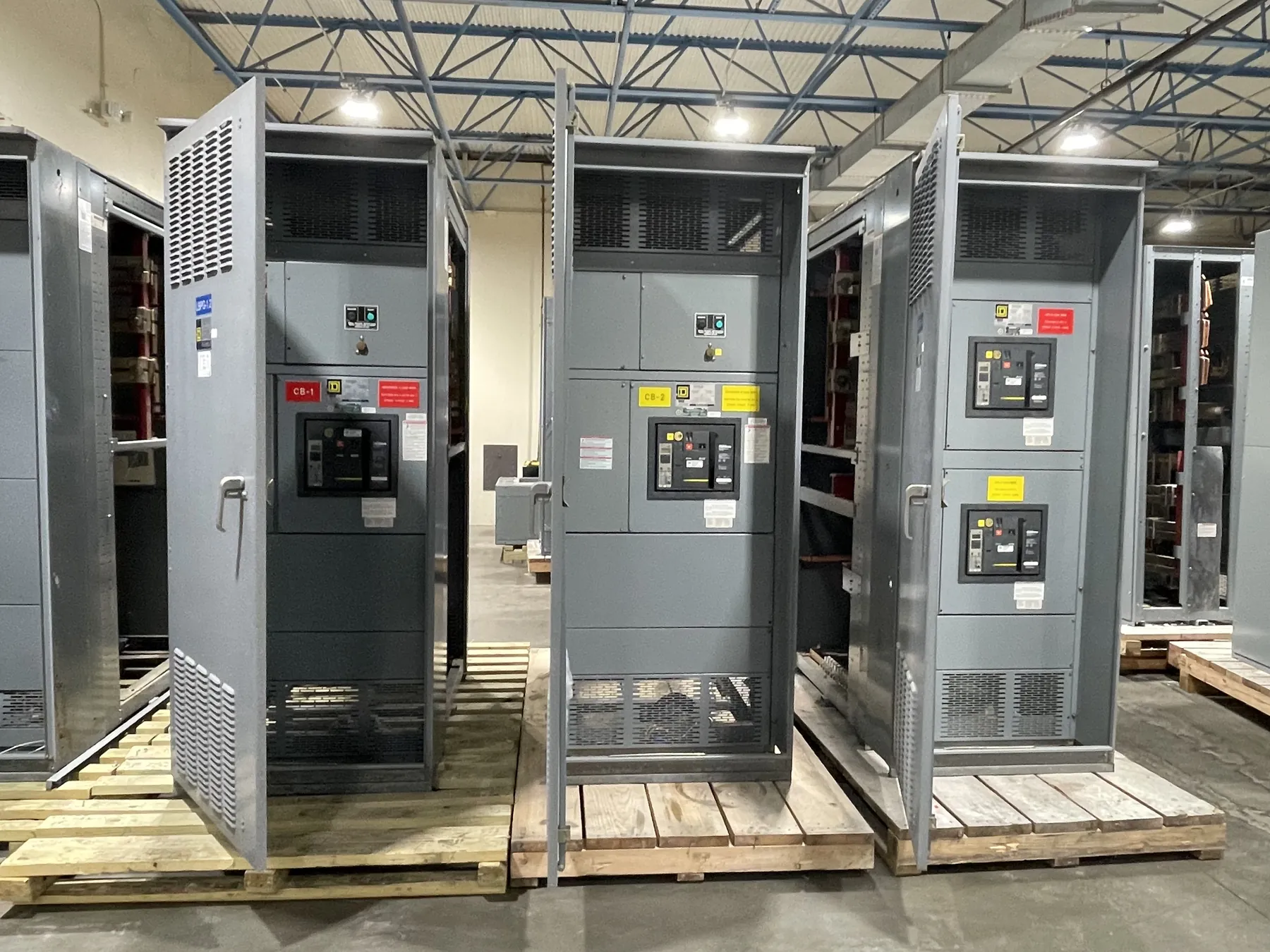
Metal-Enclosed Switchgear for Tonopah, Nevada Projects
Metal-enclosed switchgear can provide a coordinated way to house switching and protective equipment for a facility’s distribution system. For a Tonopah project, the appropriate arrangement depends on the system design, connected loads, available fault current, operating requirements and installation conditions—not simply the equipment name or nominal voltage. Our U.S.-manufactured equipment is built with all-American components, supports short lead times and can ship nationwide, including to Nevada. Final configuration, ratings and schedule depend on engineering review and confirmed project requirements.
Choose the Switching and Protection Arrangement
A proposed lineup may use switches with fuses, circuit breakers, or a combination selected for the functions required. A switch-and-fuse arrangement can suit a design where the specified fuse provides overcurrent protection for a particular circuit. A breaker-based configuration may be appropriate when the project calls for breaker protection and related control or coordination features. These options are not interchangeable by default: the engineer must assess load characteristics, available fault current, protection objectives, operating sequence and coordination with upstream and downstream devices.
When requesting a quotation, identify the intended function of each section and any known preferences for switches, fuse types or breakers. Include the one-line diagram and protective-device information if available. If those details are still under development, state that clearly; assumptions should be identified and reviewed rather than treated as final design decisions.
Understand Metal-Enclosed Versus Metal-Clad Construction — Metal-Enclosed Switchgear in Tonopah, NV
Metal-enclosed is a broad description of equipment housed in a metal enclosure. It does not, by itself, establish a particular internal compartment arrangement or construction standard. Metal-clad switchgear is a more specific construction category with defined separation and component arrangements under applicable product requirements. The terms should not be used as synonyms when preparing a specification or comparing proposals.
For a Tonopah application, confirm the required equipment category and construction in the project documents. Review the specified voltage class, service conditions, switching function, accessibility and applicable standards with the project engineer. UL 891 applies to applicable low-voltage switchboards; it should not be read as a blanket standard for metal-enclosed switchgear or as coverage for every voltage class or product type. Any requested listing or standard must be confirmed for the particular assembly.
Review Barriers, Fault Duty and Grounding
Internal barriers affect how components are separated and accessed, but the desired arrangement must be tied to the equipment design and applicable requirements. Clarify which compartments or components need separation, what access is expected for inspection or maintenance, and whether the specification calls for particular barriers. Do not assume that a general “metal-enclosed” description guarantees a specific degree of separation.
Fault duty is another essential selection input. The equipment’s applicable ratings must be suitable for the system conditions at the point of connection, including the available fault current and protective-device arrangement. A rating is not the same thing as system voltage, and a preliminary rating should not be finalized without review of the system study and equipment interfaces. Grounding details likewise require coordination: identify the project grounding scheme, incoming and outgoing connections, and any specified ground bus or bonding provisions. Qualified engineers must confirm the design and ratings for the installation.
Account for Tonopah Site and Access Conditions
Before finalizing an enclosure or its ratings, confirm the actual installation altitude and expected temperature range against the equipment’s applicable limits. Do not substitute general regional assumptions for site data. Also document whether the switchgear will be indoors or outdoors, the available floor space, the intended orientation, cable entry direction and the route from the delivery point to the installation area.
Access can affect enclosure dimensions, section arrangement and installation planning. Provide door, aisle and working-clearance constraints from the project design, as well as any limits on turning, lifting or moving the equipment into position. Nevada shipment logistics should be coordinated with the site team, particularly where delivery access or receiving arrangements require advance planning. These details help avoid quoting an arrangement that fits electrically but cannot be accommodated as intended.
Prepare a Useful Quotation Package — Metal-Enclosed Switchgear in Tonopah, NV
A complete request should include the one-line diagram, system voltage, frequency, available fault-current information, specified equipment ratings, protection preferences, grounding requirements and applicable standards. Add the site altitude and temperature limits, enclosure location, access constraints, cable termination details and any control or metering needs. Identify which requirements are firm and which remain subject to engineering review.
Our team manufactures new custom power-distribution equipment in the United States and can review these inputs to develop a proposed configuration for the Tonopah project. Product ratings, construction, listings, interfaces and lead time must be confirmed for the specific scope. Final selection requires qualified engineering review of the system and site conditions.