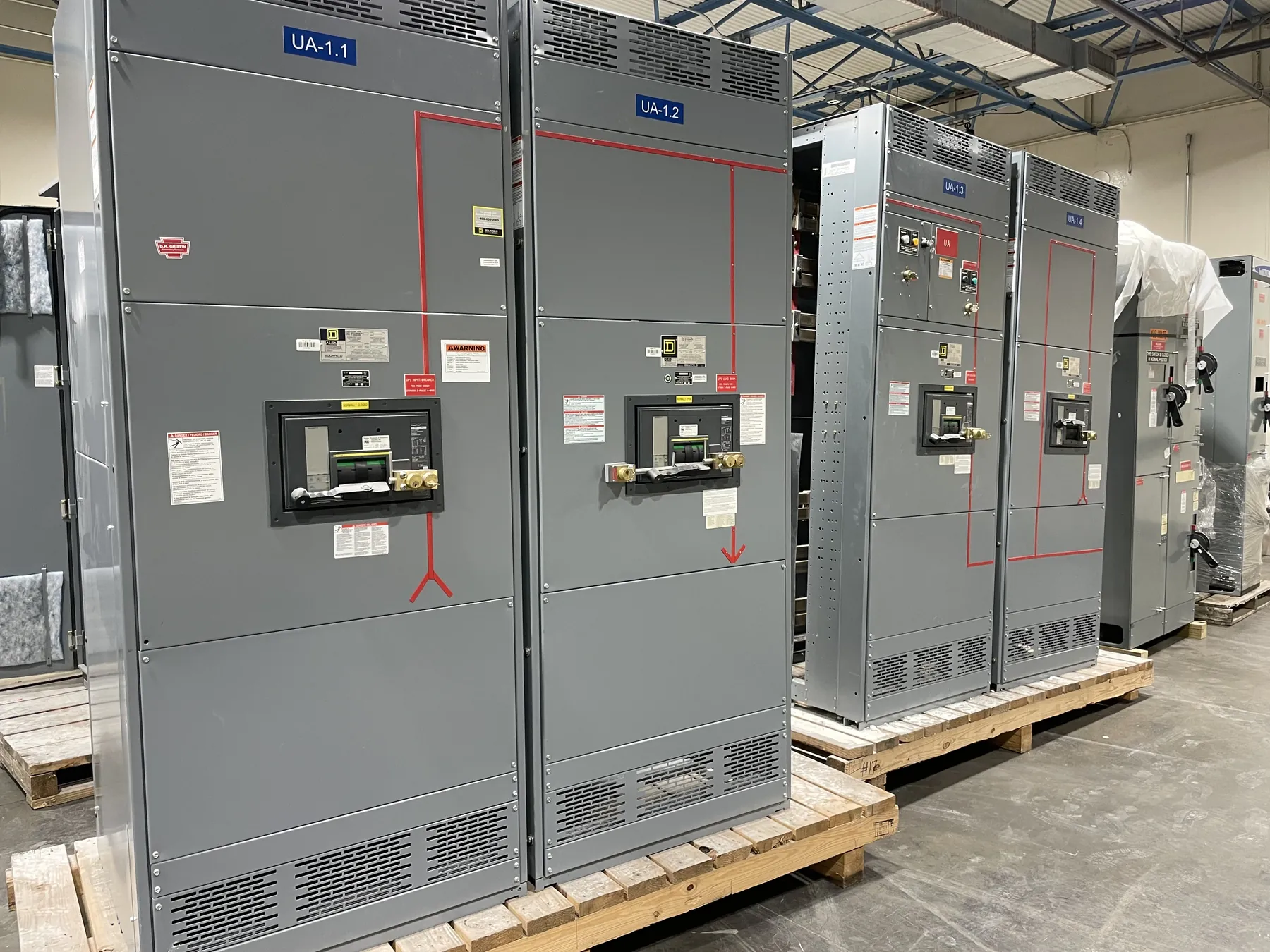
Low-Voltage Switchgear for Pahrump, NV Projects
Low-voltage switchgear can provide a central point for controlling and protecting power-distribution circuits in a commercial, industrial, institutional, or infrastructure facility. For a Pahrump project, the right configuration depends on the electrical service and the loads it must serve—not simply on a preferred lineup size or a nominal voltage label. Early design review should confirm the service voltage, grounding approach, and available short-circuit current at the installation site. Those conditions influence equipment selection, protective-device choices, and the interfaces needed for a coordinated distribution system.
We manufacture new custom power-distribution equipment in the United States using all-American components. We can develop a low-voltage switchgear proposal around project documents and stated operating requirements, then ship equipment nationwide, including to Nevada. Final design and delivery planning depend on the project scope, confirmed specifications, and manufacturing schedule.
Power Circuit Breaker Arrangements and Access — Low-Voltage Switchgear in Pahrump, NV
Low-voltage power circuit breakers may be arranged in drawout or fixed configurations, depending on the equipment design and project requirements. Drawout arrangements can support removal of a breaker from its connected position for inspection or maintenance, while fixed arrangements may suit designs where that feature is not needed. The choice affects the switchgear structure, compartment layout, interfaces, and maintenance planning. It should reflect the facility’s maintenance resources and operating requirements, not an assumption that one arrangement is best for every site.
Consider how the lineup will be accessed within the electrical room. Door clearances, aisle space, cable entry, conduit locations, and the intended path for bringing equipment into the building can all affect workable dimensions. In Pahrump, as elsewhere, the building’s actual access route and room conditions should be checked before finalizing the lineup. A drawing review can identify constraints early, but field dimensions and site conditions need confirmation by the project team.
Bus Ratings, Service Conditions, and Interrupting Requirements
Bus ratings describe the equipment’s specified current-carrying capability under stated conditions; they are not the same thing as system voltage. A suitable bus rating cannot be selected from a building’s voltage alone. The engineer must consider expected load, demand, future expansion, protective-device ratings, enclosure and environmental conditions, and the design basis for the distribution system. Adequate provision for planned growth may be useful, but unnecessary oversizing can affect footprint and project cost.
Available short-circuit current is another essential input. The specified equipment and breaker characteristics must be evaluated against the fault-current conditions at the installation point. Service voltage, grounding, fault-current data, and the proposed protective devices should be reviewed together. Ratings and equipment suitability require engineering confirmation against the actual system and site documents; they should not be inferred from a product category or a single nameplate value.
Coordination Across the Distribution System
Protective-device coordination considers how upstream and downstream devices respond to faults, with the goal of limiting unnecessary interruption while providing appropriate protection. The relevant choices may include breaker trip functions and settings, device types, and the relationship between switchgear feeders and downstream equipment. A coordination study uses project-specific system information and should be performed or reviewed by qualified electrical engineers. Device selection cannot be finalized responsibly without the available fault-current information and the protection requirements for connected loads.
Useful quotation inputs include a one-line diagram, equipment schedule, service and grounding information, load data, available fault current, required feeder count and ratings, cable-entry preferences, room constraints, and any project specifications for monitoring or communications. If a study or design is still underway, identify what is preliminary and what remains to be confirmed. Clear assumptions help distinguish a budgetary configuration from a design ready for approval and manufacture.
UL 1558 and Applicable Equipment Requirements — Low-Voltage Switchgear in Pahrump, NV
UL 1558 is a standard associated with metal-enclosed low-voltage power circuit breaker switchgear. Whether it applies to a particular project depends on the specified equipment and its intended use. It should not be treated as a blanket statement that every low-voltage assembly is covered, or as evidence that a proposed product carries a particular listing. Project documents should identify applicable standards and required listing status, and the manufacturer and qualified design team should confirm how those requirements apply to the proposed configuration.
Other details may also require review, including enclosure requirements, control power, metering, communications, cable terminations, and interfaces with upstream or downstream equipment. Ratings, listings, and project-specific construction details must be confirmed for the actual assembly; they cannot be assumed from a general description.
Planning Delivery to a Pahrump Site
Shipping custom switchgear to Pahrump involves more than selecting a destination. The project team should confirm the receiving location, unloading method, access route, staging space, and whether the equipment can be moved from the delivery point to its final room. Electrical-room readiness and coordination with construction milestones also matter when planning shipment. These logistics can affect how a lineup is configured for transport and installation, so they are useful to discuss before drawings are finalized.
Share the current one-line diagram, site and service information, room layout, and project schedule when requesting a proposal. We can use those details to develop a new custom low-voltage switchgear scope for review, with ratings and requirements subject to engineering confirmation. Manufacturing timelines and shipment arrangements are established for the specific order rather than assumed from a general lead-time claim.