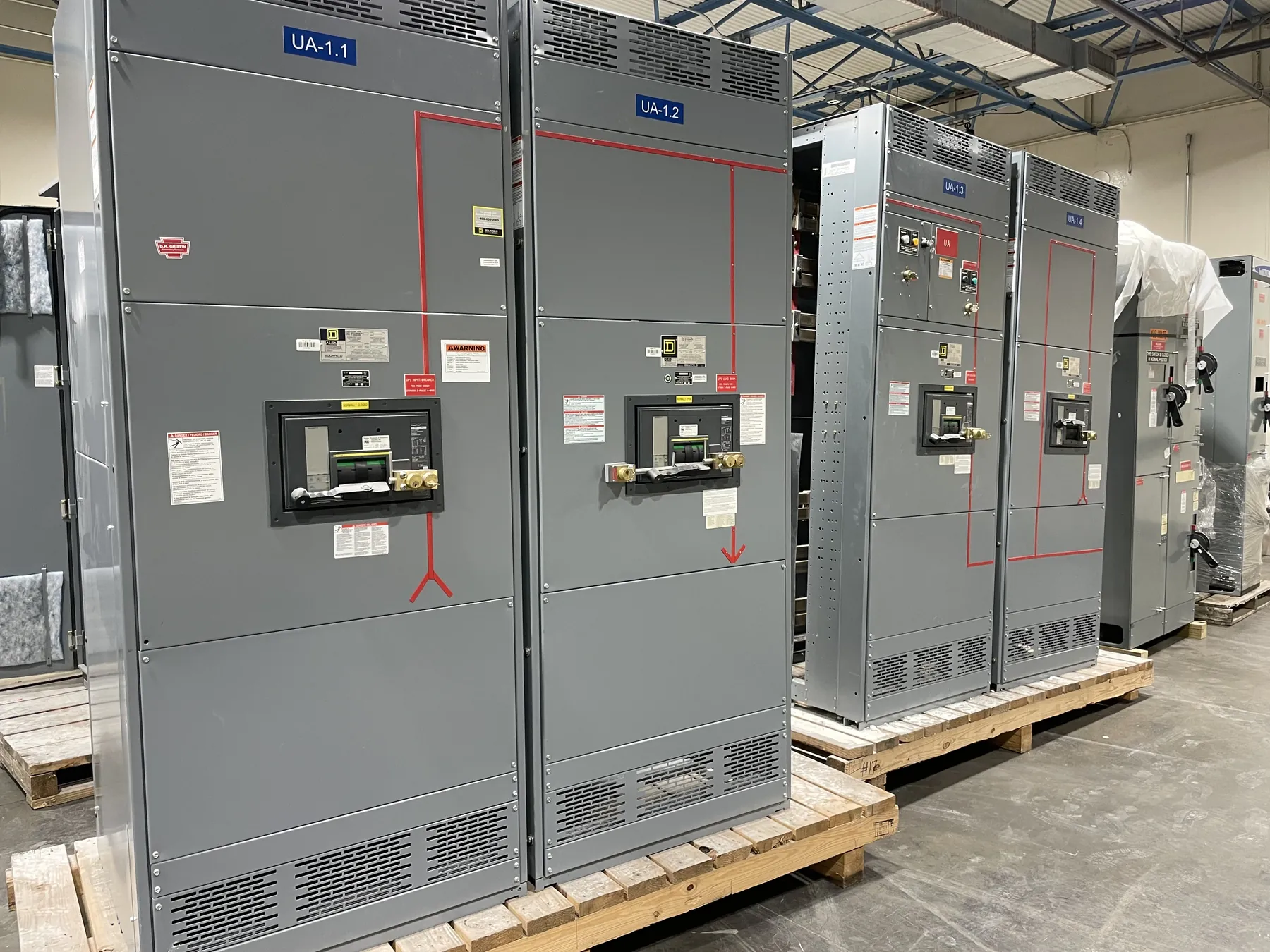
Low-Voltage Switchgear Design for North Las Vegas Projects
Low-voltage switchgear serves as a central point for distributing power and interrupting faults in facilities with substantial electrical loads. For a North Las Vegas project, the lineup should be developed around the actual one-line diagram, source characteristics, connected loads, and operating requirements—not selected by nominal voltage alone. The manufacturer can build new custom power-distribution equipment in the United States using all-American components, with short lead times supported and nationwide shipping available. Final configuration, ratings, schedule, and applicable listings must be confirmed against project documents and engineering review.
Early layout work matters as much as the breaker schedule. Map incoming and outgoing cable routes, termination locations, working clearances, and delivery access before fixing lineup dimensions. Doorways, corridors, turns, equipment-room openings, and the path from unloading point to final position can affect whether a lineup should ship assembled or in sections. Actual site measurements and handling plans are needed; assumptions about access can lead to costly layout changes after fabrication.
Power Circuit Breaker Arrangements and Operating Needs
Low-voltage power circuit breakers are commonly selected where the design calls for adjustable protective functions, high interrupting capability, or a maintainable breaker arrangement. The appropriate arrangement depends on the electrical study, system configuration, load criticality, and the facility’s maintenance strategy. Consider whether the design calls for drawout or fixed breakers, how many sources and feeders must be accommodated, and whether a tie breaker or other transfer-related arrangement is required.
Drawout construction can support removal of a breaker from its connected position for inspection or replacement, but it also adds interfaces and requires suitable space and access. Fixed construction may simplify some aspects of the assembly, while limiting how the breaker can be serviced or changed. Neither arrangement is automatically preferable. Qualified project engineers should weigh operating practices, maintenance resources, room layout, and the equipment’s intended use before the specification is finalized.
Bus Ratings, System Conditions, and Coordination — Low-Voltage Switchgear in North Las Vegas, NV
Bus ratings describe the capacity assigned to the bus under specified conditions; they are not a substitute for identifying the system voltage. The specification should separately state the nominal system voltage and the required ratings for the main bus, breakers, and other relevant components. Those values need to reflect the available fault current, load profile, source arrangement, and conditions established by the project engineering analysis.
Protective-device coordination is another design decision, not simply a matter of choosing breaker sizes. The engineer should evaluate protective settings and time-current relationships across the source, main, tie, and feeder devices, as applicable. The goal is to understand how devices are expected to respond to faults while accounting for equipment limits and the facility’s protection objectives. A coordination study and related project requirements can guide the manufacturer’s breaker and control configuration; the equipment supplier should not determine a site’s protection strategy without the necessary engineering information.
Maintainability, Cable Interfaces, and Lineup Space
Service access must be considered alongside electrical performance. Identify which sections require front access, whether rear access is available, how cables enter and leave the lineup, and where terminations need room for bending and installation. Cable entry direction, conductor sizes, lug requirements, and the position of incoming sources can affect section widths and compartment arrangements. Provide these details early so the lineup can be coordinated with conduit, tray, trenches, and adjacent equipment.
For a North Las Vegas installation, account for the site’s actual room conditions and construction sequence. Confirm floor and access constraints, environmental conditions specified for the equipment, and how the delivery vehicle and rigging team can reach the receiving area. Nevada shipping is available from the U.S. manufacturer, but route, unloading, and final placement arrangements depend on the project and carrier. Delivery access should be verified by the site team rather than inferred from a general location description.
UL 1558 and Applicable Equipment Requirements — Low-Voltage Switchgear in North Las Vegas, NV
UL 1558 is a standard associated with metal-enclosed low-voltage power circuit breaker switchgear. It may be relevant when the project specification calls for equipment within its scope, but it should not be assumed to apply to every low-voltage assembly or to other voltage classes. UL 891 concerns applicable low-voltage switchboards and is distinct from UL 1558; the applicable product category and project requirements need to be established before specifying a standard.
Do not treat a standard reference as proof that a particular lineup is listed or certified. Confirm the required construction, ratings, listing status, and documentation for the exact proposed equipment. Project specifications, applicable codes, and authority requirements should be reviewed by qualified professionals, with final design and acceptance decisions made through the appropriate engineering and site processes.
Information to Prepare for a North Las Vegas Quote
A useful quotation package typically includes the latest one-line diagram, equipment schedule, system voltage, available fault-current information, required bus and breaker ratings, and any specified standard or listing requirements. Include the intended source and feeder arrangement, breaker type and trip requirements, metering or control needs, cable entry details, and room layout with access clearances. Identify which items are mandatory and which remain subject to engineering coordination.
Also provide the delivery address, receiving constraints, preferred shipping configuration, and anticipated project milestones. These inputs help determine lineup dimensions, section breaks, interfaces, and manufacturing scope without presuming an exact completion or delivery date. A complete review can uncover conflicts between cable routing, breaker arrangement, room access, and equipment requirements before fabrication begins. The final proposal should clearly identify assumptions and items that require confirmation by the project engineer or site team.