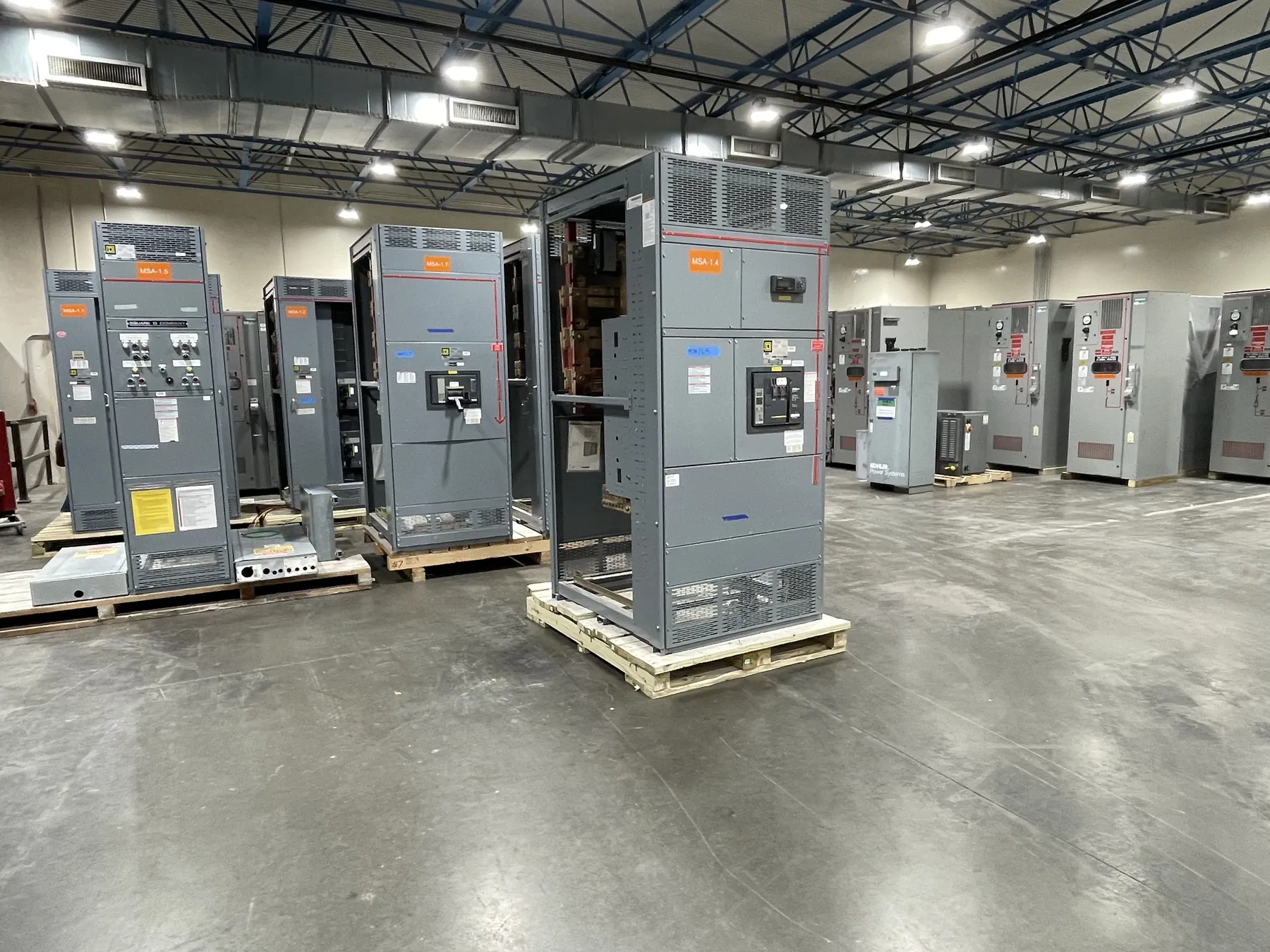
Automatic Transfer Switches for Mesquite, Nevada Projects
An automatic transfer switch (ATS) connects a load to one of two power sources and changes the connection when its controls detect a qualifying source condition. For a Mesquite facility, the right configuration depends on the actual sources, the loads that must remain supplied, and the electrical design—not simply the switch’s nominal voltage. A project may involve a utility source and a generator, or another engineered combination. The equipment must be selected and coordinated as part of the complete distribution system.
We manufacture new custom power-distribution equipment in the United States using all-American components, and supply equipment to customers nationwide, including Nevada. Project-specific requirements should be reviewed by qualified electrical engineers before equipment ratings, construction, or interfaces are finalized.
Transition Behavior and Source Sensing — Automatic Transfer Switches in Mesquite, NV
Transfer behavior describes how the ATS moves a load from one source to another. An open-transition switch disconnects the load from one source before connecting it to the other. This avoids intentional overlap between sources, but a break in supply occurs during transfer. Closed-transition equipment can briefly connect sources in parallel under defined conditions; this approach requires careful evaluation of source compatibility, system design, and applicable utility or other authority requirements. Not every installation permits or needs this mode.
Controls monitor selected source conditions, which may include voltage and frequency, and apply configured thresholds and timing. Those settings influence when the switch recognizes a source as unacceptable, initiates transfer, and considers a source suitable for retransfer. The generator’s starting and stabilization characteristics, the facility’s tolerance for interruption, and the behavior of sensitive loads all matter. A control sequence should be documented and reviewed with the system designer rather than assumed from the switch type alone.
Load, Withstand, and Coordination Requirements
ATS selection involves more than matching a system’s nominal voltage. The switch’s continuous current rating must suit the load and the intended circuit arrangement. Its withstand and closing performance must also be appropriate for the available fault current and the upstream protective device’s characteristics. These are distinct considerations: a current rating is not a statement of system voltage, and neither alone establishes suitability for a particular fault condition.
Load character can affect the design. Motor starting, transformer inrush, electronic power supplies, and other transient or nonlinear loads may shape transfer requirements. The engineer should establish which loads are served by the ATS, how they are grouped, and whether load sequencing or shedding is needed. Coordination with protective devices and generator capacity is essential; changing one component or its settings can affect the performance of the overall system. Final ratings and construction require confirmation against project documents and site conditions.
Neutral Switching and Grounding Interfaces — Automatic Transfer Switches in Mesquite, NV
Whether the neutral is switched is a system-design decision, not a universal preference. A switched-neutral arrangement may be considered when source grounding configurations and the intended separately derived system treatment call for it. A solid-neutral arrangement may be appropriate in other designs. The choice affects grounding and bonding relationships and must be coordinated with the generator, service configuration, protective devices, and applicable electrical requirements.
For quotation and engineering review, identify the source and load conductor arrangements, grounding scheme, neutral treatment, and any required auxiliary contacts or remote control interfaces. Also provide one-line diagrams and available protective-device information where possible. These details help prevent a mismatch between the ATS and the rest of the distribution assembly.
UL 1008 and Equipment Scope — Automatic Transfer Switches in Mesquite, NV
UL 1008 is the standard associated with transfer switch equipment. Where a project requires listed transfer equipment, the applicable product construction and rating must be verified for the specific ATS being proposed. Do not infer that every switch, assembly, or related distribution component is covered by UL 1008, or that a product has a particular listing without checking its documentation. Project specifications, the authority having jurisdiction, and the equipment’s actual scope determine what applies.
UL 891 concerns applicable low-voltage switchboards; it is not a blanket standard for all transfer equipment or every type of switchgear. Where an ATS is integrated with other distribution equipment, the relevant standards and listing scope for each assembly should be reviewed separately. The project engineer should confirm required ratings, construction, and approvals before release.
Mesquite Ambient Conditions and Quotation Inputs
Mesquite project teams should evaluate the equipment’s installation environment, including the design ambient temperature and ventilation available at the proposed location. Compare those conditions with the selected equipment’s published ratings and required clearances. An indoor electrical room, an outdoor enclosure, and a tightly constrained equipment space can present different thermal and access considerations. Site review should also account for the route for power and control wiring, enclosure exposure, and the space needed to integrate the ATS with adjacent equipment.
Useful quotation inputs include the one-line diagram, source details, system voltage, load and fault-current information, desired transition behavior, neutral and grounding requirements, control sequence, enclosure location, environmental conditions, and project-required documentation. We can use these inputs to scope new custom equipment for the application. Lead times and shipping arrangements depend on the finalized scope and should be confirmed for each order; equipment ships nationwide, including to Mesquite.