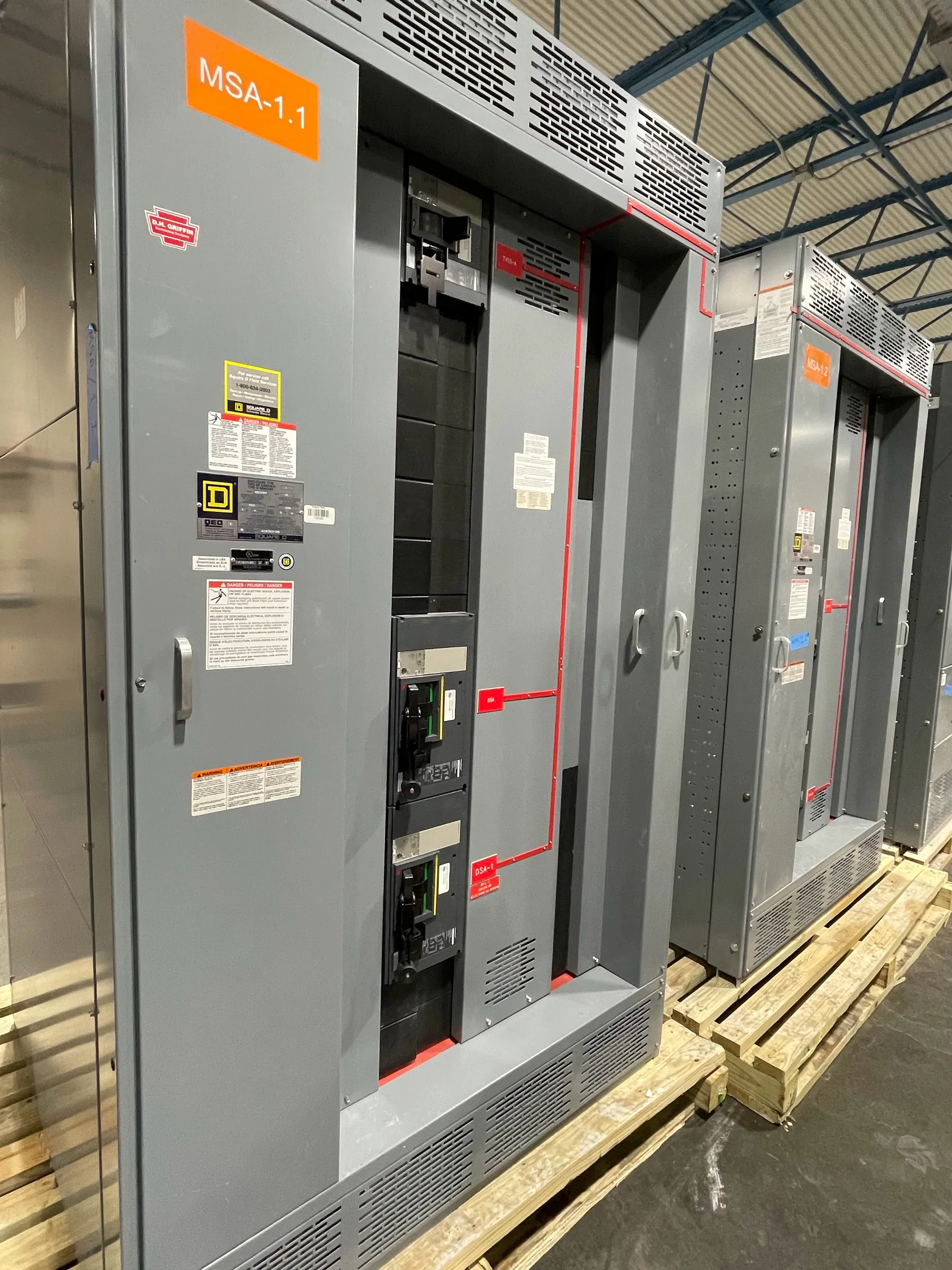
Metal-Enclosed Switchgear for Gardnerville Projects
Metal-enclosed switchgear can provide a coordinated arrangement of switches, fuses or circuit breakers within a metal enclosure for power-system applications. For a Gardnerville project, the right configuration depends on the equipment’s role in the distribution system, the available fault current, connected loads and site conditions—not on the city name alone. New custom equipment is manufactured in the United States using all-American components and can be shipped to Nevada. Project-specific ratings, product scope, listings and delivery details must be confirmed during engineering and quotation.
Start by identifying the incoming source, the outgoing circuits and the switching or protective functions required at each point. A simple switching arrangement may call for a different lineup than one that needs coordinated overcurrent protection, multiple feeders or provisions for future expansion. The one-line diagram, system voltage, grounding method and operating requirements give the design team a basis for evaluating those choices.
Choose Switches, Fuses or Circuit Breakers by Function
A switch-and-fuse arrangement and a circuit-breaker arrangement do not provide identical functions. A fuse can interrupt specified fault conditions when properly selected for the application, while a circuit breaker offers a different protective and operating approach. Whether either option is appropriate depends on system studies, load characteristics, protection coordination, maintenance strategy and the required switching duties. Do not select a device from nominal voltage alone.
Discuss how each feeder is expected to be isolated and protected, whether protective devices need adjustable settings, and how upstream and downstream devices should coordinate. Also identify motor loads, transformers, capacitors or other equipment that may affect switching duty or protection requirements. A qualified electrical engineer should determine the design based on system data and applicable requirements.
Define Barriers, Compartments and Access
Metal-enclosed construction describes equipment housed in a metal enclosure; it does not by itself establish the internal compartment arrangement or the degree of separation between components. Specify which parts need barriers, how bus and cable compartments are arranged, and what access is required for inspection, cable termination and maintenance. More separation can affect enclosure dimensions, internal layout and service access, so it should reflect the project’s actual operating and maintenance needs.
Clarify whether cables enter from the top or bottom, the termination space needed, and how control wiring and auxiliary components will be routed. Identify the approach side, working clearances and any access limitations imposed by adjacent walls or equipment. These details are especially important where the available room is constrained or the lineup must fit an existing electrical space.
Distinguish Metal-Enclosed from Metal-Clad Construction
Metal-enclosed switchgear is not interchangeable with metal-clad switchgear. Metal-clad construction generally refers to a defined arrangement of grounded metal barriers separating major components and commonly uses removable circuit-breaker elements. Metal-enclosed equipment is a broader category, and its construction may vary by design and application. The product name alone does not establish a particular internal barrier scheme, withdrawal feature or performance characteristic.
For a specification review, compare the stated construction requirements, device type, compartment layout, access provisions and applicable product standards. If a project calls for metal-clad equipment or a particular separation arrangement, state that explicitly rather than assuming a metal-enclosed assembly satisfies it. The manufacturer and project engineer should resolve any terminology or specification conflicts before the design is finalized.
Verify Fault Duty, Grounding and Ratings
Fault-duty requirements must be based on the available fault current at the installation point and the protective-device arrangement. The equipment’s interrupting or withstand ratings, as applicable to its design, must be suitable for the system and coordinated with upstream protection. A voltage rating is not a substitute for fault-duty review, and a device rating is not the same as the system voltage. Confirm all ratings against the project documents and engineering study.
Grounding details also shape the design. Provide the system grounding method, grounding conductor requirements, bonding expectations and any specified ground-fault protection. The equipment interface should be reviewed with the source, connected loads and site grounding system; assumptions about neutral treatment or grounding connections can lead to mismatched design. Final decisions require qualified engineering review.
Prepare Gardnerville Site and Quotation Details
For a Gardnerville installation, document indoor or outdoor placement and the environmental conditions at the actual site. Elevation, ambient temperature, moisture, dust, sun exposure, wind-driven precipitation and corrosive influences may affect equipment specifications or enclosure choices. Do not infer suitability from a general location description; provide the project’s environmental criteria for review. Confirm access routes, unloading constraints, equipment-room dimensions and the intended installation position before a lineup is released for manufacture.
A useful quotation package includes the one-line diagram, system voltage and frequency, available fault-current data, grounding method, feeder count and device requirements. Add the requested construction type, barriers, cable-entry direction, control power, metering or protection needs, enclosure conditions and relevant project specifications. Include required listings or standards by product scope; UL 891 applies to applicable low-voltage switchboards and does not establish coverage for every type of switchgear. Each listing, rating and project detail requires confirmation. Equipment is built in the USA and ships nationwide, with lead-time expectations confirmed for the specific configuration.