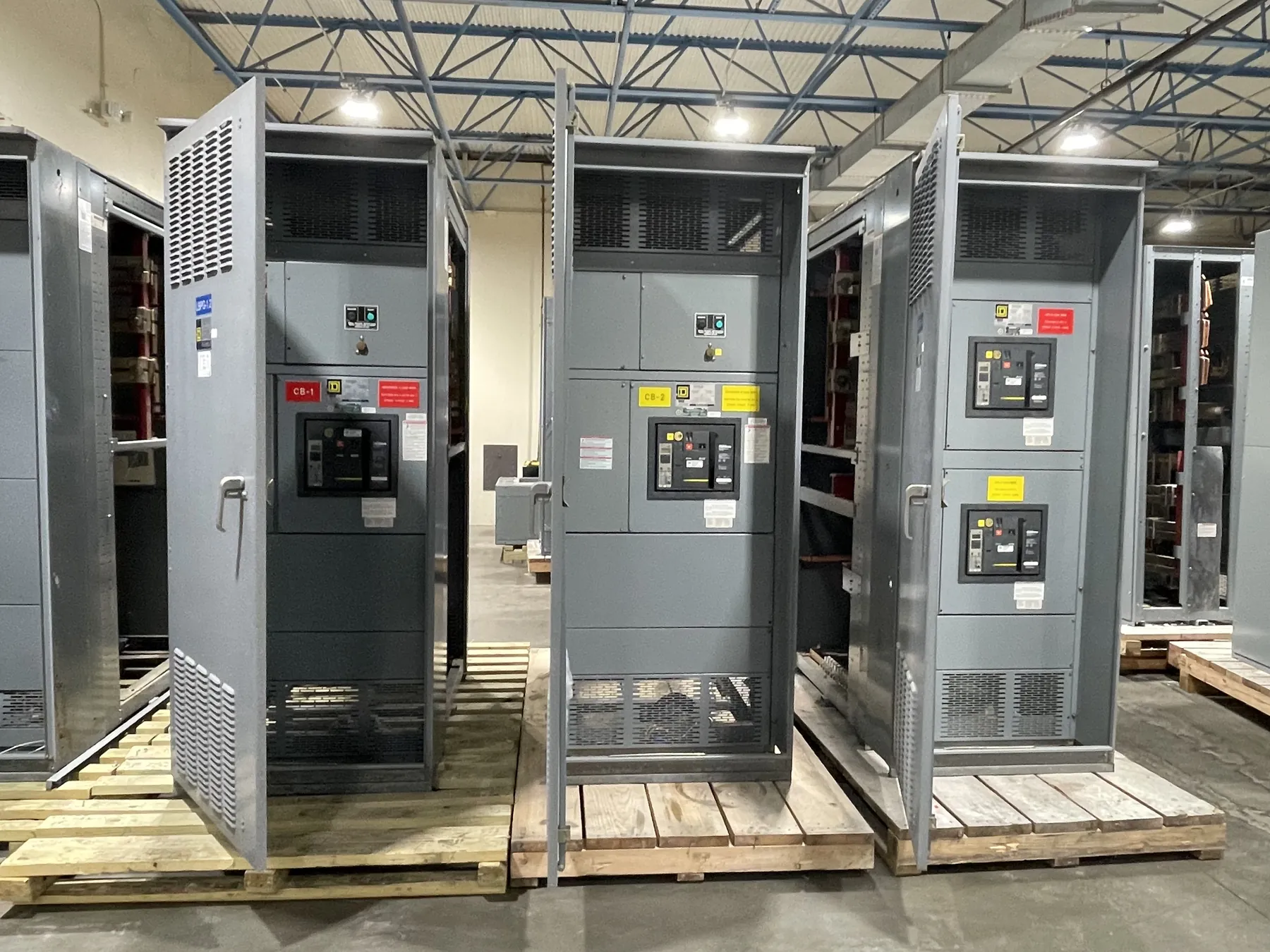
Metal-Enclosed Switchgear for Elko, Nevada Projects
Metal-enclosed switchgear is a configurable assembly for switching and protecting electrical circuits, with equipment arranged inside a metal enclosure. For an Elko project, the right arrangement depends on the electrical system, site environment, operating needs and available space—not simply on the equipment’s name or nominal voltage. A useful design review starts with the one-line diagram, the intended function of each circuit and the conditions where the assembly will be installed.
Our company manufactures new custom power-distribution equipment in the United States using all-American components. Assemblies can be shipped nationwide, including to Nevada, and manufacturing is structured to support short lead times. Actual schedules depend on the approved design, component requirements and project coordination. Product configuration, ratings, listings and suitability for a particular installation must be confirmed against project documents and reviewed by qualified electrical professionals.
Choose Switching and Protection Around Circuit Function
Metal-enclosed equipment may use switches with fuses, circuit breakers, or a combination of devices, depending on the specified application. A switch-and-fuse arrangement can provide a switching function with fuse-based overcurrent protection; a breaker-based arrangement uses a circuit breaker selected for the system and protection scheme. Neither choice is universally preferable. The decision should reflect the required interruption capability, operating sequence, protection coordination, maintenance approach and interface with upstream and downstream equipment.
For a quotation, identify each incoming and outgoing circuit, its connected load or equipment, the required switching and protection functions, and the relevant system information. Provide the project one-line diagram and any protection or coordination criteria already established by the project engineer. Fuse types, breaker features and control requirements must be checked for compatibility with the equipment and the overall design. Do not assume that a device’s rating alone establishes a suitable protection scheme.
Understand Metal-Enclosed Versus Metal-Clad Construction — Metal-Enclosed Switchgear in Elko, NV
“Metal-enclosed” and “metal-clad” describe different construction categories, not interchangeable product labels. Metal-clad construction is associated with defined compartmentalization and component separation requirements. Metal-enclosed equipment may use other internal arrangements, depending on its design and applicable standard. The enclosure’s appearance does not establish its construction category, internal barriers, maintainability or performance.
When comparing proposals, ask what construction is specified and how the proposed assembly meets that requirement. Review the equipment arrangement, access provisions and separation of functional sections against the project documents. If the specification calls for metal-clad construction, a metal-enclosed alternative should not be treated as equivalent without explicit engineering review and acceptance by the responsible parties.
Specify Barriers, Fault Duty and Grounding Together
Internal barriers can affect separation between components, access for inspection and the way a lineup is arranged. Their purpose and extent should be stated clearly rather than inferred from a general request for “compartmentalized” equipment. The design team should consider which components require separation, what access is expected and how the assembly interfaces with connected cables, bus and control wiring.
Fault-duty requirements require particular care. Available fault current at the installation point, protective-device characteristics and the equipment’s applicable ratings must be evaluated together by qualified engineers. Do not select equipment from system voltage alone or assume that a rating addresses every fault condition. Grounding details also matter: provide the project grounding method, conductor requirements and any specified bonding or ground-bus interfaces so these can be reviewed as part of the assembly design.
Document Elko Site Conditions and Enclosure Needs
Elko’s project conditions should be recorded for the actual installation, not guessed from the city name. The specification should identify the installation location, ambient conditions, exposure to moisture or dust, indoor or outdoor placement, and any other environmental requirements relevant to the enclosure. Enclosure construction and environmental suitability depend on the site and the project specification; a general-purpose description is not enough to establish suitability.
Include the planned equipment-room or pad layout, cable-entry direction, working and maintenance access requirements, and constraints on transport or placement. Building access, unloading arrangements and the route to the installation area can affect shipment planning and equipment configuration. These details are especially important when the available footprint or access path is limited. They should be confirmed with the project team before the design is finalized.
Prepare a Clear Specification for Custom Equipment
A complete inquiry helps establish a practical design basis. Useful documents include the one-line diagram, circuit schedule, specified construction type, system and equipment ratings, fault-duty criteria, grounding details, protection requirements, control and metering needs, site conditions and dimensional constraints. Also identify required standards, listing expectations and interfaces with existing or planned equipment. UL 891 applies to applicable low-voltage switchboards; it should not be assumed to cover every metal-enclosed switchgear configuration.
Once the project requirements are received, the proposed arrangement and relevant ratings can be reviewed against the stated application. Any unresolved conditions—such as fault-current information, protection coordination, enclosure needs or maintenance clearances—should be identified for engineering follow-up. This keeps the equipment selection tied to the actual Elko installation and gives the project team a clear basis for evaluating the proposed metal-enclosed switchgear.