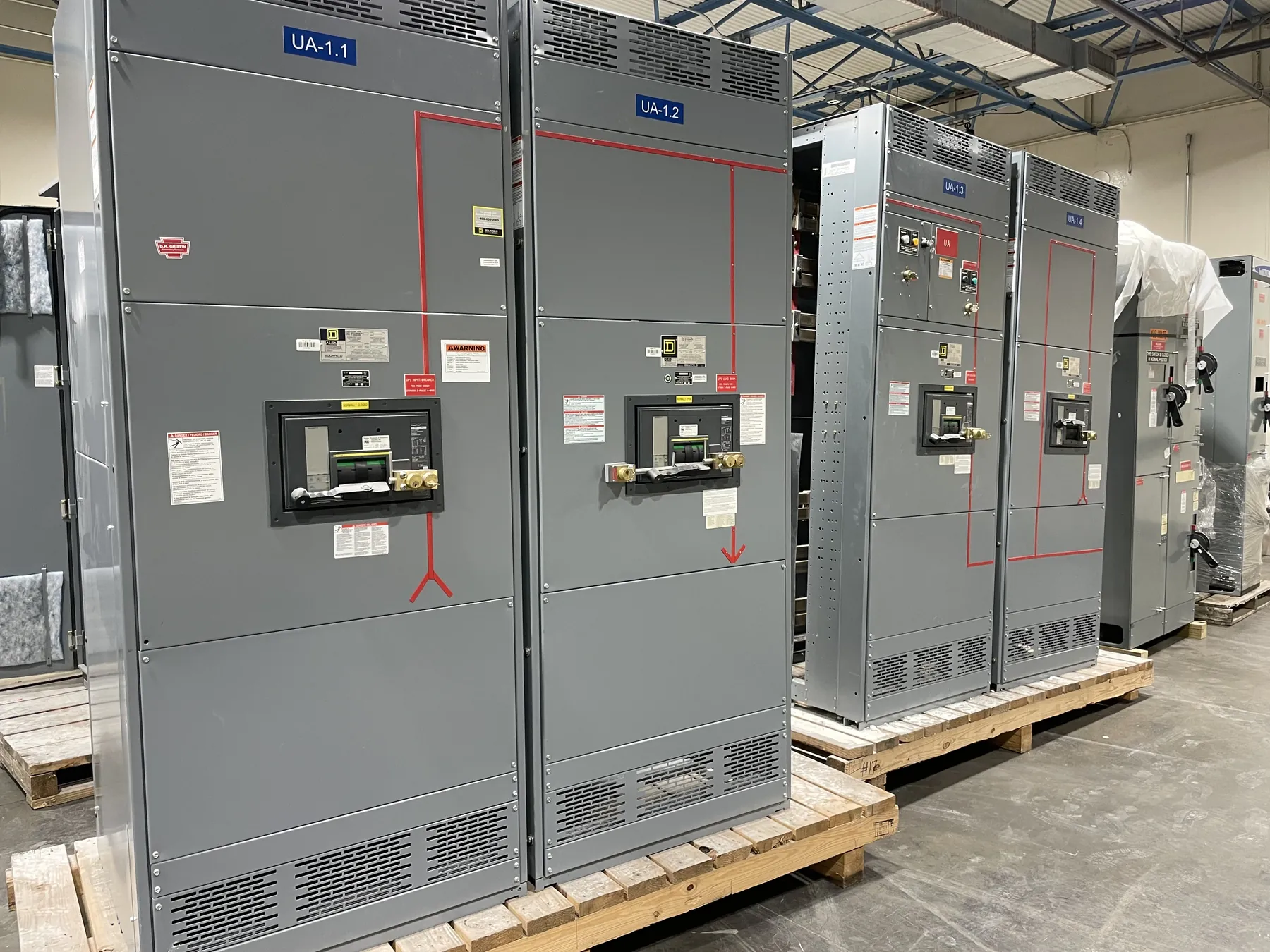
Automatic Transfer Switches for Boulder City Projects
An automatic transfer switch (ATS) moves designated loads between normal and alternate power sources when its controls determine that a transfer is needed. For a Boulder City facility, the right design begins with the actual service arrangement and the loads that must remain supplied—not simply the switch’s ampere rating. Utility characteristics, generator or other alternate-source capability, distribution equipment, grounding, and operating priorities all affect the specification. We manufacture new custom power-distribution equipment in the United States, using all-American components, and can ship equipment nationwide. Project details and ratings must be reviewed before a design or quotation can be confirmed.
Transfer transition and source sensing — Automatic Transfer Switches in Boulder City, NV
Transition describes how the ATS changes the load from one source to another. An open-transition arrangement disconnects one source before connecting the other, producing a brief interruption. Closed transition briefly overlaps the sources, but is appropriate only where the sources, controls, utility requirements, and operating conditions permit it. A delayed transition can provide a defined interval between disconnection and reconnection. These approaches are not interchangeable; the acceptable interruption, source behavior, and system constraints should guide the choice.
Source-sensing settings determine when the ATS recognizes a source as unavailable or acceptable. Voltage and frequency limits, time delays, retransfer behavior, and generator-start signals should be coordinated with the source equipment and facility requirements. Excessively sensitive settings may cause unnecessary transfers, while settings that do not reflect the system’s operating needs can delay response. Qualified electrical engineers should establish the control sequence and confirm compatibility with the actual sources.
Load rating, withstand capability, and protection coordination
The ATS load rating must suit the connected load and the installation conditions. A rating is not the same thing as system voltage: both must be specified and verified independently. Load type matters too. Motors, transformers, electronic equipment, and other loads can impose starting or transient demands that a simple connected-load total may not describe. The design team should identify the loads served, expected operating conditions, and any essential or nonessential load priorities.
Withstand and closing ratings address the switch’s ability to withstand and close onto fault current under specified conditions; they are distinct from its continuous load rating. Selection depends on available fault current, upstream protective devices, the system configuration, and coordination requirements. Provide available fault-current information and protective-device details when requesting a design review. Final ratings and coordination require engineering confirmation against the installation—not assumptions based on a nominal voltage or load figure.
Neutral switching, grounding, and the service interface
Whether the neutral is switched depends on the grounding arrangement and how the alternate source is connected. A separately derived generator system may call for a different neutral and grounding approach than a system in which the neutral remains solidly connected. The ATS pole configuration must match the approved one-line diagram and grounding scheme. An incorrect assumption can affect ground-fault sensing and protection, so the source bonding arrangement and intended neutral path should be settled before equipment release.
For a Boulder City project, define the utility interface early: service voltage and configuration, point of connection, available metering information, service disconnect arrangement, and any applicable utility requirements. Confirm whether metering is provided in separate equipment or must be coordinated with the service assembly. These interfaces can shape enclosure layout, conductor routing, and the division of responsibility between equipment packages. Utility requirements and local project conditions must be verified for the specific site.
UL 1008 and equipment scope — Automatic Transfer Switches in Boulder City, NV
UL 1008 applies to transfer-switch equipment where required by the product scope and project specifications. It is not a blanket certification for every switchgear assembly or distribution product, and a reference to the standard does not establish that a particular proposed unit is listed. Confirm the required standard, listing expectations, ratings, and documentation for the specific ATS and installation. Other equipment in the distribution system may be governed by different requirements; for example, UL 891 concerns applicable low-voltage switchboards, not every type of switchgear.
Information for a Boulder City quotation
A useful request includes the one-line diagram, source and load details, system voltage and phase, required ATS rating, available fault-current data, protective-device information, neutral and grounding scheme, enclosure location, and the desired transfer and retransfer sequence. Note any space, access, environmental, metering, or integration constraints at the site. These details help identify engineering questions before the service design is released and reduce the risk of mismatched interfaces. We support short lead times, but timing depends on the confirmed scope, design review, and project requirements; no schedule should be assumed until those details are established.