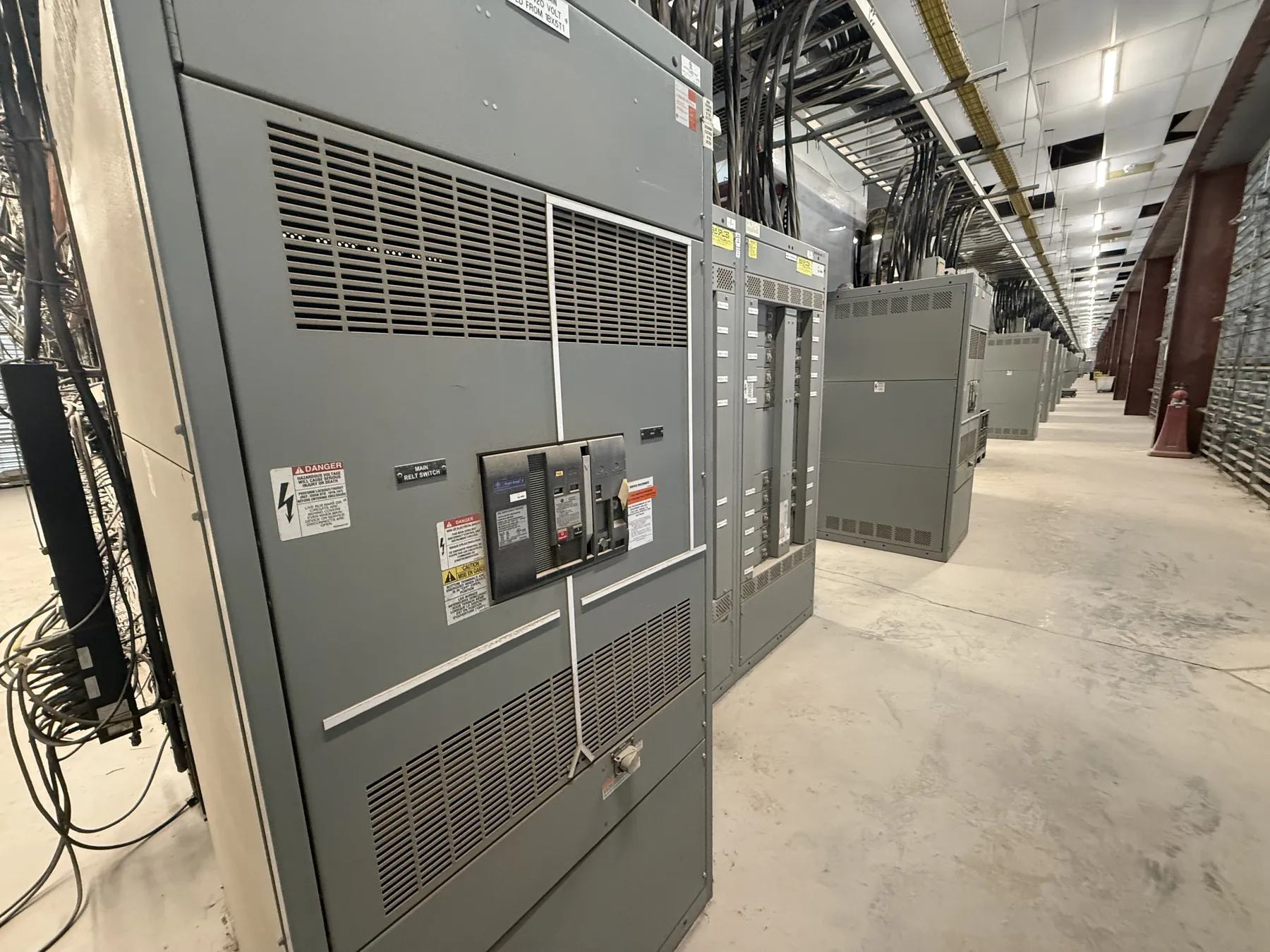
Circuit Breaker Definition for Power-Distribution Equipment
A circuit breaker is a protective switching device that can carry current under specified conditions, make or interrupt current as designed, and open a circuit when a qualifying fault or other configured condition occurs. In a switchboard or switchgear assembly, it connects a circuit to a source or bus and provides a means of isolating that circuit when open. Its protective function depends on the breaker’s design and settings, the connected system, and the application. A breaker is not simply a switch with a universal ability to stop any electrical fault.
In custom power-distribution equipment, breaker selection begins with the circuit’s actual duty and the assembly in which it will be installed. The source, conductor characteristics, expected fault current, load behavior, operating requirements, and applicable project specifications all matter. A breaker’s nameplate values describe particular limits; they do not, by themselves, establish that a complete assembly is suitable for a site.
Continuous Current Rating: How Much Current It Can Carry
The continuous current rating identifies the current a breaker is designed to carry continuously under specified conditions. It is not the same as the circuit’s system voltage, nor does it state how much fault current the breaker can interrupt. The selected rating must be considered alongside the load, conductor ampacity, enclosure and ambient conditions, equipment arrangement, and any applicable code or design requirements.
For example, a load may operate for long periods near its normal demand, while other loads have starting or inrush behavior that affects protection choices. A rating chosen without understanding the load can lead to unwanted trips or inadequate protection. Engineers also consider the breaker’s trip unit and settings where applicable; the frame or sensor rating alone may not explain the actual protective response. Rating terminology and available configurations vary by breaker type and manufacturer, so submittals should identify the exact device and relevant settings.
Interrupting Rating: The Ability to Clear Fault Current
The interrupting rating describes the maximum fault current a breaker is designed to interrupt at stated conditions, including the applicable voltage. During a fault, current can rise far above normal operating current. The breaker must be suitable for the prospective fault current at its point of installation, based on the system and the protective scheme.
This rating must not be confused with continuous current. A breaker may have a continuous rating appropriate for a load yet lack the required interrupting capability for the available fault current. Conversely, a high interrupting rating does not mean the breaker is intended to carry that magnitude of current continuously. Voltage conditions are also important: ratings may be stated for particular system voltages, and an interrupting value cannot be assumed to apply at every voltage or configuration.
Short-Time Withstand: A Different Fault-Duty Measure
Withstand ratings describe the ability of equipment to tolerate specified electrical stresses for a stated duration without unacceptable damage. In power-distribution discussions, short-time withstand capability is relevant to whether an assembly or device can remain closed during a fault for a limited period while another protective device clears it. This is distinct from a breaker’s interrupting rating, which addresses its ability to open and interrupt fault current.
The terms are related but not interchangeable. A breaker intended to interrupt a fault is evaluated for its interrupting duty; a switchboard or other equipment may have a short-time withstand rating that applies to a defined configuration and duration. The complete protective scheme must be checked so that devices, bus, connections, and enclosure are suitable for the expected fault conditions. A withstand value should never be treated as permission to expose equipment to fault current outside its stated limits.
Coordination, Selectivity, and Breaker Interfaces
Protective-device coordination concerns how devices respond to faults across a distribution system. The goal may be to have the device nearest a fault clear it while upstream equipment remains in service, where the design and system conditions permit. Engineers evaluate trip characteristics, settings, fault-current levels, and the interaction among upstream and downstream devices. Selectivity is not guaranteed merely because breakers have different current ratings, and coordination results depend on the actual device models, settings, and system study.
Breaker choice also affects the switchboard interface: mounting and connection arrangement, bus compatibility, accessory requirements, control wiring, and provisions for circuit identification and operation. These details influence assembly design and future maintenance planning. For custom equipment, a requested breaker brand or series should be confirmed against the assembly design and project requirements rather than assumed interchangeable with another device.
Information Needed to Specify a Circuit Breaker
A useful quotation or engineering review should identify the circuit’s system voltage and configuration, expected continuous load, available fault-current information, upstream and downstream protective devices, and any specified coordination objectives. Include the desired breaker type or manufacturer when required, trip-unit and accessory preferences, number and function of outgoing circuits, and applicable project documents. For a new switchboard, the enclosure, bus arrangement, service conditions, and interface requirements also affect selection.
For Nevada facilities, site conditions such as ambient temperature, elevation, indoor or outdoor placement, and available installation space may inform equipment design and rating review. Shipping to a Nevada destination does not replace site-specific engineering. Continuous current, interrupting, and withstand ratings—and any listing or applicable standard for the particular equipment—must be confirmed for the exact product and application. Qualified electrical engineers need to review the system data and project requirements before final selection; no single breaker label establishes suitability for every installation.