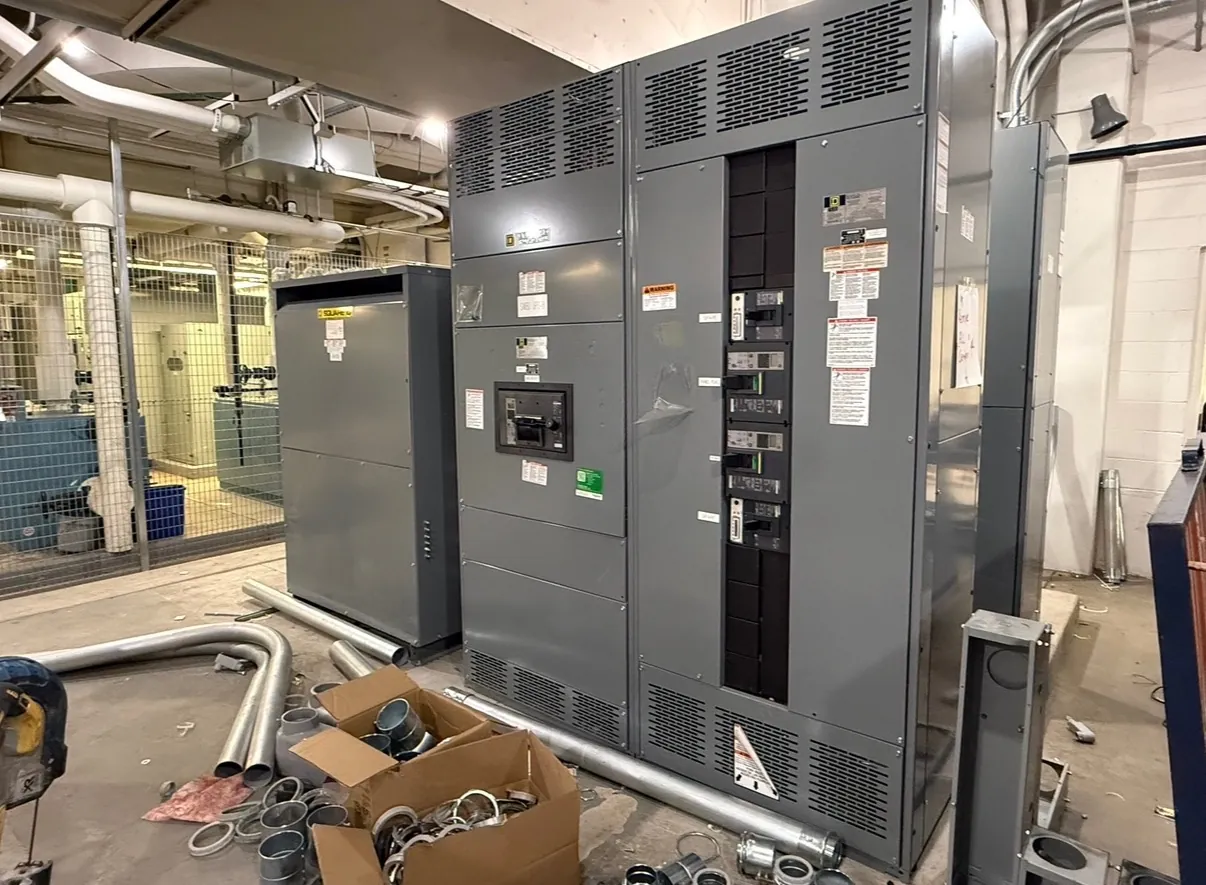
4000 A Service Entrance Switchboards: Define the Service Section
A 4000 A service entrance switchboard is a project-specific assembly, not a complete description of the electrical service. Before selecting a configuration, establish what the utility provides, where the service point is located, and which equipment must contain the service disconnect and metering. These details affect the service section layout, the connection between utility conductors and the switchboard, and the required arrangement of downstream distribution. Confirm them with the serving utility, the project engineer, and the authority having jurisdiction (AHJ) before equipment is finalized.
Service entrance requirements can change the design materially. The utility may specify metering location, compartment arrangement, access, or other service conditions. The project may also require particular provisions for service grounding and bonding. A 4000 A label does not resolve these interfaces: the actual equipment configuration, ratings, and utility acceptance criteria must be documented and confirmed for the site.
4000 A Continuous Current Is One Design Input
Evaluate the 4000 A continuous-current requirement against the calculated load and the conditions where the switchboard will operate. The design team should account for the applicable ambient conditions, installation environment, expected operating profile, and anticipated load growth. Future capacity needs should be expressed in terms of likely feeder additions or changes in connected loads, rather than assumed from the switchboard rating alone.
Feeder quantity, conductor termination requirements, and the space needed for distribution devices can influence the lineup’s arrangement. A design that accommodates planned growth may require different section allocation or provisions than one intended for a fixed set of loads. Those choices can affect footprint, cable access, and coordination with the electrical room. Equipment documentation and engineering review should confirm that the proposed assembly is appropriate for the project conditions; the nominal current rating alone is not a complete design verification.
Available Fault Current and Assembly Rating Must Align
Obtain the available fault current at the proposed service equipment location from the project’s qualified electrical design process. Then compare that information with the applicable short-circuit rating of the specified switchboard assembly and its protective devices. Do not assume a 4000 A continuous-current rating establishes the assembly’s ability to withstand or interrupt fault current. These are distinct ratings serving different purposes.
Coordination also depends on the upstream protective device, downstream devices, and the study criteria for the installation. Changes to the utility source, transformer arrangement, conductor path, or protective-device selection may affect the available fault current or coordination results. The design team must confirm the actual values and requirements for the specific system. The manufacturer’s equipment documentation should identify the applicable ratings and configuration; project engineers should determine whether they meet the design basis.
Metering, Main Disconnect, and Grounding Interfaces
Utility metering can occupy space and impose access or compartment requirements within the service lineup. Establish whether metering is utility-furnished or part of the specified equipment arrangement, where it must be located, and what interface details the utility requires. The main disconnect selection and placement should likewise match the service design, utility conditions, and project distribution plan. A preliminary layout should not be treated as approved until relevant requirements are confirmed.
Service grounding and bonding details depend on the electrical system and the location of the service disconnect. The project engineer must define the grounding arrangement, conductor connections, and any required provisions in coordination with applicable codes and AHJ requirements. Do not infer those details solely from a product rating or a generic service entrance diagram. Clear documentation reduces the risk of a mismatch between the switchboard, utility interface, and site electrical work.
Information to Resolve Before Requesting a Configuration
A useful quotation package describes the service and distribution requirements rather than naming only the 4000 A rating. Provide the one-line diagram, project voltage and system details, utility metering criteria, main disconnect requirements, available fault-current information, and the intended short-circuit rating. Include feeder counts and sizes, termination preferences, planned future provisions, installation environment, and dimensional or room constraints when known.
Also identify the project location in Nevada and any site-specific logistics that may affect shipment coordination or equipment placement. Access routes, receiving limitations, electrical-room dimensions, and construction sequencing are practical inputs to review, not assumptions about what a site can accommodate. Clarify which decisions remain open and who is responsible for confirming them, especially utility and AHJ approvals.
Manufactured to the Confirmed Project Requirements
We manufacture new custom switchgear and power-distribution equipment in the United States, using all-American components, and ship nationwide, including to Nevada. For a 4000 A service entrance switchboard, the final arrangement depends on the confirmed project information and the actual equipment configuration available for those requirements. Ratings, listings, and service provisions must be verified in the applicable product documentation; UL 891 applies to applicable low-voltage switchboards and should not be read as covering every product or configuration.
Before release, the project team should reconcile the equipment submittal with the one-line diagram, utility criteria, fault-current study, and site conditions. This review helps establish that the specified continuous-current rating, assembly short-circuit rating, service metering, disconnect, grounding provisions, and feeder arrangement are addressed together. Final suitability and approvals require review by qualified electrical professionals and the relevant authorities.