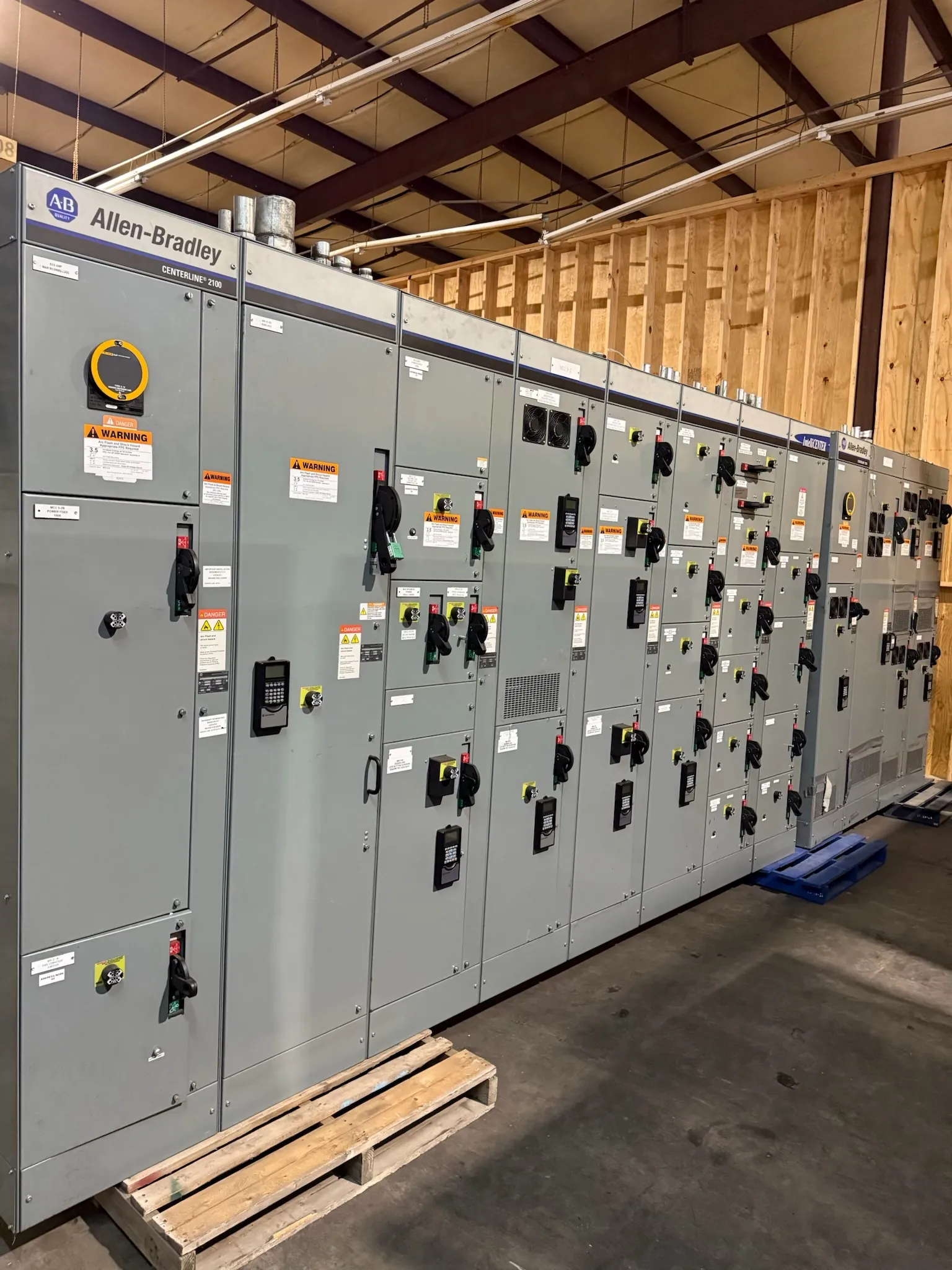
Motor Control Centers for 347/600 V Applications
A motor control center (MCC) for a 347/600 V application is an engineered assembly of motor-control units and associated distribution components, configured for the electrical system and operating needs of a facility. The notation does not, by itself, establish the system arrangement, available fault current, or ratings required for the equipment. Confirm whether the project specifies a 600 V-class system, what conductors and grounding arrangement are present, and whether a neutral is required. A neutral should not be assumed solely from the voltage designation.
Our U.S.-built MCC assemblies use all-American components and are made to customer requirements, with nationwide shipping available. The actual lineup, component selection, ratings, and applicable standards depend on project documentation and engineering review. Confirm the offered configuration against the equipment documentation before treating a proposed arrangement as suitable for a particular installation.
Motor Starters and Unit Selection
Starter selection begins with the motor and the job it must perform. The design team needs motor nameplate information, load type, starting frequency, control method, and the operating sequence for each unit. Across-the-line starters may suit some loads, while other applications call for reduced-voltage starting or a variable frequency drive (VFD). The appropriate choice depends on the motor, process, power system, and control requirements—not voltage alone.
Specify which loads need dedicated starter units, local controls, remote commands, status contacts, or interlocks with other equipment. Also identify spare units or future provisions if the facility expects growth. Unit size, enclosure arrangement, wiring interfaces, and lineup space affect how the MCC is configured. Clear load schedules and control schematics help avoid assumptions about which functions belong in the MCC and which are handled by external controls.
VFD Integration and System Interfaces
VFDs can provide adjustable motor speed and controlled acceleration, but their integration involves more than choosing a drive with a matching voltage designation. The application should identify motor and load characteristics, required speed range, control signals, communications, bypass expectations, and any process or equipment interlocks. Confirm whether drives are to be furnished as MCC units or supplied separately, and define the physical and electrical interfaces between the drive and the lineup.
Drive-related effects on the electrical system and installation also require review. Depending on the application, engineering may need to consider input protection, harmonic impact, motor-cable characteristics, cooling, and the location of drive equipment. Do not assume a standard MCC arrangement includes a particular drive, bypass, filter, or communications protocol. List requested features in the specification and verify that the final equipment documentation reflects them.
Short-Circuit Ratings and Feeder Protection — Motor Control Centers for 347/600 V
Short-circuit ratings describe equipment performance under specified fault conditions; they are not the same as system voltage or normal operating current. The required rating must be established from the project’s electrical study and available fault-current information. Confirm the system configuration, protective devices, and any upstream equipment that affect the conditions at the MCC. A rating should not be selected from a voltage label alone or treated as proof that the assembly coordinates with every upstream device.
Feeder protection and motor branch-circuit protection must be considered together with the loads, conductors, and protective-device arrangement. The project engineer should review device types and settings, coordination requirements, and applicable code and project standards. When requesting a quotation, provide the available fault-current data and required short-circuit rating, or identify that these items remain subject to engineering confirmation. The proposed rating, listing, and protective configuration need to be verified in the equipment documentation.
UL 845, Project Standards, and Rating Verification
Confirm whether UL 845 is required for the specified MCC and installation. Do not infer that a particular assembly is UL listed, or that a listing applies to every possible configuration, without checking the documentation for the offered equipment. The project specification may also call for other standards, construction details, or documentation. Identify those requirements early so they can be reviewed for applicability and reflected in the quotation.
Clarify whether “347/600 V” refers to the site system, a requested equipment class, or shorthand in a preliminary schedule. Verify system voltage, frequency, phase and wire arrangement, grounding method, neutral requirements, and the equipment’s voltage and current ratings. These details are distinct from short-circuit ratings and must match the actual installation. Qualified engineers should assess design and code requirements using site-specific information.
Maintenance Access and Quotation Information — Motor Control Centers for 347/600 V
Maintenance access begins with the physical layout. Provide the intended lineup location, available room dimensions, cable-entry preferences, adjacent equipment, and any access constraints. Facility conditions—including ambient environment, dust, moisture, ventilation, and available working space—can affect enclosure and layout decisions. Maintenance and inspection needs should be considered during design, but site-specific work practices and safe operating procedures must be established by qualified personnel; this product page is not an instruction for work on energized equipment.
For a useful quotation, submit a one-line diagram, load schedule, motor data, control schematics, feeder requirements, fault-current information, and the applicable project specification. Include requested starter and VFD functions, lineup arrangement, neutral and grounding details, and any documentation or standards requirements. If information is incomplete, identify open items rather than assuming ratings or features. Final configuration and suitability are subject to engineering review and confirmation against the equipment documentation.