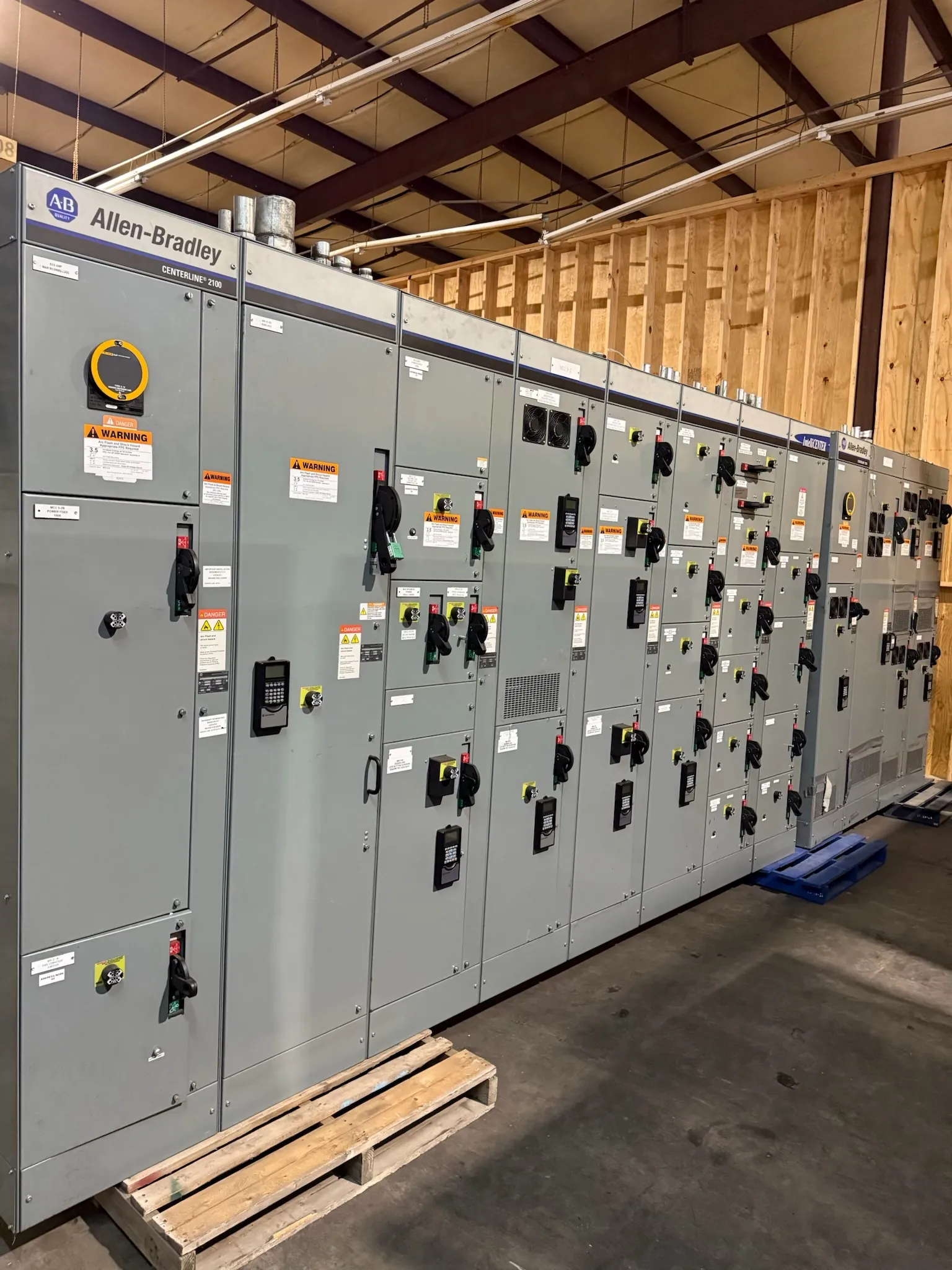
High-Voltage Switchgear for Yerington Substation Projects
High-voltage switchgear for a Yerington project must be specified around the electrical system it will serve, not selected by a voltage label alone. Substation arrangements can differ in source configuration, transformer connections, switching duties, protection philosophy and plans for expansion. A sound specification begins with the project’s one-line diagram and the utility or system owner’s requirements, then identifies which switching and protective functions belong in the proposed equipment. Our U.S. manufacturing business builds new custom switchgear and power-distribution equipment; the exact high-voltage construction available for a project must be confirmed during engineering review.
Early planning should also document expected load growth, spare circuits and the space reserved for future extensions. Those decisions can affect the lineup arrangement, bus configuration, control interfaces and provisions for adding equipment later. A spare circuit is useful only if its electrical function, physical position and control requirements are understood. Likewise, future expansion space needs to account for the actual site layout and connection approach rather than simply leaving an unspecified gap.
Confirm Voltage Class, Insulation and Switching Duties
Project documents should distinguish nominal system voltage from the equipment’s assigned voltage class and ratings. These terms are related but not interchangeable: system conditions, insulation coordination and the equipment’s specified duties all influence selection. The engineering team should review the highest operating conditions and applicable system data, along with the required insulation levels and clearances. Do not infer a suitable rating from a nominal voltage alone.
Switching and fault duties also need project-specific evaluation. Required interrupting, withstand and continuous-current ratings depend on the system study and the equipment’s location and function. The design review should identify the relevant fault-current assumptions, switching operations and protective-device interfaces. A rating that appears adequate in isolation may not suit the complete system or the intended operating arrangement.
Choose a Substation Arrangement That Fits the Site
Available construction can vary by voltage class, insulation approach, switching device, enclosure and substation layout. The quotation process should establish whether the requested arrangement is feasible and what equipment boundaries are included. For example, specify whether the scope covers a switchgear lineup, associated control and protection interfaces, or connections to separately supplied transformers and other substation equipment. Exact construction details should be confirmed rather than assumed from a general product description.
Yerington site conditions matter to layout and logistics. Provide the proposed installation area, access route, delivery constraints, indoor or outdoor exposure, environmental conditions and any known limits on equipment footprint or lifting access. These details help evaluate enclosure requirements, arrangement and shipment planning without assuming a particular facility or local project. Nationwide shipping is available from our U.S. manufacturing operation; the project schedule and delivery arrangements depend on confirmed scope and site requirements.
Coordinate Protection, Controls and Utility Interconnection
Protection cannot be finalized independently of the power system. The design team should review relay functions, instrument-transformer interfaces, trip and close circuits, control power, communications and the signals exchanged with adjacent equipment. Protection settings and device selections require qualified engineering and coordination with the system owner. The switchgear specification should make interface responsibilities clear so that equipment, relays, wiring and external controls work together as intended.
Utility interconnection requirements may affect the one-line arrangement, metering, protective functions, control points, communications and review documents. Confirm the responsible utility or interconnecting authority, its current requirements, the point of interconnection and the division of scope among project parties. Applicable IEEE or IEC requirements should be identified for the equipment and project jurisdiction, with the relevant editions and scope confirmed by the design team. A reference to a standard does not by itself establish that a particular assembly is listed, approved or suitable for every application.
Prepare Clear Inputs for a Useful Quotation
A well-developed inquiry helps distinguish required equipment from assumptions. Useful inputs include the latest one-line diagram, system and equipment voltage information, required ratings, fault-study data, insulation requirements, protection and control philosophy, utility criteria, site conditions and the planned arrangement. Include current and forecast loads, spare circuit needs, future extension plans and known dimensional limits. Identify exclusions and interfaces with transformers, buses, cables, grounding, civil work and control systems.
If some information is still under development, label it as preliminary and identify who will confirm it. This reduces the risk of treating conceptual values as approved design data. Ratings, applicable listings, standard requirements and project details must be reviewed and confirmed for the specific application before equipment is finalized.
Plan Expansion and Engineering Review Together
For Yerington facilities expecting growth, discuss future circuits while the initial lineup and site arrangement are being developed. The team can then evaluate whether planned additions are compatible with the selected construction, bus arrangement, protection scheme and available space. Expansion provisions should be defined in engineering documents, including the intended limits of the initial scope and the assumptions for later work.
Our assemblies use all-American components, are built in the USA and support short lead times, with shipment nationwide. Actual scope, schedule and construction depend on project information and engineering confirmation. Qualified engineers and the relevant utility or system authority must review the design, ratings, protection, interconnection requirements and site interfaces before a final specification is established.