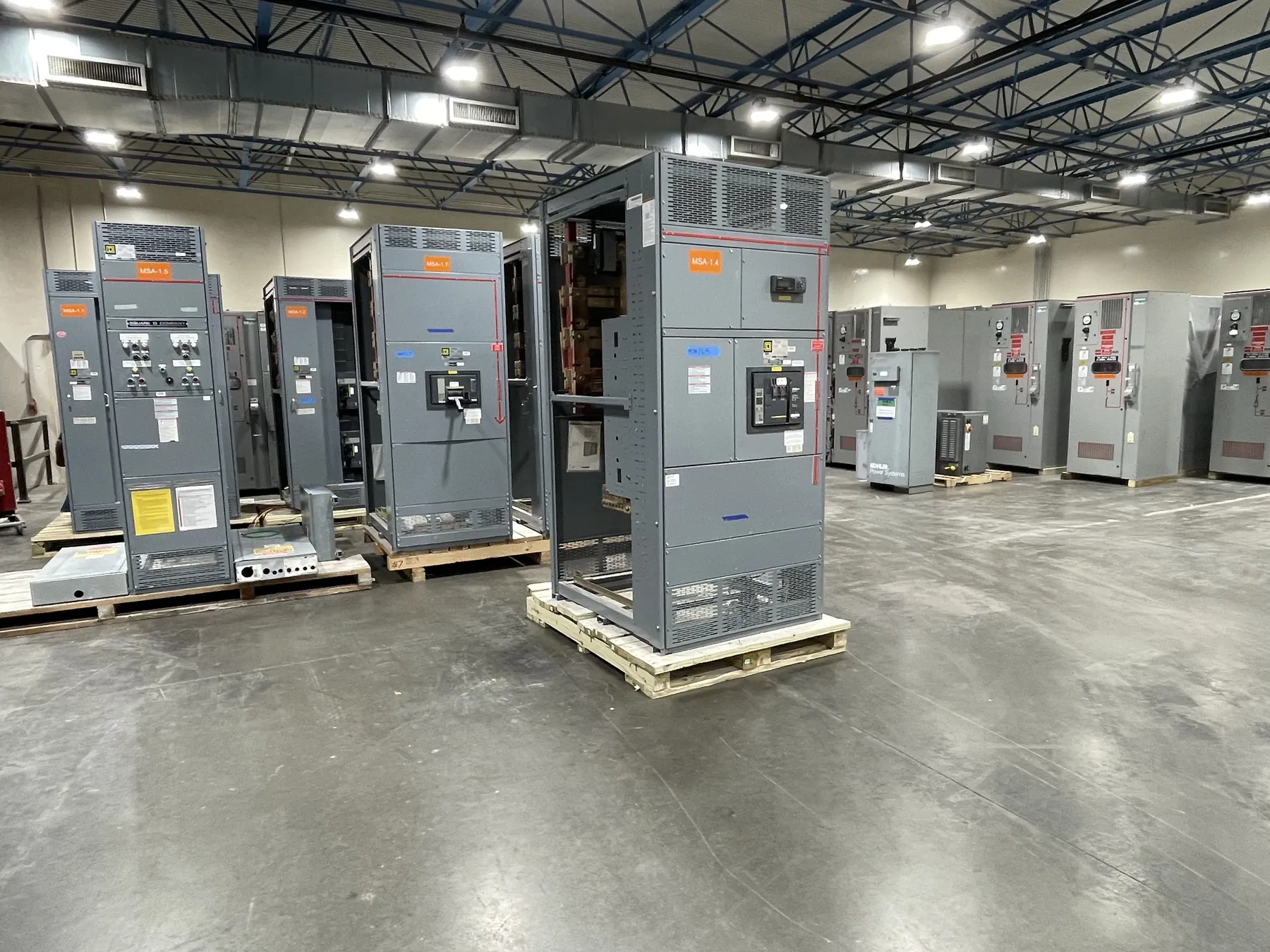
High-Voltage Substation Switchgear for Tonopah Projects
Substation switchgear for a Tonopah project must be selected around the electrical system it will serve, not a general label such as “high voltage.” The project team first needs to establish the system’s nominal voltage, maximum operating voltage, grounding arrangement, available fault current, and the functions required at each switching point. These conditions affect equipment construction, insulation coordination, switching duty, protection, and interfaces with transformers, lines, and downstream distribution. Our U.S. manufacturing business builds new custom power-distribution equipment using American components and ships nationwide, including to Nevada. The exact high-voltage construction available for a project must be confirmed during engineering review.
Voltage Class, Insulation Levels, and Construction
Voltage classification is not interchangeable with a switchgear assembly’s current or interrupting ratings. A voltage class identifies the system range for which equipment is designed; insulation levels address how its insulation withstands specified operating and transient stresses. A project may require air-insulated or another purpose-designed arrangement, but the suitable construction depends on system conditions, installation environment, maintainability expectations, and the manufacturer’s confirmed capabilities. Do not infer that a low-voltage switchboard standard applies to high-voltage substation equipment. The applicable product standards and ratings must be identified for the actual equipment type and jurisdiction.
Engineering review should establish the required insulation level and coordination with transformers, surge protection, connected lines, and other substation apparatus. Clearances, creepage distances, barriers, terminals, and enclosure details can be influenced by the selected insulation system and environmental exposure. The equipment schedule and quotation should state the intended voltage class and required ratings explicitly, rather than relying on an informal description of the site voltage.
Protection, Switching Duty, and Utility Interconnection
Protection design depends on more than the switchgear itself. The utility’s interconnection requirements, system grounding, fault-current study, transformer data, and relay scheme help determine breaker duties, protective functions, instrument-transformer requirements, and control interfaces. Coordination with upstream and downstream devices is necessary so that protection responds as intended across the defined system. The project engineer and utility should resolve these requirements; equipment selection alone cannot establish a complete or approved protection scheme.
For quotation and design, identify the required switching functions and the proposed arrangement of breakers, disconnecting devices, grounding provisions, bus, metering, and control wiring. Clarify relay and communications interfaces, auxiliary power, terminal responsibilities, and whether the scope includes related substation components. Utility review and approval are project-specific. No equipment description should be treated as confirmation of interconnection acceptance.
IEEE or IEC Requirements and Rating Confirmation
Applicable IEEE or IEC requirements depend on the equipment construction, voltage class, intended service, and project specifications. The governing standards should be named in the procurement documents and reviewed by the responsible electrical engineer. If the project requires a particular standard, edition, test evidence, or documentation package, those needs should be identified before the design is finalized. Standards applicability must not be assumed from a product category alone, and any claimed listing, certification, or compliance requires confirmation for the specific offered assembly.
Ratings also need careful separation. System voltage, continuous-current rating, short-circuit or interrupting duty, insulation level, and environmental limits describe different design conditions. Their values must be established from the project study and verified against the selected equipment. The final submittal should align the nameplate and technical schedule with the approved one-line diagram, protection concept, utility requirements, and installation conditions.
Tonopah Site Conditions, Enclosure, and Delivery Planning
Tonopah’s location makes site information important to both equipment configuration and delivery planning, without assuming conditions at any particular facility. Confirm actual installation altitude, expected temperature range, exposure to dust or moisture, wind and seismic criteria where applicable, and whether the equipment will be indoors or outdoors. Altitude and temperature can affect equipment limits and ratings; the design team must review these conditions before selecting an enclosure or finalizing performance requirements. A site-specific environmental review is more reliable than using broad regional assumptions.
Access arrangements also belong in early planning. Provide the delivery route, gate and road constraints, available unloading equipment, receiving hours, staging space, and any restrictions on transport dimensions or site access. These details help establish practical shipping and handling requirements for Nevada delivery. We support short lead times, but timing depends on the approved scope, component requirements, engineering decisions, and production scheduling; no exact delivery date should be assumed before those details are reviewed.
Information to Prepare for a Tonopah Switchgear Quote
A useful inquiry includes the one-line diagram, system voltage and grounding details, available fault-current information, transformer and line interfaces, preliminary protection requirements, applicable IEEE or IEC specifications, and the utility’s interconnection criteria. Include site altitude, temperature limits, enclosure environment, layout constraints, delivery access, and the requested documentation. Identify which components and services are within the equipment scope and which are supplied by others. With those inputs, engineers can assess the required construction, confirm which ratings and interfaces are available, and develop a project-specific proposal for new high-voltage switchgear.