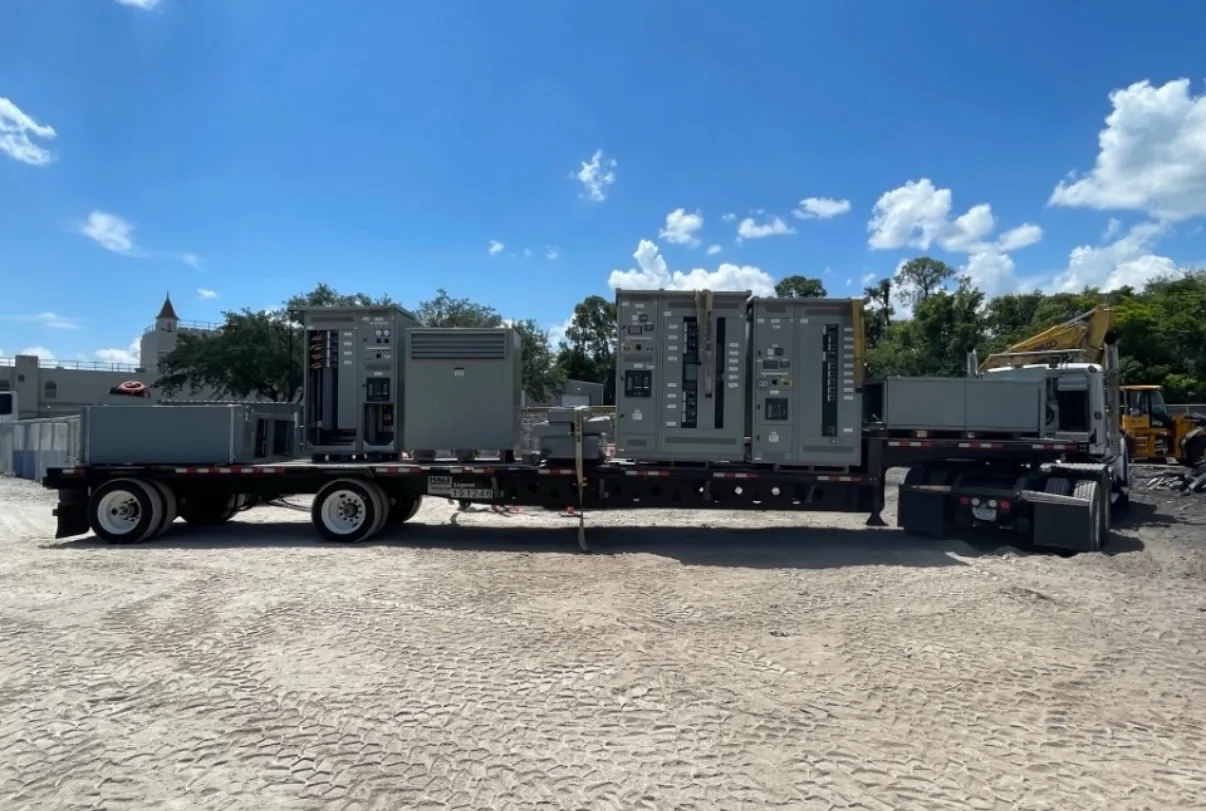
Metal-Clad Switchgear for Mesquite, Nevada Projects
Metal-clad switchgear can serve medium-voltage distribution needs at facilities in and around Mesquite, but the right lineup depends on the system design, equipment location, and operating requirements—not on the city name alone. Applications may include utility interfaces, industrial facilities, water infrastructure, and large commercial buildings. Each project calls for a review of the one-line diagram, available fault current, connected loads, protection scheme, environmental conditions, and required interfaces before equipment is specified.
Our U.S.-built, custom-manufactured switchgear uses all-American components and ships nationwide, including to Nevada. A quotation can begin with the project’s preliminary documents and operating requirements. Final equipment selection, ratings, and construction details require review by qualified engineers familiar with the installation and applicable requirements.
Compartments, Access, and Lineup Configuration
Metal-clad construction separates major primary circuit elements into grounded metal compartments. Depending on the design, the lineup may include compartments for the circuit breaker, bus, cable terminations, and instrument transformers. This separation helps define the equipment arrangement and the boundaries between components; it does not eliminate the need for a project-specific safety assessment or make every compartment arrangement interchangeable.
Compartment size and location affect cable entry, termination space, service access, and the overall lineup footprint. Engineers should confirm whether conductors enter from the top or bottom, how incoming and outgoing circuits are arranged, where control wiring lands, and whether adjacent equipment or building features limit access. A compact lineup may reduce floor space but can constrain cable routing or future expansion. Those tradeoffs should be resolved against the facility layout before the equipment is released for manufacture.
Withdrawable Breakers and Equipment Interfaces — Metal-Clad Switchgear in Mesquite, NV
Metal-clad switchgear commonly uses removable, or withdrawable, circuit breakers that connect to the stationary equipment through a defined arrangement. The breaker, cell, and associated interlocks must be compatible as a complete design. Breaker ratings, control voltage, trip functions, auxiliary contacts, and any required communications or remote-control interfaces need to match the project documents.
Specify the intended relationship between the switchgear and upstream or downstream equipment. Relevant interfaces may include transformers, protective relays, metering, control power, building-management or supervisory systems, and cable terminations. Identify required wiring diagrams and terminal points early; late changes to control schemes or accessory requirements can affect drawings and manufacturing. The selected breaker’s interrupting and continuous-current ratings must be checked for the actual system conditions rather than inferred from nominal system voltage.
Grounding and Relay Coordination — Metal-Clad Switchgear in Mesquite, NV
Grounding provisions should reflect the system grounding method and the project’s protection design. The equipment grounding path, grounding bus connections, cable shields, and any ground-sensing devices need to be addressed in the one-line diagram and detailed design. If the system uses a grounding transformer, resistor, or other grounding arrangement, its relationship to the switchgear and protective relays should be clearly documented.
Relay coordination is a system-level task. Protection settings and device selection depend on a short-circuit study, load characteristics, upstream protection, downstream equipment, and the owner’s operating requirements. The goal is to coordinate protective devices so that the intended portions of the system respond to faults, while accounting for equipment withstand and interrupting limits. A switchgear manufacturer can build to an approved design, but qualified project engineers must establish and verify the protection scheme using site-specific information.
Applicable IEEE C37.20.2 Requirements — Metal-Clad Switchgear in Mesquite, NV
IEEE C37.20.2 addresses metal-clad switchgear assemblies within its stated scope. The project specification should identify the applicable edition and the requirements relevant to the selected assembly, including its arrangement and rated characteristics. Confirm that the proposed equipment type is within the standard’s scope; do not assume that a reference to this standard establishes compliance for unrelated equipment or resolves every installation requirement.
Voltage, continuous-current, short-circuit, and other ratings are separate considerations and must be evaluated against the system and project conditions. A rating is not itself the system voltage. Applicable ratings, construction details, standard references, and any required documentation should be confirmed during engineering review. Listing status and project-specific requirements must also be verified for the actual product configuration; no general statement should be taken as confirmation that a particular lineup is listed or approved.
Mesquite Ambient Conditions, Ventilation, and Quotation Inputs
For a Mesquite installation, check the equipment’s published ambient-temperature limits against the expected conditions at its actual location. An outdoor enclosure, a sun-exposed electrical room, or a space with limited air exchange can experience conditions different from nearby weather readings. Review ventilation, heat sources, room dimensions, equipment clearances, and any enclosure or environmental requirements with the project engineer. Do not assume that a standard configuration will suit a particular room without comparing the site conditions with the selected equipment’s ratings.
For a useful quotation, provide the one-line diagram, preliminary equipment schedule, system voltage, available fault-current information, grounding method, breaker and relay requirements, cable-entry preferences, control-power details, and site ambient and ventilation conditions. Include the desired lineup arrangement, expansion needs, and shipping destination in Nevada. These inputs help establish scope and identify open engineering questions; final ratings, drawings, listing details, and delivery expectations require confirmation for the specific order.