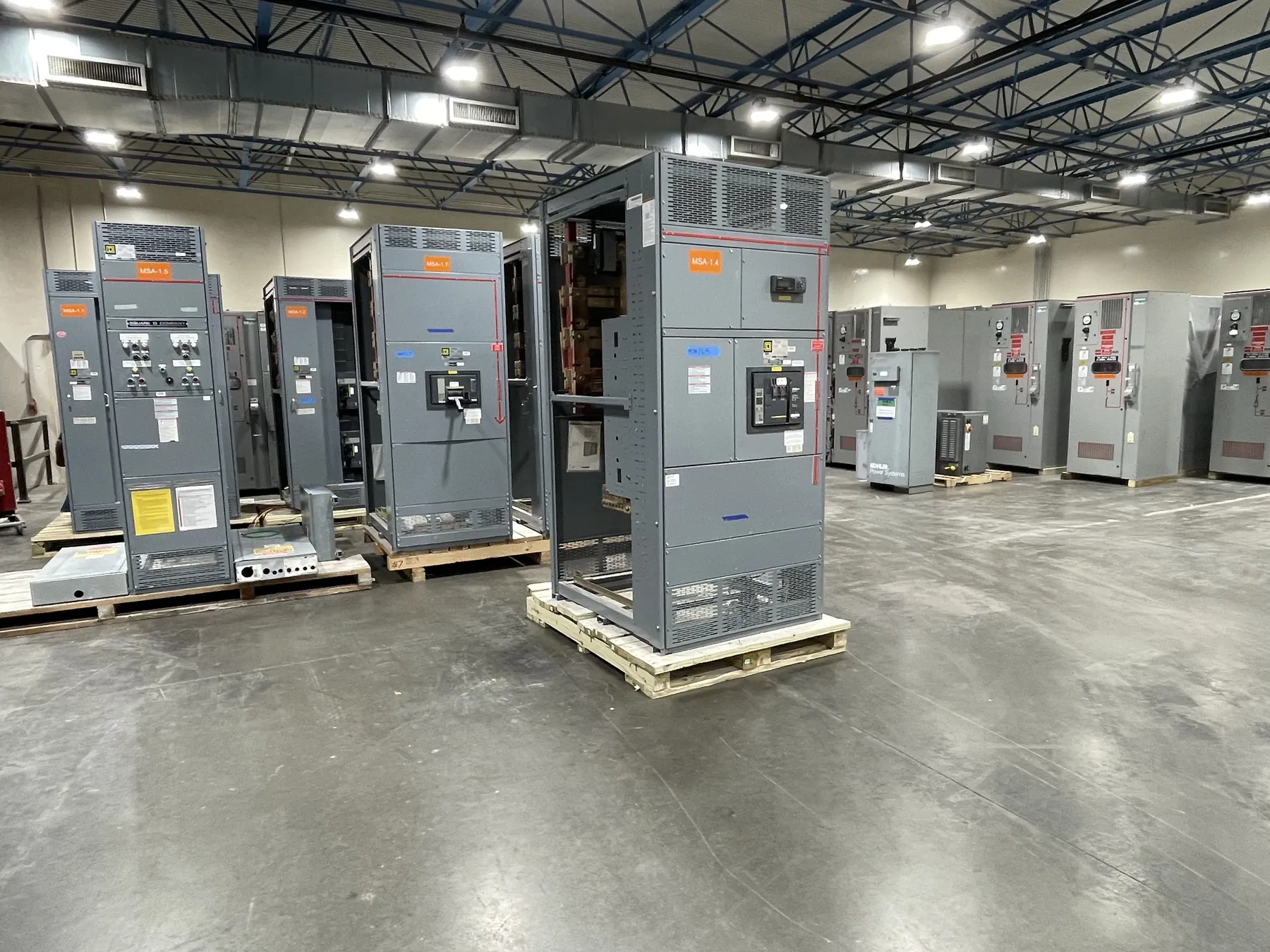
Manufacturing Switchgear for Mesquite Facilities
Manufacturing operations depend on electrical distribution that fits the production process, not just the building’s service entrance. A custom switchboard or switchgear assembly can bring incoming power, feeder distribution, protective devices and controls together in a configuration planned around the facility’s equipment and operating priorities. For a Mesquite project, early coordination helps connect the electrical design to production loads, motor-control interfaces, available floor space and the shutdown window for installation.
Equipment selection begins with the project’s electrical design and site conditions. The required system voltage, continuous and interrupting ratings, fault-current information, configuration and applicable product standards must be confirmed by the responsible electrical engineer. A device’s current rating is not the same thing as system voltage, and neither alone establishes whether an assembly is suitable for a particular installation. The equipment manufacturer can develop a quotation from defined requirements, but final selection depends on qualified engineering review and the actual site.
Translate Production Loads into a Distribution Plan
Manufacturing facilities may serve process lines, pumps, compressors, material-handling equipment, HVAC and general building loads from the same distribution system. A useful load schedule identifies each major load, its electrical characteristics, operating pattern, starting or control requirements, and the panel or equipment it needs to connect to. It should distinguish existing loads from planned additions rather than treating a forecast as a confirmed requirement.
Motor control may be integral to the distribution assembly or provided in separate equipment, depending on the design and project scope. The engineer should establish which party supplies starters, drives, control power, interlocks and field wiring, and identify the boundaries between switchgear, motor-control equipment and production machinery. Drives can affect system design and coordination, so their input requirements and intended locations should be available before equipment layouts are finalized.
Plan Feeder Space for Realistic Expansion
Future feeder provisions can be valuable where production changes are likely, but spare space is not the same as a fully equipped, ready-to-energize circuit. The design team should decide whether the project needs empty mounting space, provisions for specified devices, or complete spare feeders. That choice affects enclosure dimensions, bus arrangement, protective-device selection and cost. It also requires clear documentation so later modifications can be evaluated against the assembly’s ratings and the facility’s updated electrical conditions.
Physical fit matters as much as the one-line diagram. Confirm room dimensions, working and access clearances, cable entry direction, conduit locations, equipment orientation, transport route and any structural or housekeeping-pad requirements. Existing rooms can constrain section sizes and service access; new spaces offer more layout flexibility but still need coordinated architectural, mechanical and electrical plans.
Account for Mesquite Heat and Ventilation
Mesquite’s hot weather makes the equipment environment an important design input. The project team should document expected ambient temperatures at the equipment location, whether the room is conditioned, how air moves through the space, and whether heat from adjacent process equipment may affect the switchgear. Compare those conditions with the selected equipment’s published ratings and installation requirements. Do not assume that a building’s outdoor temperature, room temperature and equipment operating environment are interchangeable.
Ventilation and cooling provisions should be coordinated with the equipment design rather than added as an afterthought. Restricted airflow, dust, process contaminants and nearby heat sources may influence the enclosure or room plan. The responsible engineer should evaluate the site conditions and determine whether the proposed equipment arrangement is suitable; any rating or derating implications require confirmation for the specific product and application.
Coordinate Uptime with a Workable Shutdown
Manufacturing projects often have limited opportunities to interrupt production. Establish which loads can be taken offline, which processes require staged transitions, and whether temporary power or phased cutovers are part of the project plan. A shutdown sequence depends on the facility’s electrical topology, process constraints and qualified site personnel; it cannot be determined from an equipment quotation alone.
Coordination should cover the incoming service, upstream protective devices, downstream feeders, control and communication interfaces, grounding approach, cable terminations and responsibilities for field installation. The engineer should review protective-device coordination and available fault-current information for the complete system. Changes to the one-line diagram or connected loads can affect those decisions, so revisions should be tracked before manufacture and again during site planning.
Prepare a Clear Manufacturing Equipment RFQ
A complete request for quotation helps the manufacturer define scope and identify open questions. Useful inputs include the current one-line diagram, load and feeder schedules, system voltage, available fault-current data, required device functions, control interfaces, enclosure and access constraints, ambient conditions, requested standards or listings, and the project schedule. Include the destination and site delivery constraints so shipment planning can be considered without assuming a particular delivery date.
Our company manufactures new custom power-distribution equipment in the United States using all-American components and ships nationwide, including to Nevada. We can review the provided project information, clarify equipment boundaries and coordinate design details with the project team. Applicable ratings, product listings, standards and final configuration must be confirmed for the selected assembly and application. For low-voltage switchboards, UL 891 may apply when specified and appropriate; it should not be treated as a blanket standard for every switchgear product or voltage class.