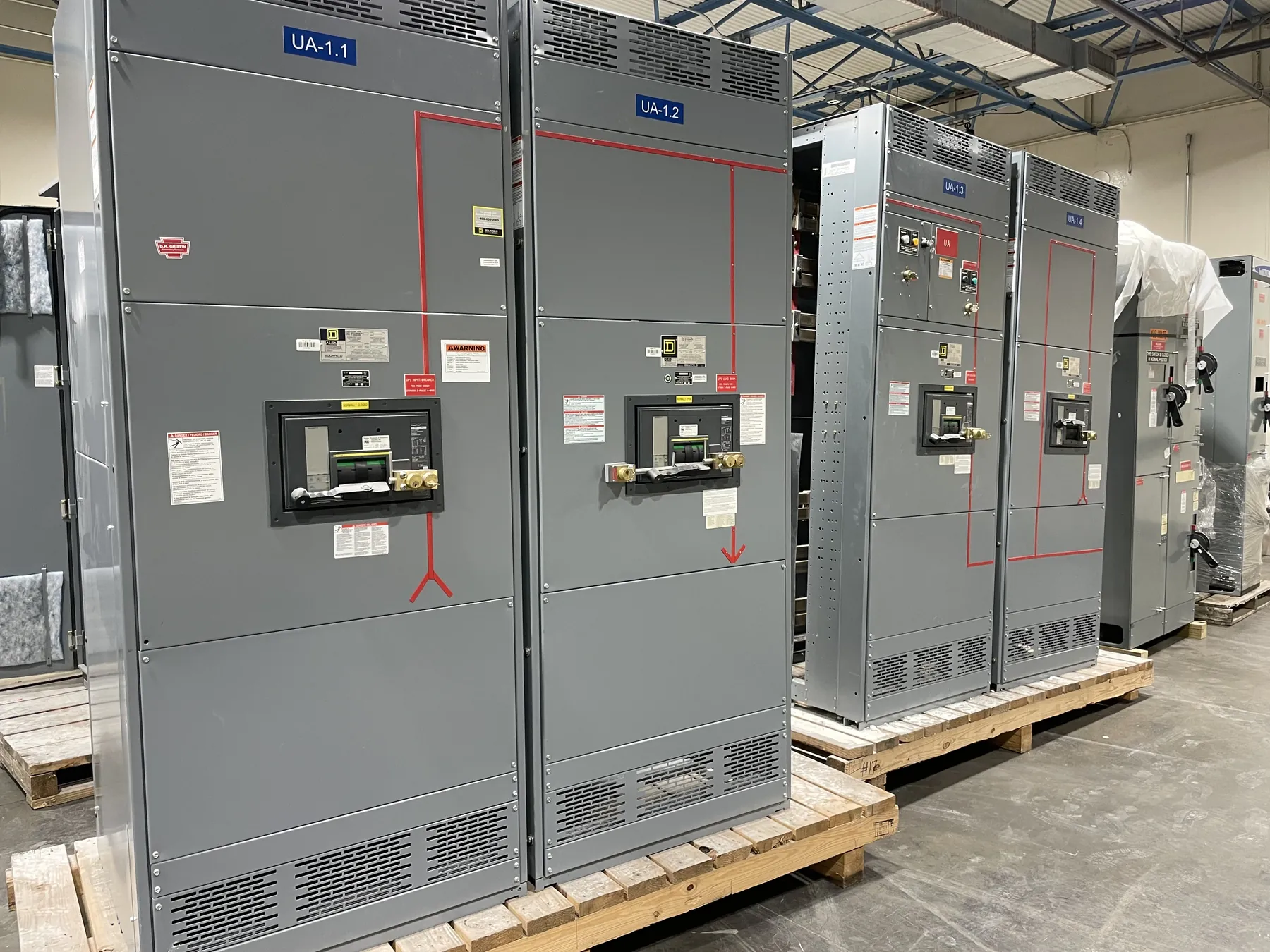
High-Voltage Switchgear for Mesquite Substation Projects
High-voltage switchgear is part of a larger substation system, not a standalone choice based only on a nominal voltage. For a Mesquite-area project, the design begins with the system’s operating conditions and the role each assembly must serve: connecting a source, transformer, feeder, or other circuit while providing the specified means of switching, isolation, and protection. The equipment arrangement must fit the one-line diagram and the project’s operating philosophy. Our U.S. manufacturing business builds new custom power-distribution equipment using all-American components and ships nationwide. The exact high-voltage construction available for a project must be confirmed during engineering review; product form, interrupting capability, insulation system, and interfaces depend on the application.
Define Voltage Class and Insulation Requirements
System voltage and equipment ratings are related but are not interchangeable. A project team should provide the nominal and maximum system voltage, grounding method, frequency, and the required equipment voltage class. Insulation requirements also depend on the system and installation, including specified power-frequency and impulse withstand levels where applicable. Altitude, contamination, moisture, and other service conditions may influence insulation selection and clearances. These details should be established against the governing project documents rather than inferred from a single voltage label. The selected construction and available ratings require confirmation for the specific design.
Coordinate Switching, Protection, and Instrumentation
Protection equipment must work with the system’s fault levels, relay scheme, and upstream and downstream devices. The design review should identify the required switching functions, protective devices, control power, current and voltage sensing, metering, and any interlocking or status indication. Current transformers and voltage transformers, when required, need suitable ratios, accuracy classes, burdens, and placement for the intended protection and measurement functions. Interrupting and short-time withstand requirements must be coordinated with the available fault current and clearing strategy. Qualified engineers should confirm these selections using system studies and project criteria; they cannot be determined from location or equipment name alone.
Plan the Utility Interconnection and Substation Interfaces
Utility interconnection requirements can affect the one-line arrangement, metering boundaries, protective relays, communications, grounding, and physical interfaces. Mesquite projects should identify the serving utility and obtain its current interconnection and equipment requirements early in design. Confirm who supplies and installs each item at the point of connection, how trip and permissive signals are exchanged, and what documentation or review the utility requires. The switchgear design also needs to coordinate with transformers, bus, surge protection, cables or conductors, grounding grid, and control systems. Utility approval is project-specific and should not be assumed from a product description.
Check Mesquite Ambient Conditions and Ventilation — High-Voltage Switchgear in Mesquite, NV
Mesquite’s desert setting makes the project’s design ambient temperatures and equipment-room conditions important inputs. Compare expected outdoor or room temperatures, solar exposure where relevant, ventilation strategy, enclosure arrangement, and equipment heat dissipation with the selected equipment’s published ratings. A room’s ventilation capacity and air path can affect internal conditions; simply providing an opening or fan does not establish suitability. Review dust, moisture, elevation, and other site conditions as applicable, and determine whether any environmental provisions are required. The equipment configuration and ratings must be checked against these conditions by the project’s qualified engineering team.
Confirm Applicable Standards and Construction Scope
Applicable IEEE or IEC requirements depend on the equipment type, voltage class, project specification, and jurisdictional context. The design team should name the standards and editions required by the contract, then confirm that the proposed construction and documentation address them. UL 891 applies to applicable low-voltage switchboards; it should not be treated as a general listing standard for high-voltage switchgear. Do not assume that a standard, listing, or certification applies to a particular assembly without confirmation. Exact construction—such as indoor or outdoor arrangement, enclosure details, switching technology, and control compartments—must also be verified for availability and suitability.
Prepare a Mesquite Project RFQ
A useful quotation package includes the one-line diagram, equipment schedule, voltage and insulation requirements, fault-duty criteria, protection and metering needs, utility interface documents, site ambient conditions, enclosure location, and applicable standards. Include cable entry and termination preferences, control voltage, communications requirements, layout constraints, and the anticipated project schedule. Clear inputs help identify open engineering questions before the equipment scope is finalized. We manufacture new custom equipment in the United States, use all-American components, support short lead times, and ship nationwide. Actual schedule, construction, ratings, and project compliance depend on confirmed requirements and engineering review.