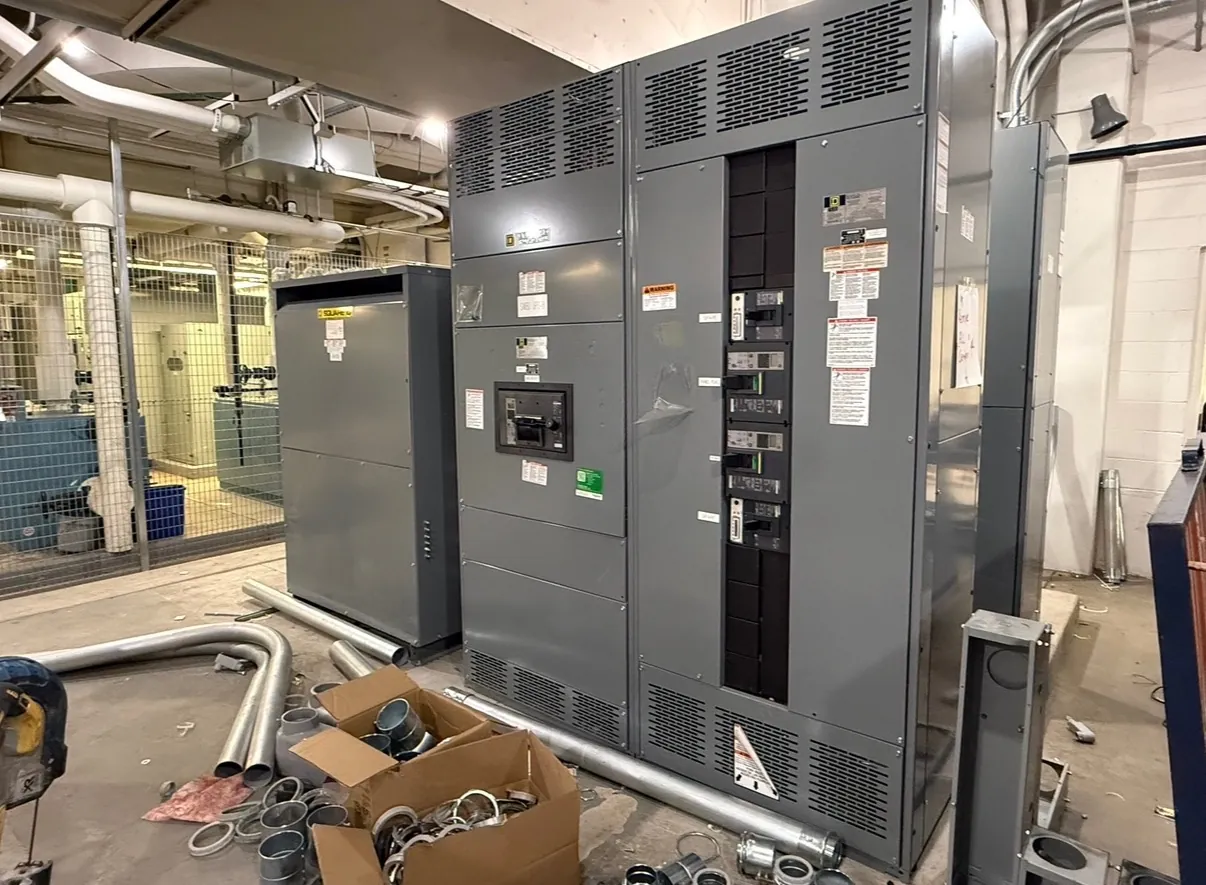
Utility Switchgear for Las Vegas Service Interconnections
Utility-related distribution equipment for a Las Vegas project must be developed around the actual service arrangement—not selected from a generic voltage label or assumed utility practice. The serving utility’s requirements govern key interfaces such as the point of delivery, metering provisions, available fault current information, protective-device coordination, grounding, and equipment acceptance. These details can differ by service and project, so confirm them with the utility and the project’s qualified electrical engineer before establishing the switchboard or switchgear scope.
Our U.S. manufacturing business builds new custom switchgear and power-distribution equipment for customer projects. For a utility-facing application, the design conversation begins with the project documents and utility criteria. The equipment’s voltage, continuous-current rating, short-circuit rating, configuration, and applicable listing are separate matters that must be checked against the service and intended installation. A rating is not, by itself, confirmation that the assembly is suitable for a particular system or accepted by a utility.
Confirm Service and Metering Before Sizing the Main
The main section cannot be responsibly sized from the city name alone. The project team should establish the service characteristics, including the utility’s stated nominal system voltage and phase arrangement, the point of service, and the service configuration. The engineer should also confirm the demand basis and anticipated load additions used for the design. These inputs inform bus and main-device selection, space planning, and the relationship between the service equipment and downstream distribution.
Metering requirements deserve early attention because the utility may specify the metering arrangement, access, compartment provisions, instrument-transformer interfaces, or physical separation from customer equipment. Requirements can vary with service type and utility standards. Drawings should clearly show which components are utility-furnished, customer-furnished, or part of the manufactured assembly, and who is responsible for their installation and connections. Do not assume a standard meter section will meet the requirements without utility review.
Protection, Fault Duty, and Coordination
Protective-device selection depends on more than the nominal service voltage. The engineer needs utility-provided fault-current data at the relevant point, along with transformer and feeder information where applicable, to evaluate equipment duty and protective coordination. The specified short-circuit rating must suit the available fault current and the design basis; it should not be inferred from a breaker frame size or a general product description.
Coordination also involves the upstream utility protection and downstream customer devices. The project engineer should define the intended protection scheme, device functions, settings responsibility, and documentation needed for review. Where the assembly includes protective relays or control interfaces, the drawings and submittals should identify their intended role and connection boundaries. Final design and settings require qualified engineering review using project-specific system information.
Grounding and Utility-Customer Boundaries
Grounding provisions need to align with the service arrangement and the project’s grounding and bonding design. The engineer should identify the system grounding method, the required equipment grounding path, neutral treatment, and the location of the service bonding connection. Utility rules may also define the demarcation between utility and customer responsibilities. Clear one-line diagrams, grounding details, and connection schedules help prevent incompatible assumptions from carrying into fabrication or field installation.
Control power, metering circuits, communications, and remote status signals can cross the same boundary. Define signal ownership, terminal requirements, and any required isolation or interface devices before drawings are released. Utility acceptance is not implied by a manufacturer’s drawing review; the project team must obtain the applicable utility review and acceptance for the specific installation.
Las Vegas Project Conditions and Equipment Layout
Las Vegas installations may involve outdoor service areas, restricted electrical rooms, rooftop or site distribution points, and long equipment routes through active facilities. The project team should provide the actual installation location and environmental conditions, including whether equipment is indoors or outdoors and any exposure to heat, dust, moisture, or direct sun. Enclosure construction, ventilation, access clearances, and equipment arrangement should be evaluated for the site rather than assumed from a standard indoor layout.
Access for delivery and placement can also affect section dimensions, shipping splits, and the planned sequence of installation. Confirm door openings, corridors, lifting or rigging constraints, floor conditions, and the final equipment position. Nationwide shipping from our U.S.-based manufacturing operation can support Nevada projects, but the project schedule and logistics depend on the approved configuration and site conditions.
Information for a Utility Switchgear Quotation
A useful quotation package includes the latest one-line diagram, utility service requirements, load and demand information, fault-current data, metering criteria, protection expectations, grounding details, and the proposed equipment location. Include required main and feeder functions, enclosure conditions, control or communications interfaces, and any utility submittal format or review milestone. Identify the applicable project specifications and requested ratings, while distinguishing equipment ratings from system voltage.
Our assemblies use all-American components and are built in the USA, with short lead times supported as a manufacturing goal rather than a promised delivery date. The final scope, schedule, ratings, and any applicable listing must be confirmed for the particular design. UL 891 may apply to low-voltage switchboards when appropriate; it does not establish suitability for every switchgear product or service. Utility criteria, project engineering, and site review remain central to a workable Las Vegas distribution solution.