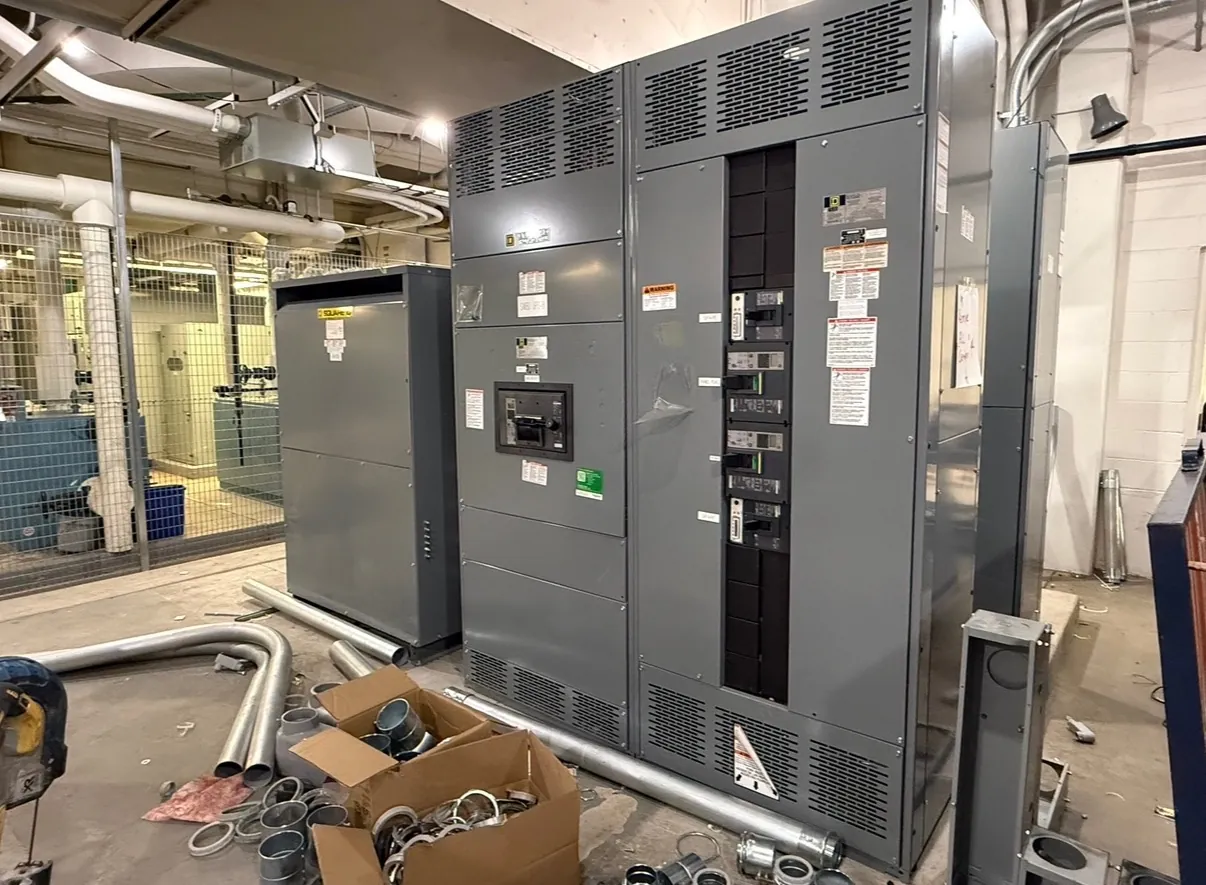
Utility Switchgear Starts With the Service Arrangement
For a utility, switchgear must fit the actual point of connection and the responsibilities assigned to each party. A project may involve utility-owned equipment, customer-owned distribution, or an interface where ownership, access, and operating authority change at a defined boundary. Those distinctions affect enclosure layout, metering provisions, protective devices, grounding connections, and how equipment is accepted before service. Begin with the one-line diagram and the utility’s current service requirements, rather than assuming that a catalog configuration will satisfy a particular interconnection.
Utility service characteristics must be established for the specific site. Relevant inputs can include nominal system voltage, available fault current, grounding method, conductor arrangement, and whether the installation is indoor or outdoor. A switchboard’s voltage rating and short-circuit rating are equipment ratings; neither should be treated as a substitute for confirming the system conditions at the connection point. Qualified engineers and the serving utility must resolve the design basis.
Coordinate Interconnection, Metering, and Ownership Boundaries
Interconnection requirements determine more than where incoming conductors land. They may shape compartment arrangement, barriers, access, termination space, and the location of utility-approved metering components. Confirm whether the utility requires instrument transformers, test provisions, a particular meter location, visible isolation, or other service-specific features. Requirements can differ among utilities and may also depend on the rate schedule, service type, and project configuration.
Define which party furnishes, installs, inspects, and maintains each component. A clear scope should identify the service entrance equipment, metering interface, conductors, grounding connections, and any transition to downstream distribution. This prevents an important interface from being omitted or assumed to be supplied by the other party. Utility review and equipment acceptance should be treated as project requirements to verify—not as automatic outcomes of selecting a product described as utility switchgear.
Protection and Grounding Need a Shared Design Basis
Protection choices depend on the system study, equipment arrangement, and utility coordination criteria. The design team may need to evaluate device types and settings, interrupting capability, selective coordination objectives, and the relationship between utility protection and customer-side devices. These decisions cannot be made from nominal voltage alone. Available fault current, conductor and transformer data, relay requirements, and the utility’s coordination process all matter.
Grounding provisions likewise need to match the service configuration and applicable design requirements. Clarify the grounding method, neutral treatment, bonding points, and how the switchgear connects to the site grounding system. The equipment layout should provide the connections required by the approved design without presuming that a generic arrangement is suitable. Qualified engineering review is essential where protection, grounding, or system behavior depends on site conditions.
Select Equipment Ratings and Construction for the Application
Specify ratings against the documented system conditions and the intended role of each assembly. Confirm voltage class, continuous current, short-circuit withstand or interrupting requirements as applicable, and the ratings of installed devices and bus. These terms describe different characteristics; they should not be collapsed into a single “capacity” figure. Rating selection and compatibility require review against the project documents and the equipment configuration being quoted.
Construction choices follow from the installation environment and operating needs. Indoor rooms, outdoor locations, restricted access, conductor entry direction, cable termination space, and future expansion can affect enclosure form and arrangement. For low-voltage switchboards, UL 891 may be relevant where applicable, but it does not cover every type of switchgear or determine utility acceptance. Listings and standards applicable to the proposed equipment must be confirmed for the specific product and project.
Prepare a Quote Package That Resolves Interfaces
A useful quotation request gives the manufacturer enough information to identify the intended assembly and flag open engineering questions. Include the latest one-line diagram, equipment schedule, service voltage and system data, available fault-current information, grounding details, utility metering and protection requirements, and site conditions. Provide conductor entry and exit preferences, feeder quantities, device requirements, enclosure location, and any dimensional or access constraints known at the time of inquiry.
Also identify required submittals, review milestones, inspection or acceptance steps, and the division of responsibility among the utility, engineer, contractor, and equipment manufacturer. If requirements are preliminary, mark them as such. A quotation can then distinguish confirmed configuration details from items that depend on utility feedback or engineering review, rather than implying that unresolved project conditions have already been settled.
Manufacturing and Delivery for Nevada Utility Projects
Custom switchgear and power-distribution equipment can be configured around project documents and interface requirements. Assemblies use all-American components, are built in the USA, support short lead times, and ship nationwide, including to Nevada. Actual schedule and shipping arrangements depend on the approved scope, component requirements, design review, and project logistics; confirm them for the specific order.
Before release, reconcile the equipment drawings with the approved one-line, utility comments, metering provisions, protection requirements, grounding design, and site dimensions. Confirm the applicable ratings, listing details, and acceptance criteria in writing. That disciplined review helps utility teams and project partners receive equipment aligned with the service design while keeping site-specific engineering decisions with the qualified professionals responsible for the installation.