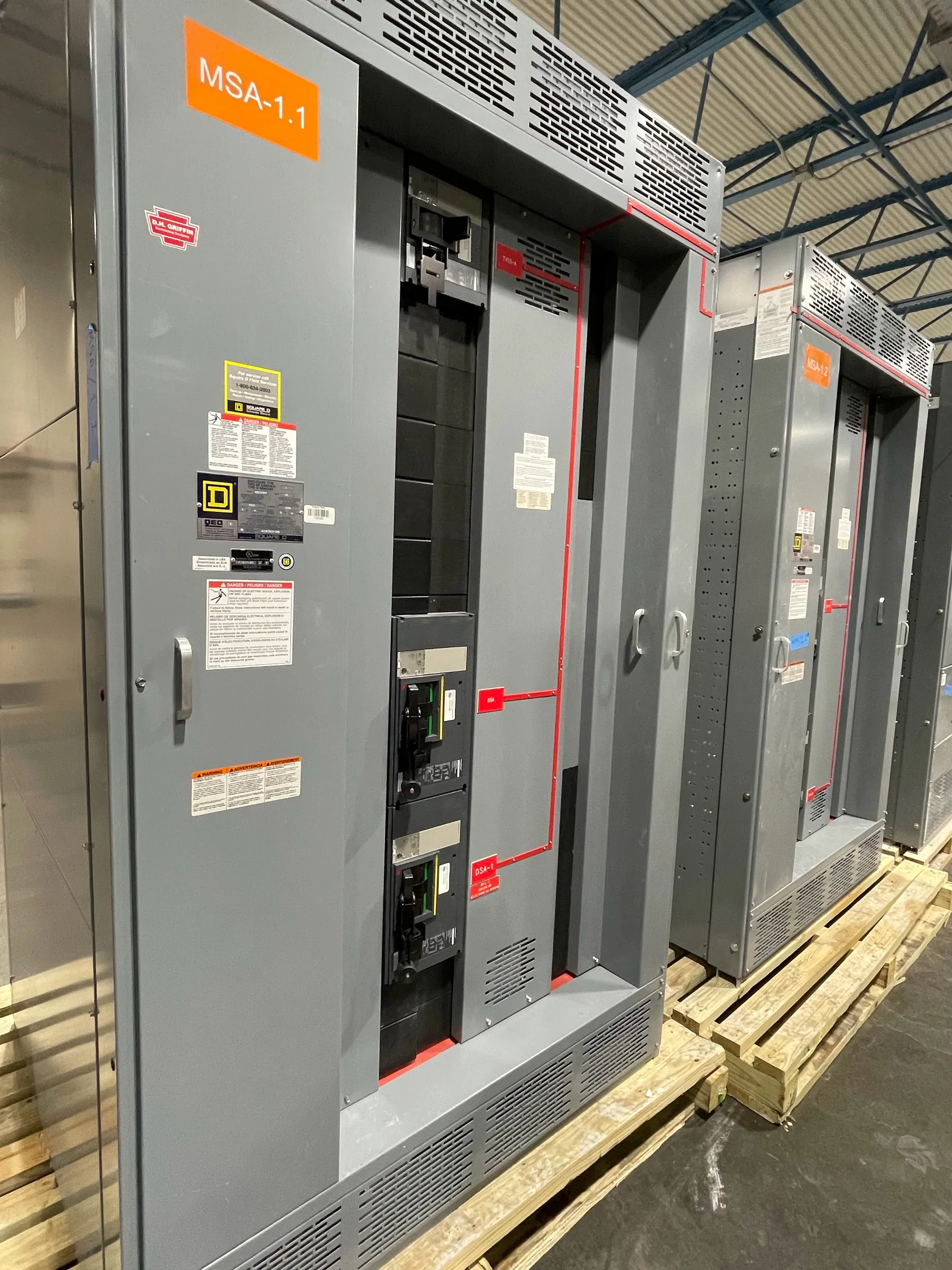
Manufacturing Switchgear for Henderson Production Facilities
Manufacturing plants rely on electrical distribution that fits the way their equipment operates—not just a sum of nameplate loads. A Henderson project may include process machinery, motors, building services, material-handling equipment and planned production additions. A custom switchboard or switchgear lineup should be developed around those loads, the facility’s electrical service and the operating priorities identified by the plant team. We manufacture new custom power-distribution equipment in the United States using all-American components, with assemblies available for shipment nationwide.
The first design conversation should establish what the equipment must distribute and how the plant expects to use it. That means documenting connected load, demand assumptions, equipment operating patterns and anticipated expansion before settling feeder and bus capacity. Those inputs help engineers evaluate competing needs: adequate provision for production today, room for future circuits, and an assembly suited to the available electrical room and project scope.
Plan Around Motors, Controls and Production Loads
Motor loads can affect distribution choices differently from lighting, receptacles or steady process loads. Provide motor schedules where available, including equipment ratings, starting methods and any known operating sequence. Identify variable-frequency drives, soft starters, control transformers or other equipment that affects the electrical interface. The design team can then review feeder requirements, protective-device coordination and space needs in context, rather than treating every load as interchangeable.
Clarify which controls are supplied with the machinery and which are part of the distribution scope. A switchgear lineup may need defined provisions or interfaces for control wiring, metering, remote indications or communications, but those details depend on the project. Confirm responsibility boundaries with the equipment integrator, electrical contractor and plant controls team early. Clear interface documents reduce the risk of mismatched terminals, missing signals or an unclear division of field work.
Match Capacity to Documented Demand and Expansion
Connected load is an important starting point, but it is not by itself a complete basis for selecting bus and feeder capacity. Demand assumptions should reflect how equipment actually runs, including simultaneous operation, production shifts and foreseeable process changes. List planned additions separately from present loads, noting which are committed and which are possible future phases. This helps the design team compare a larger initial assembly with a staged approach that reserves practical feeder space.
Spare space is useful only when it is defined. Discuss whether the plant needs empty compartments, provisions for future devices, or simply physical room to extend the lineup. Future equipment can also change fault-current, protection or service requirements, so reserved space should not be treated as automatic approval for any later load. System voltage, equipment ratings and available fault current are distinct project facts; they must be confirmed against the site electrical information and engineering review.
Coordinate Uptime Needs With a Workable Shutdown Plan
For an operating plant, installation timing can be as important as the equipment arrangement. Describe which production areas depend on the existing distribution, what outages the facility can plan, and whether construction will be phased. Identify temporary power expectations, tie-in boundaries and the parties responsible for outage planning. These constraints help the project team evaluate lineup configuration and sequencing without assuming that a particular installation can be completed during a short shutdown.
Replacement or expansion work may also involve existing switchboards, transformers, generators, transfer equipment or control systems. Provide available one-line diagrams and explain what must remain in service during each phase. A qualified electrical engineer and site team should assess the installation conditions and determine the appropriate design and transition plan; equipment selection alone cannot establish a safe or workable sequence.
Account for Henderson Site and Delivery Conditions
Facility conditions influence enclosure and layout choices. Share the proposed equipment location, room dimensions, access route, indoor or outdoor exposure, ambient conditions and any known dust or process contaminants. Henderson projects may have different building layouts, site access rules and construction schedules, so logistics should be confirmed with the receiving facility and project contractor rather than assumed from the city name. Include door clearances, handling constraints and the intended final position when reviewing the lineup footprint.
We support short lead times and ship nationwide, but schedule and transportation details depend on the approved scope, manufacturing requirements and project coordination. A complete submittal review and timely decisions on interfaces help keep the production plan aligned with the installation schedule. Confirm delivery access, unloading responsibility and any site-specific receiving restrictions as part of the project planning.
Prepare a Useful Henderson Manufacturing Project Request
For a quotation, provide the service voltage and available electrical data, connected-load schedule, demand assumptions, motor information, one-line diagram, desired feeder count, expansion plans and installation constraints. Include the required equipment type and ratings, environmental conditions, control and metering interfaces, preferred dimensions, and target project milestones. If a low-voltage switchboard is being considered, UL 891 may apply to that product category; it does not establish suitability or coverage for every switchgear assembly. Listing requirements and the applicable equipment standard must be confirmed for the specific design.
These details give the manufacturer and project engineers a sound basis to define scope, identify open questions and develop an assembly for the facility’s needs. Final ratings, listings, protection, bus and feeder selections, and compatibility with the existing system require confirmation through qualified engineering and site review. Clear documentation at the outset makes that review more productive and helps align production requirements with the plant’s operating priorities.