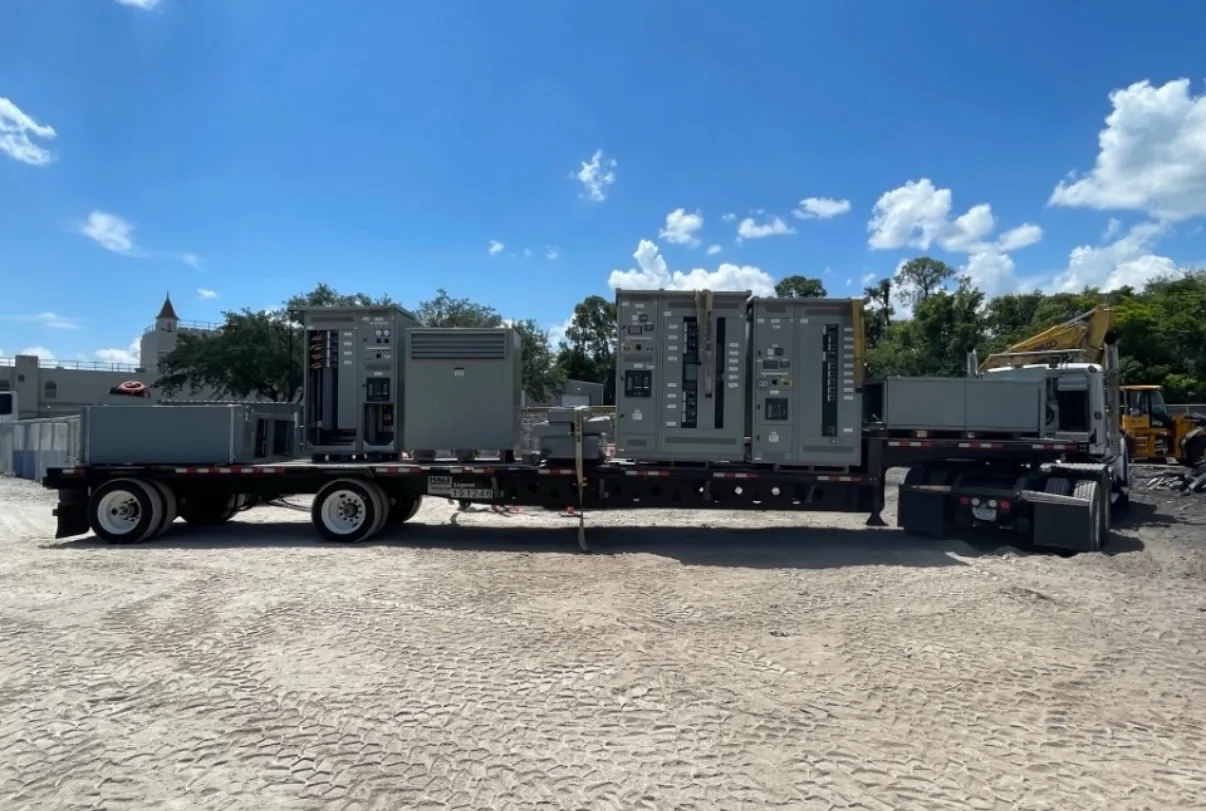
Metal-Clad Switchgear Design for Hawthorne, Nevada Projects
Metal-clad switchgear is a medium-voltage equipment arrangement in which major components are separated into grounded compartments by metal barriers. For a Hawthorne project, that construction can help organize the incoming source, bus, breakers, instrument transformers, and cable connections while limiting access between sections. The arrangement must fit the electrical design and the physical site; “metal-clad” alone does not establish a voltage, interrupting capability, enclosure suitability, or listing for a particular installation.
We manufacture new custom power-distribution equipment in the United States using all-American components and serve projects nationwide, including in Nevada. A project-specific design begins with the one-line diagram, operating requirements, and installation conditions rather than a generic lineup. Applicable requirements and ratings must be confirmed for the selected equipment and project.
Compartmentalization and Lineup Interfaces
Compartment boundaries, barriers, and access points affect how the lineup is arranged and how its sections connect. The design team needs to understand which equipment belongs in each section, how power and control wiring enter, and where cables, bus connections, and instrument transformers interface. The required arrangement may also depend on whether the lineup has one incoming source, multiple sources, tie breakers, or other switching points.
Space and service access are practical design inputs, not afterthoughts. Hawthorne site conditions may include constraints on the delivery route, equipment-room entry, floor support, working space, cable approach, and the sequence for placing lineup sections. These details should be reviewed by the project team before the equipment arrangement is finalized. A proposed footprint should not be treated as confirmation that the equipment will fit or can be installed without site review.
Withdrawable Breakers and Operating Requirements
Metal-clad designs commonly use withdrawable circuit breakers, but the breaker type and its interface must match the switchgear design and project requirements. The specification should identify the breaker’s intended role, control-power needs, auxiliary contacts, trip and close circuits, and any interlocking or indication requirements. These choices affect wiring, compartment layout, control schematics, and the way the switchgear integrates with upstream and downstream equipment.
Clarify whether the project requires particular breaker positions or status signals for its control system, and identify any remote-control or monitoring interfaces. Those functions must be engineered and documented; they should not be assumed from the equipment category. Operating and maintenance practices belong to the facility’s qualified personnel and approved procedures. Equipment selection or website descriptions cannot substitute for site-specific training and engineering review.
Grounding, Fault Duty, and Relay Coordination
Grounding decisions depend on the source and system design. Provide the project’s grounding method and relevant one-line details so the engineering review can assess grounding connections, ground-fault sensing, and protective-device requirements. The design should also account for the available fault current at the switchgear and the applicable short-circuit and momentary ratings. These ratings describe equipment capabilities under defined conditions; they are not the same thing as nominal system voltage, and neither should be inferred from the other.
Relay coordination requires information about the full protection scheme, not just a breaker rating. Relevant inputs may include source protection, transformer data, downstream devices, relay functions and settings, and the intended operating modes. Qualified project engineers must evaluate selectivity, protection objectives, and the effects of alternate source or tie configurations. Changes to the source arrangement can alter fault duty and coordination, so the assumptions used for a quotation need to be stated and verified.
IEEE C37.20.2 and Project-Specific Requirements — Metal-Clad Switchgear in Hawthorne, NV
IEEE C37.20.2 is the relevant standard to review when specifying metal-clad switchgear within its scope. The project specification should identify the applicable edition and the requirements that apply to the proposed equipment and configuration. Naming the standard does not, by itself, establish that a particular assembly complies, nor does it replace review of the complete specification, drawings, ratings, and interfaces. Any required listing, testing, or other evidence should be identified explicitly and confirmed for the offered design.
Before design release, the responsible engineers should check that the selected equipment’s voltage class, insulation and switching characteristics, fault-duty ratings, enclosure details, and control features meet the project documents. Requirements for environmental conditions, seismic considerations, special access, or other site conditions should be communicated where applicable. Their relevance and design implications depend on the actual installation.
Information for a Hawthorne Switchgear Quotation — Metal-Clad Switchgear in Hawthorne, NV
A useful quotation package includes the one-line diagram, source arrangement, nominal system voltage, available fault-current information, grounding method, protection and control requirements, and required ratings. Also provide the intended lineup location, cable entry direction, room dimensions and access constraints, connection details, and any specified IEEE C37.20.2 edition or project-specific documentation. If some inputs are preliminary, identify them as assumptions so they can be confirmed before final design.
Our team can use those project details to develop a custom equipment proposal for a Hawthorne installation. Manufacturing in the United States, use of all-American components, support for short lead times, and nationwide shipping are relevant planning considerations; actual scope, schedule, and shipment arrangements depend on the confirmed design and project requirements. Final ratings, interfaces, applicable standards, and site fit require qualified engineering review and confirmation.