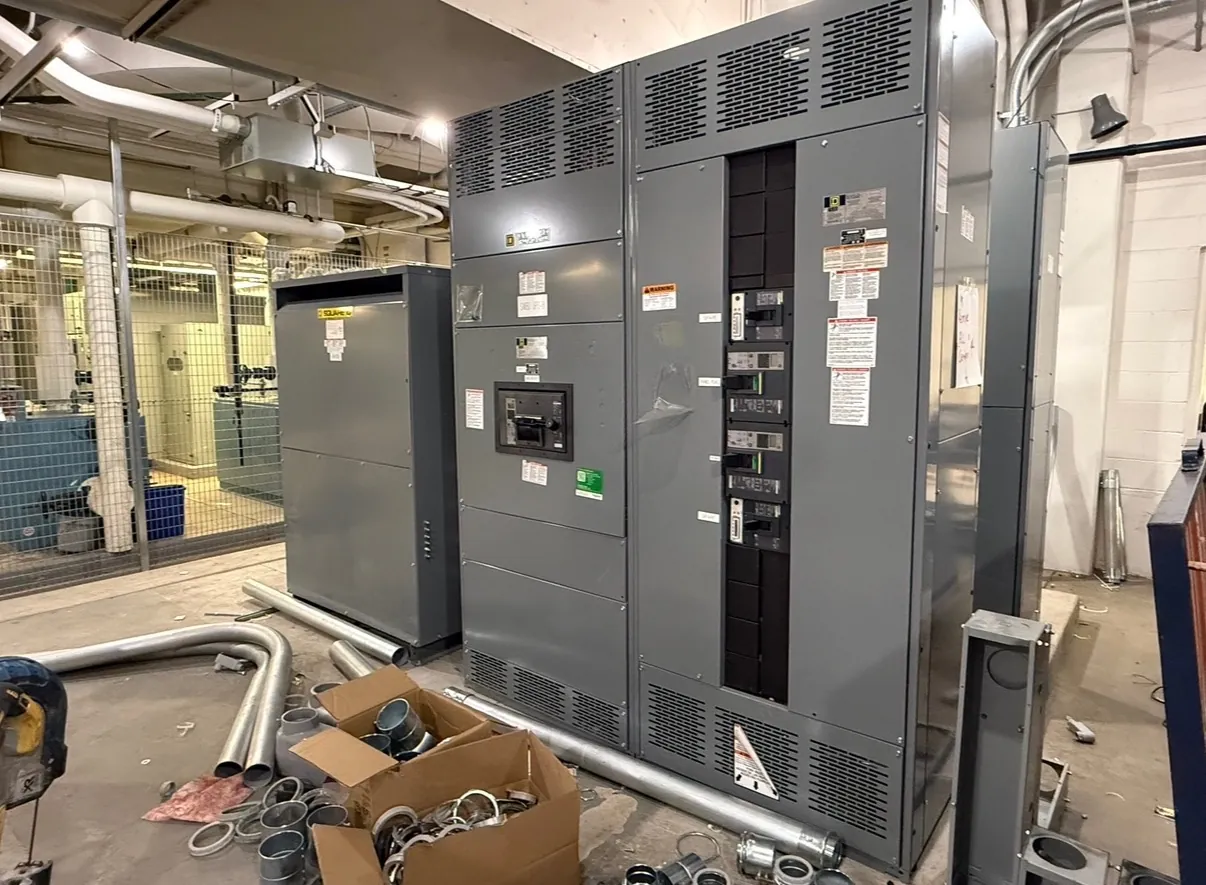
Data Center Switchgear Planning for Hawthorne, Nevada
Data-center power distribution starts with the facility’s operating plan, not a catalog configuration. A Hawthorne project may need switchboards or other distribution assemblies that connect utility or on-site sources, UPS equipment, generators, and downstream loads. The right arrangement depends on how the facility is intended to respond to a source loss, equipment maintenance, or a change in load. We manufacture new custom switchgear and power-distribution equipment in the United States and can discuss a project designed for a Nevada site. The equipment configuration, ratings, applicable listing, and interfaces must be confirmed against the project documents and site conditions.
Early planning should establish which loads require continuous power, which can transfer or shed, and which distribution paths must remain independent. Redundancy is a system-level design objective; it cannot be established by labeling two sections “A” and “B” if they share a limiting upstream source or an unplanned common connection. A one-line diagram, operating narrative, and equipment schedule help identify those dependencies before a quotation is prepared.
Redundant Paths, Sources, and Transfer Boundaries
Describe the intended source arrangement clearly: utility service, generators, UPS systems, tie breakers, and the points where each path connects. For each source, identify its expected role and the loads it is intended to support. The design team can then review whether the proposed bus sections, breakers, and interconnections align with the required operating modes. A normally open tie, for example, may support an alternate configuration, but its use affects protection, operating procedures, and the conditions under which sources can be paralleled.
UPS output and bypass connections deserve particular attention. The project should show whether maintenance bypass equipment is part of the UPS package or supplied as a separate assembly, where the bypass source originates, and how downstream distribution is maintained during planned work. Confirm control and status signal responsibilities between equipment suppliers. These interfaces often involve more than power conductors: interlocks, transfer logic, alarms, metering, and communications may need coordination across the electrical and controls scopes.
UPS and Generator Interfaces for Facility Operations
Generators and UPS systems behave differently during normal operation, transfer, testing, and recovery. The engineering team should provide source characteristics and operating sequences so switchgear components and controls can be selected and coordinated for the intended duty. Relevant details may include generator configuration, transition approach, UPS input and output arrangements, bypass mode, and whether load shedding or staged restoration is expected. Do not assume that a particular transfer scheme or control function is included unless the equipment scope explicitly assigns it.
For a maintainable bypass sequence, document the required states and the conditions that prevent an unintended connection between sources. Review the sequence with the UPS supplier, generator supplier, switchgear manufacturer, and project engineer. The design must account for the actual equipment and system—not just a simplified diagram—and qualified professionals should resolve operating logic and electrical design before construction.
Fault Duty, Selective Coordination, and Ratings
Available fault current and the system configuration influence equipment selection. Provide the latest study information or the project engineer’s design basis, including source contributions and any operating modes that could change fault duty. Breaker interrupting ratings, bus ratings, withstand capability, and protective-device settings are distinct considerations; a nominal system voltage alone does not establish that an assembly is suitable. Ratings and applicable product listings require confirmation for the exact design.
Selective coordination is also a system study, not a general property of a switchboard. The project team should identify the protective devices and downstream equipment in scope, then evaluate settings and time-current behavior for the relevant source modes. Generator operation, UPS bypass, tie positions, and alternate feeds can affect coordination conclusions. For low-voltage switchboards, UL 891 may be relevant where applicable, but it does not describe every switchgear product or system. Confirm the required standard and listing for the specified equipment.
Hawthorne Site Conditions, Access, and Delivery Planning
For a Hawthorne installation, include site-specific logistics in the equipment plan without assuming that every facility has the same access or environmental conditions. Confirm delivery route, receiving arrangements, unloading responsibility, equipment-room access, door and corridor clearances, and the intended movement path to the final location. Nevada climate, dust exposure, ventilation, room temperature, and installation setting may also affect enclosure or environmental requirements; the project team should provide the applicable site criteria rather than relying on a generic location assumption.
Shipping is available nationwide from our U.S. manufacturing operation. To assess practical configuration and shipment planning, provide the delivery site, receiving constraints, requested equipment breakdown, and any restrictions on delivery timing or access. A final schedule depends on confirmed design scope, engineering review, and production details; no exact lead time should be assumed before those inputs are reviewed.
Information for a Project-Specific Quotation — Data Center Switchgear in Hawthorne, NV
A useful quotation package includes the one-line diagram, equipment schedule, system voltage, required ratings, source and tie arrangement, fault-duty information, protective-device study criteria, and the UPS and generator interface requirements. Also identify control, metering, communications, enclosure, and environmental expectations, along with applicable project specifications and listing requirements. Note whether drawings, submittals, or coordination with other suppliers are part of the requested scope.
Our assemblies use all-American components and are built in the USA, with short lead times supported where the confirmed scope allows. The engineering and quotation review should resolve open questions rather than infer them. For a data center in Hawthorne, clear source boundaries, a documented bypass sequence, verified fault duty, and practical site-access details give the project team a stronger basis for selecting new custom distribution equipment.