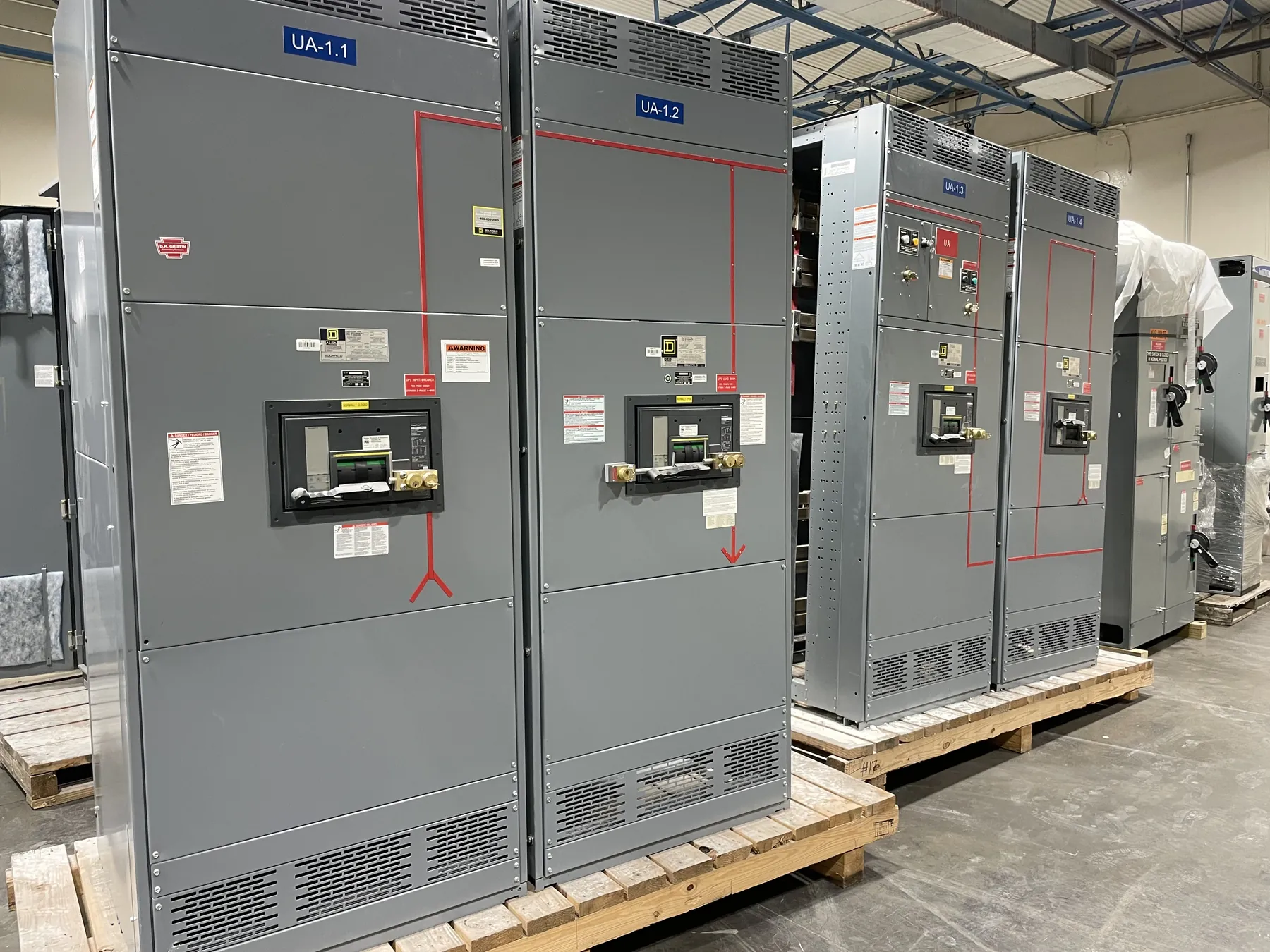
High-Voltage Switchgear for Hawthorne, Nevada, Substation Projects
High-voltage switchgear is part of a coordinated power system, not a stand-alone selection based solely on a voltage label. For a Hawthorne project, the right arrangement depends on how power reaches the site, what equipment the switchgear must connect or protect, and the requirements of the serving utility and project engineer. Our U.S. manufacturing business builds new custom power-distribution equipment and ships nationwide. The specific high-voltage construction available for a project must be confirmed during technical review; a request for “high-voltage switchgear” alone does not establish a suitable design or product scope.
Early planning should identify whether the equipment serves a substation, an industrial facility, a campus, or another installation, along with the intended operating role and system configuration. The project team should also clarify which components are included in the requested scope and which are supplied by others. Those boundaries affect mechanical interfaces, protection functions, control wiring, installation planning, and the information needed for a meaningful quotation.
Voltage Classification, Insulation, and Equipment Ratings
System voltage and equipment ratings are related but distinct. Engineers must establish the nominal system voltage and the applicable maximum equipment voltage, then determine insulation requirements for the system conditions and installation. The specification may address insulation coordination, power-frequency withstand, impulse withstand, clearances, and environmental factors, as applicable to the proposed construction. These values cannot be inferred safely from a city name or a general product description.
Confirm the equipment’s intended service conditions, including indoor or outdoor placement, altitude, ambient conditions, contamination exposure, and other site-specific influences. In Nevada, the project team should provide actual installation conditions rather than assume a standard environment. The manufacturer and qualified design professionals can then review whether the proposed construction and insulation approach are appropriate. Available designs and ratings must be verified for the particular request.
Source Arrangement, Fault Duty, and Protection Interfaces
The source arrangement shapes the switchgear configuration. A project may involve one incoming source, multiple sources, transformer connections, bus sections, or provisions for future expansion. Drawings should show the intended one-line arrangement, normal and alternate operating states, and the equipment interfaces on each side of the switchgear. These details help identify required switching functions, interlocking concepts, metering points, and control connections without presuming a particular scheme.
Fault duty is a critical design input. The available fault current and its duration depend on the electrical system, source characteristics, transformers, conductors, and operating configuration. Qualified engineers must establish the applicable duty and confirm that equipment ratings and protective devices are suitable for the actual conditions. Protection coordination should consider upstream and downstream devices, relay functions, instrument transformer requirements, and the owner’s operating philosophy. A switchgear quotation should not substitute for a short-circuit study or protection engineering.
Utility Interconnection and Applicable Standards — High-Voltage Switchgear in Hawthorne, NV
Utility interconnection requirements can affect the connection point, metering, relaying, isolation, control, and documentation. The serving utility and project engineer should identify applicable interconnection criteria and review the proposed interface before equipment details are finalized. Utility acceptance, approval, or authorization cannot be assumed from a product description; those decisions belong to the relevant utility and project authorities.
IEEE or IEC requirements may apply depending on the equipment type, project specification, jurisdiction, and owner or utility criteria. The specification should identify the governing editions and the exact standards applicable to the requested construction. UL 891 applies to certain low-voltage switchboards; it should not be treated as a general listing standard for high-voltage switchgear. Ratings, listings, and standards compliance are product- and configuration-specific and require confirmation. The project team should state required documentation and any inspection or testing expectations for review.
Hawthorne Site Conditions and Delivery Planning
For a Hawthorne installation, delivery planning should reflect the actual destination, receiving arrangements, site access, unloading resources, and construction sequence. Road access, laydown space, building openings, lifting constraints, and the route from delivery point to the final location can influence shipping sections and installation interfaces. These are project logistics to verify with the site team, not assumptions about a particular Hawthorne facility. The manufacturer ships nationwide; shipping timing and arrangements depend on confirmed scope and project requirements.
Site review should also address the intended equipment location and its surroundings. Outdoor exposure, available working space, foundations or supports, cable or bus connections, grounding interfaces, and control-power provisions may affect the design and installation plan. Qualified professionals familiar with the site should evaluate access and electrical conditions. No equipment choice can resolve site-specific design questions without that review.
Information for a High-Voltage Switchgear Quotation — High-Voltage Switchgear in Hawthorne, NV
A useful inquiry includes the one-line diagram, system voltage, source arrangement, known fault-duty information, protection and metering requirements, and the requested construction scope. Include applicable IEEE or IEC references, utility interconnection documents, environmental and installation conditions, required interfaces, project schedule, and delivery destination when available. Identify open engineering items rather than filling gaps with assumed ratings. This allows the team to clarify feasibility, confirm the exact available construction, and identify the decisions that must be resolved before a final configuration can be established.