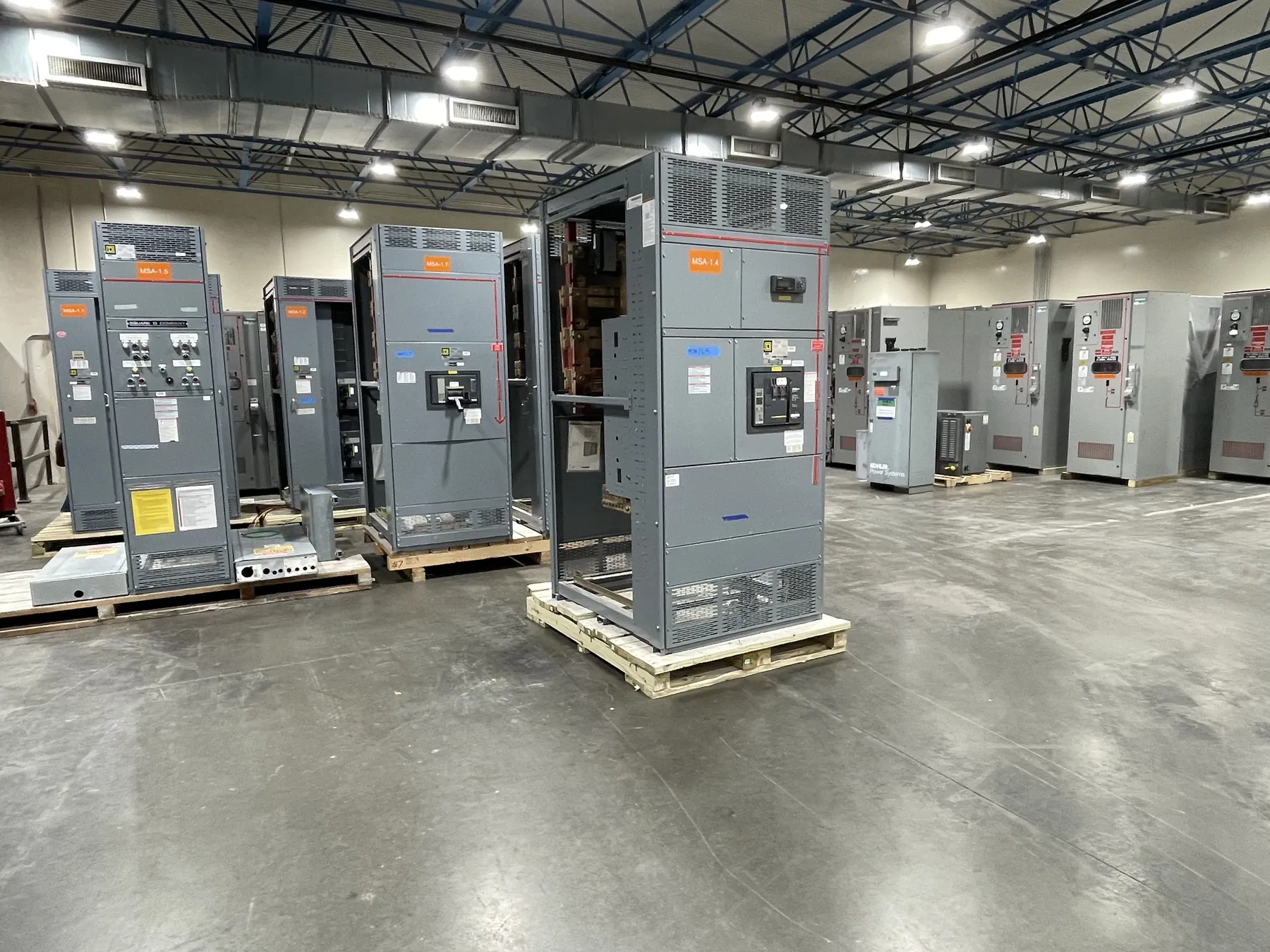
Metal-Clad Switchgear for Gardnerville Projects
Metal-clad switchgear can serve medium-voltage distribution needs at facilities in and around Gardnerville, but the right configuration depends on the electrical system and the conditions at the installation site. A project team should begin with the one-line diagram, system voltage, available fault information, load requirements, and the intended point of connection. The equipment’s voltage class and ratings must be selected for that system; a rating is not a substitute for confirming compatibility with the site’s actual operating conditions.
Gardnerville’s location makes elevation an important item to include in the engineering review. The project team should provide the installation elevation so qualified engineers can determine whether it affects equipment application or requires adjustments to the specified ratings. Indoor or outdoor placement, ambient conditions, exposure to dust or moisture, and the available footprint also influence enclosure and equipment choices. A product description alone cannot establish suitability for a particular site.
Compartments and Internal Separation
Metal-clad construction organizes major components into separate grounded compartments, commonly including spaces for the bus, circuit breakers, and cable terminations, with control components arranged as part of the assembly. This compartmentalization helps define where components are located and how the lineup is configured. The arrangement should be reviewed against the project’s maintenance approach, cable entry direction, room layout, and required access clearances.
Compartment boundaries and barriers are not interchangeable with a complete site safety plan, nor do they eliminate the need for qualified engineering review. The specification should identify the intended lineup arrangement, bus configuration, incoming and outgoing feeder requirements, and any metering or control provisions. Cable type, termination details, and routing constraints should be confirmed early, since they can affect compartment dimensions and the placement of equipment within the lineup.
Withdrawable Breakers and Feeder Configuration
Many metal-clad switchgear designs use withdrawable circuit breakers. The breaker can be positioned in defined states within its compartment, allowing the equipment design to support inspection or maintenance practices established by the facility. The project specification should state the breaker functions, continuous-current and interrupting requirements, control voltage, and the number and purpose of feeder positions. These details need to align with the one-line diagram and the protection study rather than being selected in isolation.
Incoming sources, bus ties, transformers, motors, and outgoing feeders can call for different breaker and control arrangements. Where the design includes multiple sources or a tie breaker, the operating philosophy and required interlocks should be documented for engineering review. The lineup must also fit the room’s access and cable-routing constraints. A withdrawable mechanism does not, by itself, determine an appropriate maintenance procedure; facility procedures and qualified personnel govern work on the installed equipment.
Grounding, Protection, and Relay Coordination — Metal-Clad Switchgear in Gardnerville, NV
Grounding provisions must match the system design, including the grounding method, source configuration, and expected ground-fault protection approach. The project team should identify how the switchgear connects to the facility grounding system and provide relevant transformer and source information. Grounding details affect protection choices and should be resolved with the project engineer, not inferred from the equipment name or nominal system voltage.
Relay coordination requires a complete view of protective devices across the connected system. Relevant inputs may include source data, transformer characteristics, feeder loads, conductor information, and upstream and downstream device settings. Qualified engineers use this information to assess selectivity and protection behavior for the project. Relay functions, instrument-transformer requirements, control wiring, and communications interfaces should be specified in coordination with that study. No coordination outcome can be established from a switchgear quotation alone.
Applying IEEE C37.20.2 to the Specification
IEEE C37.20.2 addresses metal-clad switchgear assemblies within its scope. The project specification should identify the intended standard and edition and ask the manufacturer and project engineer to confirm that the proposed equipment configuration and ratings fall within the standard’s applicable requirements. The reference should not be treated as a blanket statement that every switchgear product, system voltage, or installation condition is covered.
For a Gardnerville installation, review the standard’s applicability alongside site elevation, indoor or outdoor placement, and environmental specifications. Confirm the requested voltage class, continuous-current and short-circuit ratings, enclosure requirements, and any project-specific interface or control provisions. Ratings, listings, and compliance details require confirmation for the actual design; they should not be assumed from a general product description.
Information for a Gardnerville Project Quotation
A useful quotation package includes the one-line diagram, equipment schedule, system and source data, preliminary protection requirements, site elevation, installation environment, and room or pad layout. Include cable entry and termination preferences, lineup orientation, feeder count, control power, metering needs, and the required documentation. If the project has defined access or environmental constraints, identify them before equipment configuration is finalized.
We manufacture new custom power-distribution equipment in the United States using all-American components and ship nationwide, including to Nevada. Lead time depends on the finalized design, component selection, and project requirements; it should be confirmed during quotation and order review. Early coordination among the owner, electrical engineer, installer, and manufacturer helps resolve interface questions and keeps the proposed metal-clad switchgear aligned with the Gardnerville site and the project’s documented requirements.