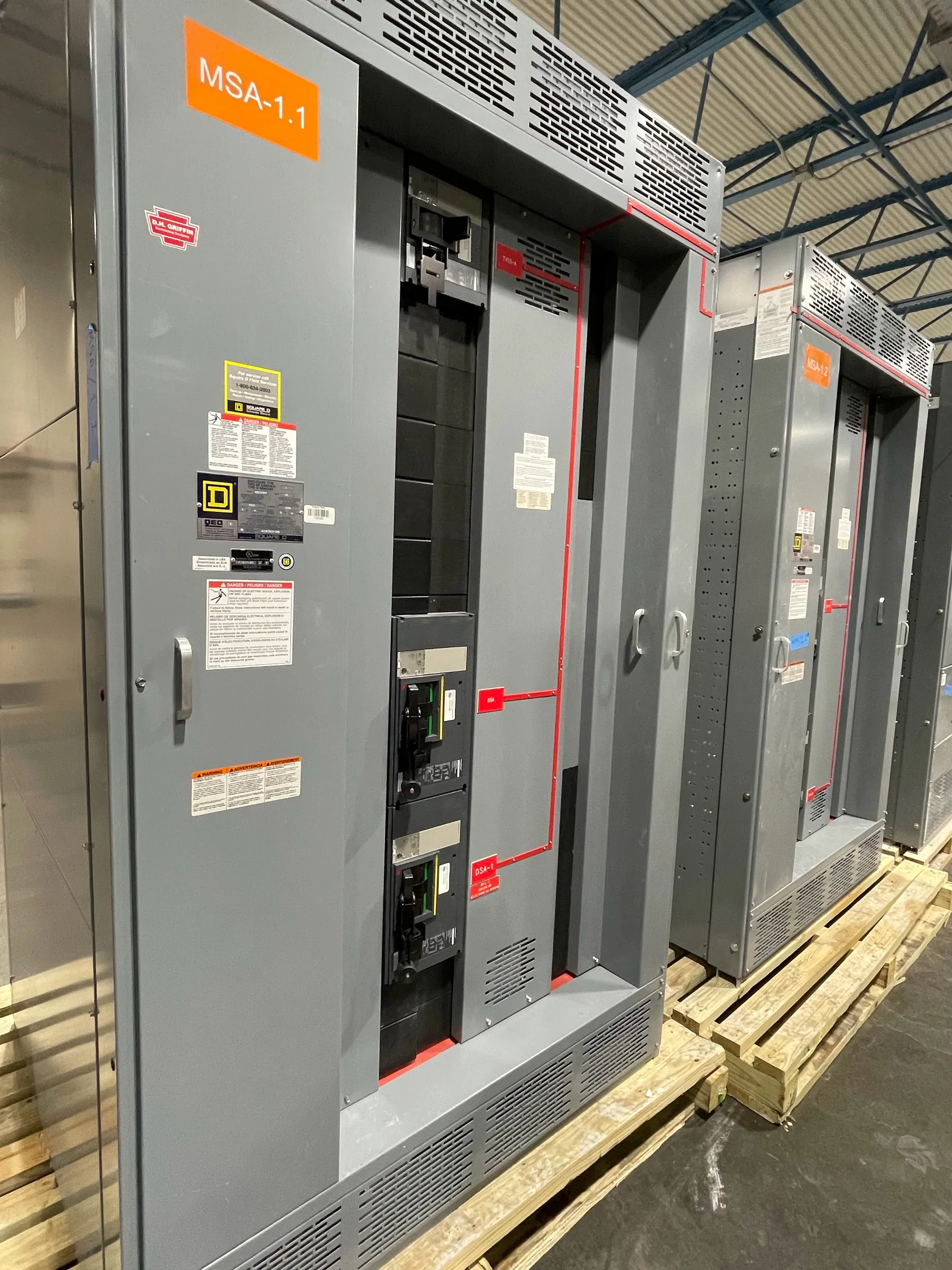
High-Voltage Substation Switchgear for Fernley Projects
High-voltage switchgear for a Fernley project must be selected around the role it serves in the substation and the conditions of the connected power system. A main incoming position, transformer connection, bus section, and outgoing feeder can each call for different switching, interruption, isolation, and protection functions. The equipment arrangement also affects how the substation can be operated and maintained. Begin with the single-line diagram, utility interface information, and intended operating scheme rather than choosing a product from a voltage label alone.
We manufacture new custom power-distribution equipment in the United States using all-American components, with nationwide shipping that can serve projects in Nevada. The exact high-voltage construction available must be confirmed for the project. High-voltage equipment is not interchangeable with low-voltage switchboards, and UL 891 applies to applicable low-voltage switchboards—not to high-voltage switchgear. Product scope, applicable standards, and any required listing or certification should be established during engineering review.
Confirm Voltage Classification and Insulation Requirements — High-Voltage Switchgear in Fernley, NV
Project documents may refer to nominal system voltage, maximum system voltage, equipment voltage class, or insulation level. These terms describe related but distinct requirements. The system’s operating voltage does not, by itself, establish the correct equipment rating or insulation coordination. The engineer needs to evaluate the service conditions, grounding arrangement, switching duties, expected overvoltages, and the utility’s requirements before defining an acceptable equipment class.
Insulation coordination may involve power-frequency withstand, impulse withstand, clearances, and the characteristics of connected surge-protection devices. The relevant values and tests depend on the equipment type and the governing specification; they should not be assumed from a generic catalog description. For a Fernley installation, the project team should also document site elevation, indoor or outdoor placement, ambient and environmental conditions, and exposure to dust or moisture. Those details can affect construction and insulation choices, but their design implications require qualified engineering review.
Choose a Configuration Around Feeder Duties
Switchgear configuration should reflect the electrical one-line and the consequences of losing a source, transformer, or feeder. A project may need a defined bus arrangement, incoming and outgoing positions, sectionalizing, metering, grounding provisions, or a spare feeder position for future expansion. A spare position is not automatically a complete future-ready circuit: its required bus capacity, protection provisions, cable interface, physical space, and control wiring should be identified in the design.
Equipment construction also depends on the specified switching and interruption technology, enclosure arrangement, access requirements, and connection method. Indoor and outdoor installations can impose different requirements for weather protection, access, footprint, and maintenance. The available construction must be confirmed against the required voltage class, duty, and applicable standard. Avoid treating ratings as a substitute for a complete design: short-circuit duty, continuous current, insulation level, and switching capability address different aspects of performance.
Coordinate Protection and the Utility Interconnection
Protection settings and devices need to coordinate with the source, transformers, downstream equipment, and utility protection scheme. Project engineering may consider overcurrent, differential, ground-fault, bus, or other protection functions as appropriate to the system. The actual scheme depends on fault studies, grounding, transformer characteristics, operating modes, and utility requirements. Relay functions or settings should not be selected solely from a general product description.
Interconnection information is a key quotation and design input. Confirm the point of connection, ownership boundaries, metering requirements, utility-specified protection, communications or control interfaces, and any required review or approval process. Utility acceptance is determined by the utility and project documentation; it should not be presumed from the equipment description. The engineer of record and utility should resolve interface requirements before a final configuration is established.
Apply the Right IEEE or IEC Requirements — High-Voltage Switchgear in Fernley, NV
Specifications should identify the standards that apply to the particular equipment and project, including the relevant IEEE or IEC requirements where specified. Standards can address different equipment categories, ratings, construction, and test methods, so citing a standards family alone may not define the complete obligation. The project team should confirm the applicable editions, exceptions, performance criteria, and documentation requirements with the engineer and utility.
Likewise, a requested rating or standard reference does not establish that a proposed assembly is listed, certified, or suitable for every duty. Any required listing, certification, or type-test evidence must be confirmed for the exact construction being quoted. Where requirements conflict or leave ambiguity, resolve them in the project specification before release for manufacture.
Prepare Fernley Project Details for Quotation
A useful request for quotation includes the one-line diagram, equipment schedule, system and equipment voltage requirements, insulation levels, fault-duty information, bus arrangement, feeder count, and protection and control scope. Include the utility’s interconnection criteria, metering and communication interfaces, indoor or outdoor location, site conditions, cable or bus connections, and requested spare feeder provisions. Identify applicable IEEE or IEC clauses and the required submittal and inspection documents.
For a Fernley site, confirm delivery access, unloading arrangements, installation location, and any site-specific constraints that affect equipment dimensions or shipment planning. These logistics should be reviewed with the project team; they do not establish a local manufacturing presence or guarantee a delivery date. Clear technical inputs help determine the appropriate construction, engineering scope, and schedule. Final ratings, standards, interfaces, and suitability remain subject to qualified engineering review and confirmation against the actual site and utility requirements.