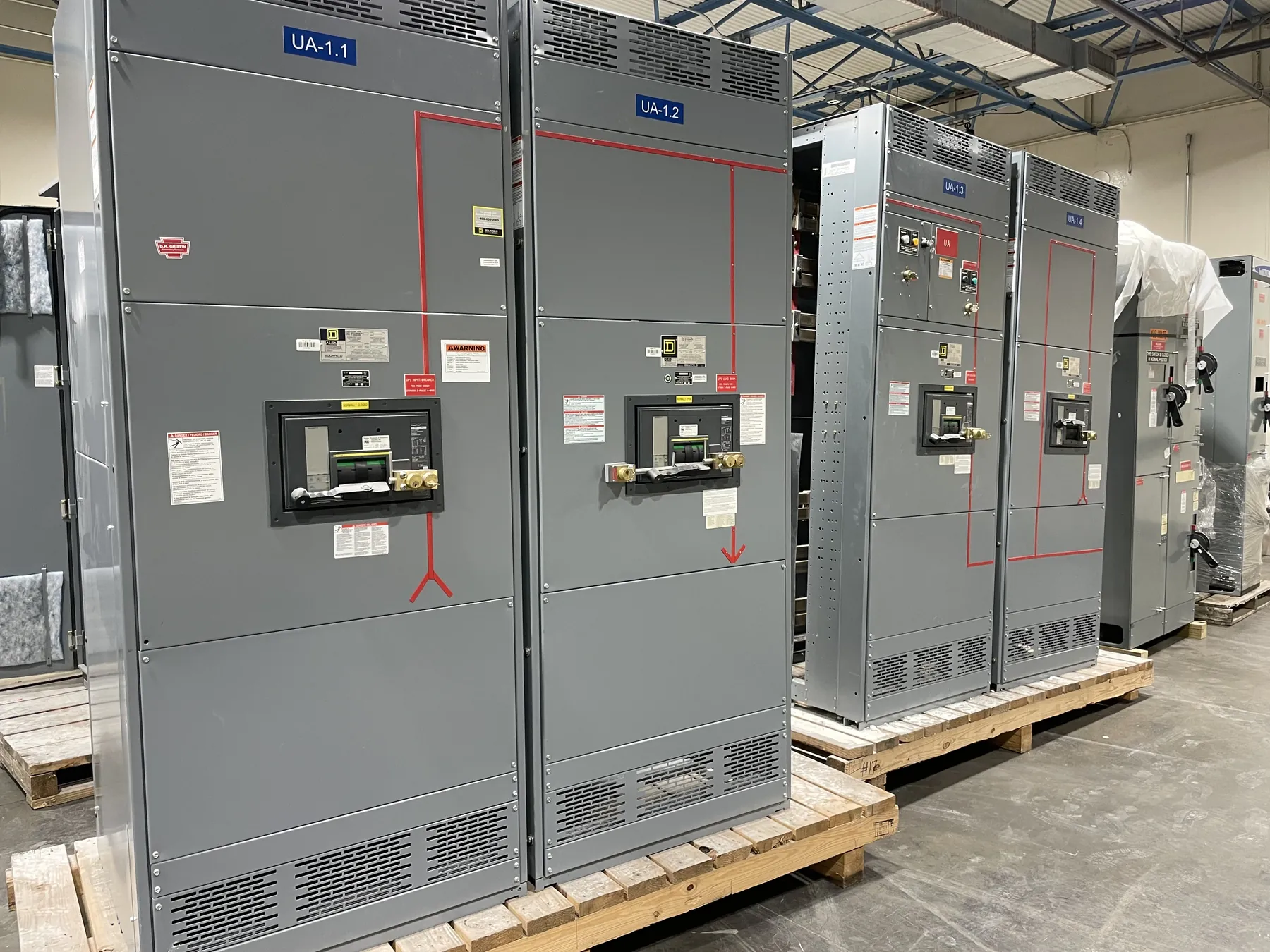
Airport Electrical Distribution for Fernley Facilities
Airport power distribution has to serve more than the most visible loads. A project in Fernley may involve terminal or administrative spaces, airfield lighting, communications, security, maintenance areas, fueling-related facilities, or other site-specific systems. Each airport has its own operating priorities and electrical layout, so equipment selection begins with a clear picture of which loads must remain available, which can tolerate interruption, and how those loads are supplied. We manufacture new custom switchgear and power-distribution equipment for projects; the final arrangement depends on the facility’s engineering documents and requirements.
For a Fernley project, identify the installation location early. Indoor electrical rooms, exterior enclosures, and constrained retrofit spaces can impose different requirements for dimensions, access, environmental exposure, cable entry, and equipment handling. Nevada conditions and the actual site environment should be considered by the project team rather than assumed from the city name alone. Drawings, room details, and access constraints help determine whether a proposed assembly can be installed and maintained within the available space.
Separate Critical Airport Loads by Operational Need
A useful design discussion distinguishes essential operational loads from loads that may be shed or restored later. For example, airfield lighting and certain communications or control systems may have different continuity requirements from general building loads, but the airport’s qualified engineers must establish those priorities. Grouping loads without checking their function can complicate emergency-source planning and create an arrangement that does not match actual operating procedures.
Load schedules should identify connected equipment, expected demand, starting characteristics where relevant, and the preferred source or distribution path. Confirm whether separate areas need dedicated feeders, whether loads are expected to operate simultaneously, and how future expansion is anticipated. The goal is not simply to fit more circuits into an assembly; it is to support a documented distribution plan that accounts for operational importance and the limits of available sources.
Coordinate Emergency-Source Interfaces Carefully
Where a project includes an emergency generator or another alternate source, the switchgear arrangement must coordinate with that source and the transfer equipment. The source’s electrical characteristics, available capacity, protection scheme, grounding approach, and intended sequence of operation all affect the interface. An emergency source is not a substitute for verifying which loads it can support or how the system responds when normal power is unavailable.
Provide the design team’s one-line diagram and transfer-system details with the equipment inquiry. Clarify whether the new assembly is intended to include source and feeder sections, connect to separate transfer equipment, or serve downstream distribution. Those distinctions affect section layout, bus arrangement, control interfaces, and the space required for incoming and outgoing conductors. Final selections require review by qualified electrical professionals familiar with the airport’s system and applicable project requirements.
Plan Phased Outages Around Airport Operations — Airport Switchgear in Fernley, NV
Airport work may need to proceed in stages so that affected areas can be isolated and returned to service in a planned sequence. The project team should identify allowable outage windows, temporary distribution needs, circuits that cannot be interrupted together, and dependencies between electrical work and other trades. These constraints can influence feeder grouping, connection points, equipment placement, and the amount of work that can be completed during a given phase.
Existing conditions matter as much as the proposed design. Field-verified circuit identification, cable routes, available clearances, and the condition of interfaces should be compared with drawings before fabrication details are finalized. Where a retrofit must connect to existing distribution, confirm dimensions, conductor information, termination requirements, and the planned boundary between new and existing equipment. A staged plan should be developed and approved by the project’s qualified team; equipment details alone cannot establish a safe outage or switching plan.
Address Spare Feeders and Future Changes
Spare feeder provisions can preserve flexibility for later airport changes, but the right amount and arrangement depend on a credible expansion plan. Discuss which future areas or systems may need service, whether reserved positions should be equipped or left as space, and what electrical characteristics those feeders may require. Spare capacity in a physical layout does not by itself establish that the source, bus, or upstream distribution can support additional load.
For quotation, provide current and proposed load schedules, feeder requirements, one-line diagrams, source information, room or enclosure dimensions, cable-entry preferences, and any required interface details. Include the desired spare positions and clearly distinguish confirmed requirements from possible future needs. Ratings, product scope, listings, and project-specific details must be reviewed and confirmed; voltage and current ratings are separate specifications, and a rating should not be inferred from the system description.
Manufactured Equipment and Fernley Project Logistics
Our new custom assemblies use all-American components, are built in the United States, and can be shipped nationwide, including to Fernley. Lead time depends on the approved scope, component selection, engineering coordination, and project schedule; confirm timing during quotation rather than relying on a general estimate. For delivery planning, account for the receiving location, unloading arrangements, route and door clearances, staging space, and any airport access controls or work-hour restrictions established by the facility.
Early coordination among the airport owner, electrical engineer, contractor, and equipment manufacturer can resolve interface questions before they affect installation planning. Share the project’s operating priorities, outage constraints, source arrangements, and site conditions at the outset. That information supports a more relevant equipment proposal while leaving electrical design decisions and final system acceptance with the qualified professionals responsible for the project.