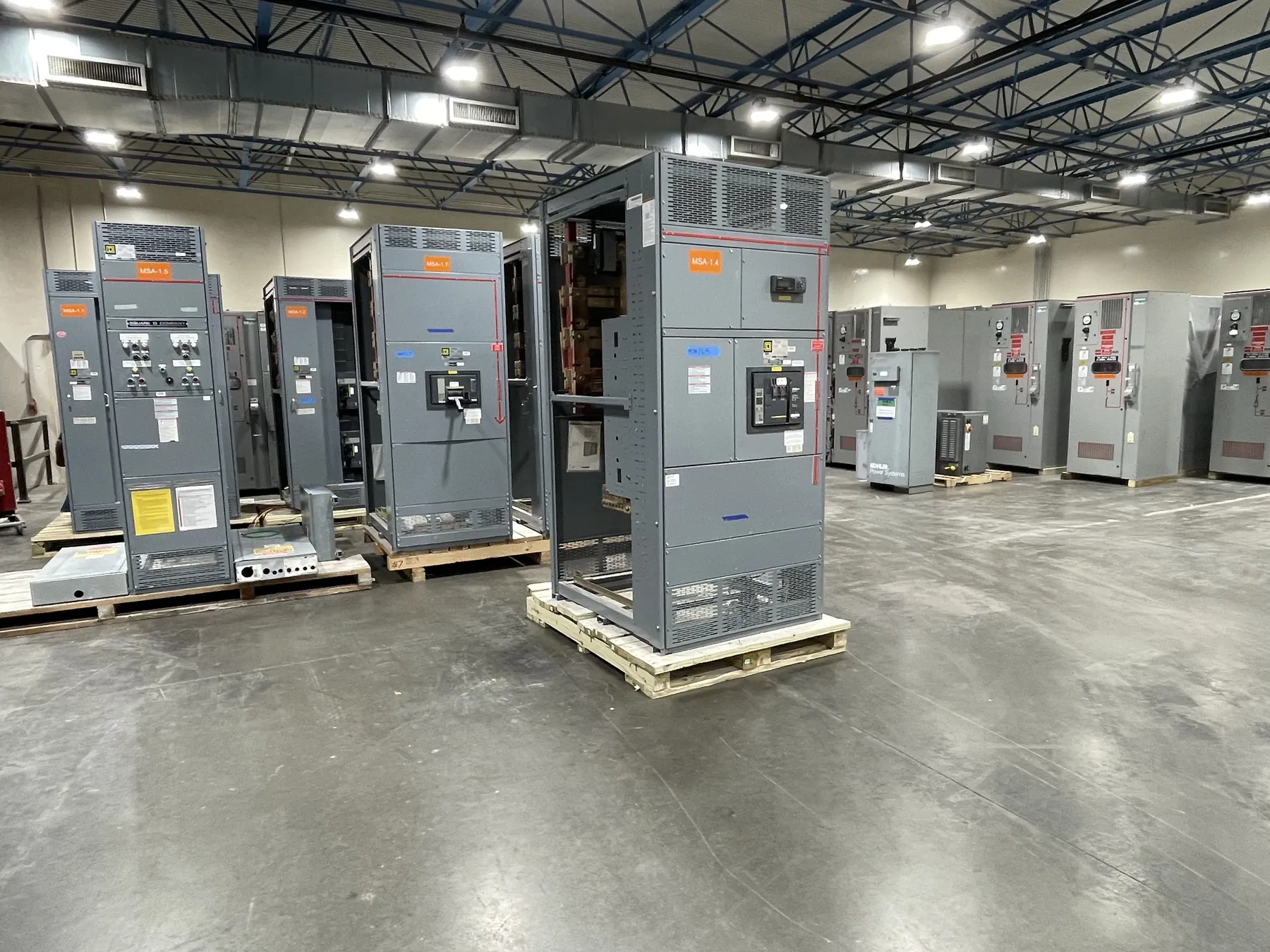
Switchboard Definition for Power-Distribution Professionals
A switchboard is an assembly of electrical buses, protective devices, switching devices, and related components arranged to distribute power to downstream circuits. It provides a point where incoming power can be divided among feeders or other loads, with devices selected to interrupt or control circuits as the design requires. A switchboard is not simply a cabinet or a collection of breakers: its electrical ratings, internal arrangement, connections, and intended use all matter.
In a typical distribution system, power reaches the switchboard from a transformer, service source, generator, or another upstream assembly. The switchboard’s bus structure carries current to outgoing protective devices, which connect to feeders supplying panels, equipment, or other portions of a facility. The exact configuration depends on the system and project. A qualified electrical engineer must determine whether a proposed assembly is suitable for the source, loads, installation, and applicable requirements.
How a Switchboard Differs from Related Equipment
The terms switchboard, switchgear, and panelboard are sometimes used loosely, but they do not describe interchangeable products in every application. A panelboard is generally a more compact distribution assembly intended for branch circuits or smaller feeder arrangements. A switchboard commonly serves as a larger distribution point with a bus and multiple incoming or outgoing devices. Switchgear describes equipment built for particular switching and protection functions; its construction and applicable standards vary with the type and voltage class.
These distinctions are useful when discussing a project, but terminology alone does not establish suitability. The equipment name, voltage class, construction, ratings, and governing requirements need to be confirmed for the actual application. In particular, a low-voltage switchboard standard should not be assumed to apply to medium- or high-voltage switchgear, busway, or every assembly described informally as “switchgear.”
Ratings, Construction, and the System They Serve
Switchboard selection involves more than matching a number on a drawing. Relevant characteristics can include system voltage, continuous current, short-circuit rating, service or feeder function, number and type of devices, bus arrangement, enclosure, and available connection space. A rating describes a limit or capability of the equipment under specified conditions; it is not, by itself, the voltage of the electrical system. The equipment ratings must be appropriate for the system and its calculated conditions.
Physical and interface decisions also affect the design. Engineers may need to coordinate incoming conductors, cable access, conduit entry, device mounting, working clearances, adjacent equipment, and the route to downstream loads. Indoor or outdoor placement, environmental exposure, room dimensions, and access for installation can constrain enclosure and layout choices. A design that fits an electrical single-line diagram may still need adjustment to suit the building and installation conditions.
UL 891 and Applicable Low-Voltage Switchboard Standards
UL 891 is a standard associated with applicable low-voltage switchboards. Whether it is relevant depends on the product and its intended application; the reference should not be extended to every type of switchgear or to equipment outside its scope. A mention of UL 891 does not establish that a particular assembly is listed, nor does a standard reference alone confirm that a proposed configuration meets a project’s requirements.
When a specification calls for a particular listing or standard, the manufacturer and project team need to confirm that the requested equipment, options, ratings, and construction fall within the applicable scope. Listing status and other project-specific details require confirmation for the actual assembly. The engineer of record and other qualified professionals should review the design against applicable electrical codes, site conditions, and project documents.
Coordination, Protection, and Operational Context
Protective devices in a switchboard must be considered as part of the broader electrical system. Their selection and settings can affect overload and fault protection, coordination with upstream and downstream devices, and continuity of service. A device that appears suitable in isolation may not provide the intended system behavior when paired with other equipment. Coordination studies, fault-current information, and design review may therefore inform equipment selection and configuration.
Operational constraints matter too. The switchboard’s location, access, connected loads, expansion plans, and relationship to other distribution equipment can affect the arrangement. Work involving electrical equipment requires qualified personnel and site-specific controls; a general definition or product description is not a substitute for engineering review or the facility’s safety program. No operational procedure should be inferred from the equipment name alone.
Information Needed to Specify or Quote a Switchboard
For a useful technical discussion or quotation, provide the project’s single-line diagram and specification when available, along with system voltage, source information, required equipment ratings, and the intended service or feeder arrangement. Include device quantities and types, bus requirements, enclosure and location conditions, cable-entry preferences, space limitations, and any specified listing or standard. Note unusual loads, planned future capacity, and interfaces with transformers, generators, or downstream assemblies.
These inputs allow a manufacturer to identify design questions and develop a configuration for engineering review. Missing or conflicting information may affect layout, component selection, ratings, and compliance with the project specification. Final suitability cannot be determined from the word “switchboard” alone; it depends on the complete application and confirmation by qualified professionals.