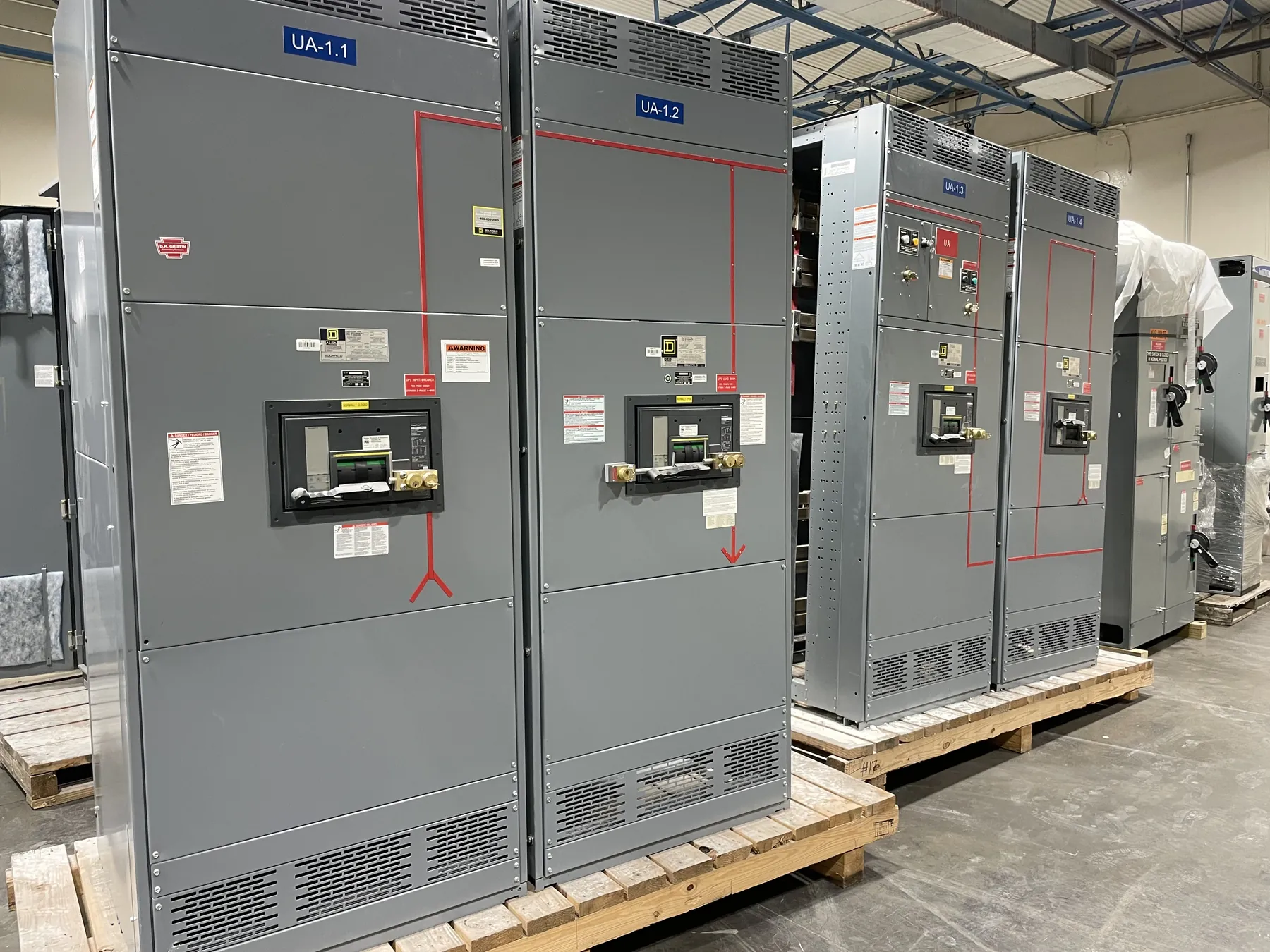
Casino Switchgear Planning for Sparks, Nevada
Casino electrical distribution has to support more than gaming areas. A property may include hotels, restaurants, kitchens, event spaces, back-of-house operations, security and building systems, each with distinct operating priorities. For a Sparks project, the distribution plan should identify which loads are critical, which are life-safety loads, and which are general loads before equipment is specified. That classification helps engineers develop a suitable one-line diagram, define panel and feeder boundaries, and determine how emergency power interfaces with normal distribution.
Our U.S.-manufactured custom switchgear and power-distribution assemblies are built with all-American components and can ship nationwide, including to Nevada. Equipment configuration depends on the project documents, electrical design and site conditions; the city or building type alone does not establish a suitable rating or equipment arrangement.
Separate Load Priorities Before Selecting Equipment
Critical operational loads and life-safety loads are not interchangeable categories. The project’s electrical and life-safety professionals should identify applicable loads, required sources, transfer arrangements and operating sequences. General loads may include areas or systems that can be shed or restored according to the facility’s plan. Those decisions affect how distribution sections are grouped, what source connections are needed and how operators distinguish equipment serving different functions.
For casino properties, coordination may involve gaming-floor systems, guest services, food service, ventilation, elevators, communications, security and support spaces. Their importance and required power continuity must be established by the project team rather than assumed from the equipment name. Clear load schedules and consistent circuit identification help reduce ambiguity during design, construction and future modifications.
Coordinate Emergency Power and Transfer Interfaces — Casino Switchgear in Sparks, NV
Emergency generators, transfer equipment and switchgear must be treated as connected parts of a system. The design team should document source capacity, transfer scheme, interlocks, control interfaces, available operating modes and the loads assigned to each source. Where emergency power is limited, the sequence for carrying, shedding and restoring loads should be reviewed across the system, not decided from a switchgear quotation alone.
For an operating casino, emergency-power work may need to account for occupied areas, ongoing operations and access restrictions. Phased construction can require temporary distribution or carefully scheduled cutovers, subject to the facility’s approved plan and qualified engineering review. Identify required tie points, outage windows, temporary connections and sequencing assumptions early; changes to those interfaces can affect equipment layout and project scope.
Use Sparks Fault-Current and Protection Information
A Sparks project should obtain the available fault current at the connection point from the responsible electrical source or qualified project team. That information is essential to evaluating equipment ratings and coordinating protective devices. It should be paired with the system voltage, grounding arrangement, source configuration, conductor information and relevant one-line diagrams. Do not treat a product’s ampere rating as its voltage or interrupting capability: each rating describes a different design requirement and must be confirmed for the application.
Protective-device coordination should consider upstream devices, downstream loads, generator contribution where applicable, and the intended operating modes. Engineers must assess selectivity and fault-clearing requirements against the actual system and project criteria. Equipment selection cannot establish those decisions without a qualified engineering review and site-specific information.
Account for Phased Maintenance and Facility Constraints
Casino facilities may have limited opportunities to interrupt service, particularly where multiple departments share electrical infrastructure. During planning, clarify which equipment must remain in service during each phase, what sections can be isolated under the approved work plan, and whether temporary distribution is contemplated. Switchgear section arrangement, cable access, working clearances and connection locations should be coordinated with room dimensions, existing equipment and the construction sequence.
For Nevada delivery, confirm the receiving location, access route, unloading responsibilities, staging space and installation schedule with the project team. Sparks weather, site access and building conditions can influence logistics, but they do not establish a delivery date or equipment suitability. Shipping arrangements and timing should be confirmed against the actual order and site requirements.
Prepare Complete Quotation and Design Inputs
A useful quotation package typically includes the one-line diagram, equipment schedule, system voltage, continuous current requirements, fault-current information, required ratings, enclosure and room conditions, incoming and outgoing cable details, metering needs, control requirements, and emergency-power interfaces. Include applicable project specifications and identify any phased installation constraints or required future provisions.
We manufacture new custom switchgear and power-distribution equipment to project requirements. UL 891 applies to applicable low-voltage switchboards; it should not be read as covering every switchgear assembly or voltage class. Any requested listing, standard, rating or configuration must be confirmed for the specific equipment and design. Complete, coordinated inputs allow the project team and manufacturer to resolve scope and interfaces before fabrication without assuming that a standard arrangement fits every casino facility.