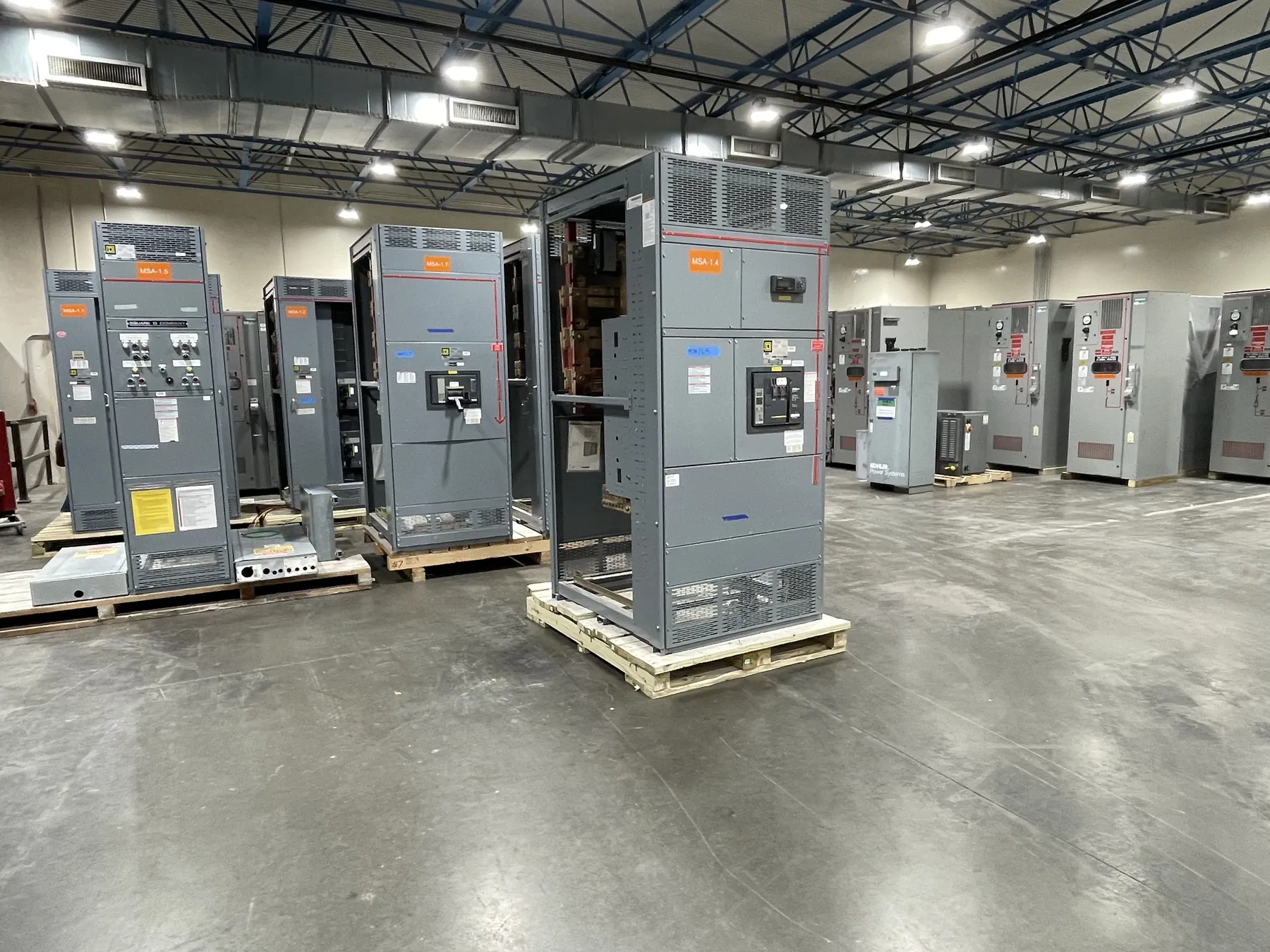
Industrial Switchgear for North Las Vegas Facilities
Industrial electrical distribution in North Las Vegas must be designed around the facility’s actual loads, operating patterns and site layout—not just a nominal voltage or a desired lineup footprint. A custom switchboard or switchgear assembly can bring incoming power to distribution sections that serve motors, drives, process equipment and building loads. The appropriate arrangement depends on the electrical system, the project’s operating needs and the equipment specified by qualified project engineers.
For industrial projects, early design work should account for motor starting, variable-frequency drives (VFDs), load duty, available fault current and protective coordination. These factors influence equipment ratings, protective devices, section arrangements and interfaces with downstream equipment. A rating is not the same as system voltage, and neither can be selected reliably from a general description of the facility. The project team should confirm electrical data, applicable requirements and design decisions before equipment is finalized.
Motor Starting, VFDs and Load Duty
Motors can impose operating demands that differ from steady-state loads. Starting method, motor characteristics, frequency of starts and the equipment served all matter. VFDs may change how motors start and operate, but their presence also requires attention to the drive manufacturer’s requirements, upstream protection, installation arrangement and effects on the distribution system. A switchgear specification should identify which loads are motor-fed, which use drives, and whether any loads have distinct operating or cycling patterns.
Load duty is equally important. A process line that runs continuously presents a different design context from equipment that operates intermittently or in staged sequences. Engineers need a load schedule that distinguishes essential, nonessential, standby or future loads where those categories apply. That information helps the design team evaluate the distribution arrangement and protective devices without assuming that all loads operate at once—or that they never do.
Fault Current, Ratings and Protective Coordination — Industrial Switchgear in North Las Vegas, NV
Available fault current at the equipment location is a key input to equipment selection. It must be determined from the project’s electrical system and reviewed alongside the intended protective devices and their ratings. The equipment rating, system voltage and protective-device interrupting capability are related design considerations, but they are not interchangeable values. Source information, transformer data and upstream protection can affect the analysis, so a switchgear quotation should not rely on an unverified fault-current estimate.
Protective coordination requires review of the complete path from the source through the distribution equipment to downstream circuits. The aim is to select and arrange protective devices in accordance with the project’s engineering requirements, available data and applicable criteria. Coordination decisions can affect device selection, section layout and how loads are grouped. Final settings and design suitability require qualified engineering review; they cannot be established from a generic product description.
Lay Out Cable Routes and Working Clearances Early
Before fixing lineup dimensions for a North Las Vegas project, map the incoming and outgoing cable routes. Identify where conductors enter and leave the assembly, the direction and space needed for routing, and any constraints created by structural elements, existing equipment or the planned electrical room. Cable routing can influence section configuration and termination space, so it is better to resolve these conditions before the physical arrangement is treated as final.
Working clearances and access around the equipment also need site-specific review. Consider how personnel will reach the intended operating and maintenance areas, how doors or covers interact with nearby walls and equipment, and whether the room’s planned layout leaves practical access. Delivery access matters as well: confirm the route from the receiving point to the installation area, including door openings, turns, floor transitions and staging limitations. These details can affect how an assembly is configured for shipment and handled at the facility.
Information That Supports a Useful Quotation — Industrial Switchgear in North Las Vegas, NV
A well-developed request gives the manufacturer and project team enough information to discuss the proposed equipment without making unsupported assumptions. Useful inputs include the one-line diagram, system voltage, source and transformer data, available fault-current information, load schedule, motor and VFD details, protective-device preferences or project criteria, and the applicable project specifications. Provide known requirements for incoming and outgoing connections, cable entry, enclosure and room conditions, and any planned expansion or operational separation.
For North Las Vegas facilities, include site drawings or measurements that show cable approaches, working clearances, delivery access and the intended equipment location. If any information is preliminary, label it as such. The design team can identify what still needs confirmation before dimensions, ratings, devices and interfaces are finalized. Applicable listings and standards must also be confirmed for the specific equipment and project; UL 891 applies to applicable low-voltage switchboards and should not be treated as a blanket designation for every switchgear assembly.
Custom Manufacturing and Project Review — Industrial Switchgear in North Las Vegas, NV
Custom equipment is built around the approved project requirements, with configuration and interfaces developed from the information provided. Our assemblies use all-American components and are built in the USA. Short lead times may be supported, and equipment ships nationwide, including to Nevada; actual timing depends on the scope, approved design, component requirements and production schedule.
Before release, the project team should reconcile electrical data, protective coordination requirements, connection details and site dimensions. Any changes to loads, source information or room layout can affect the design and should be reviewed rather than assumed to fit the original arrangement. This collaborative review helps align industrial distribution equipment with the facility’s process needs and the physical conditions at the North Las Vegas site.