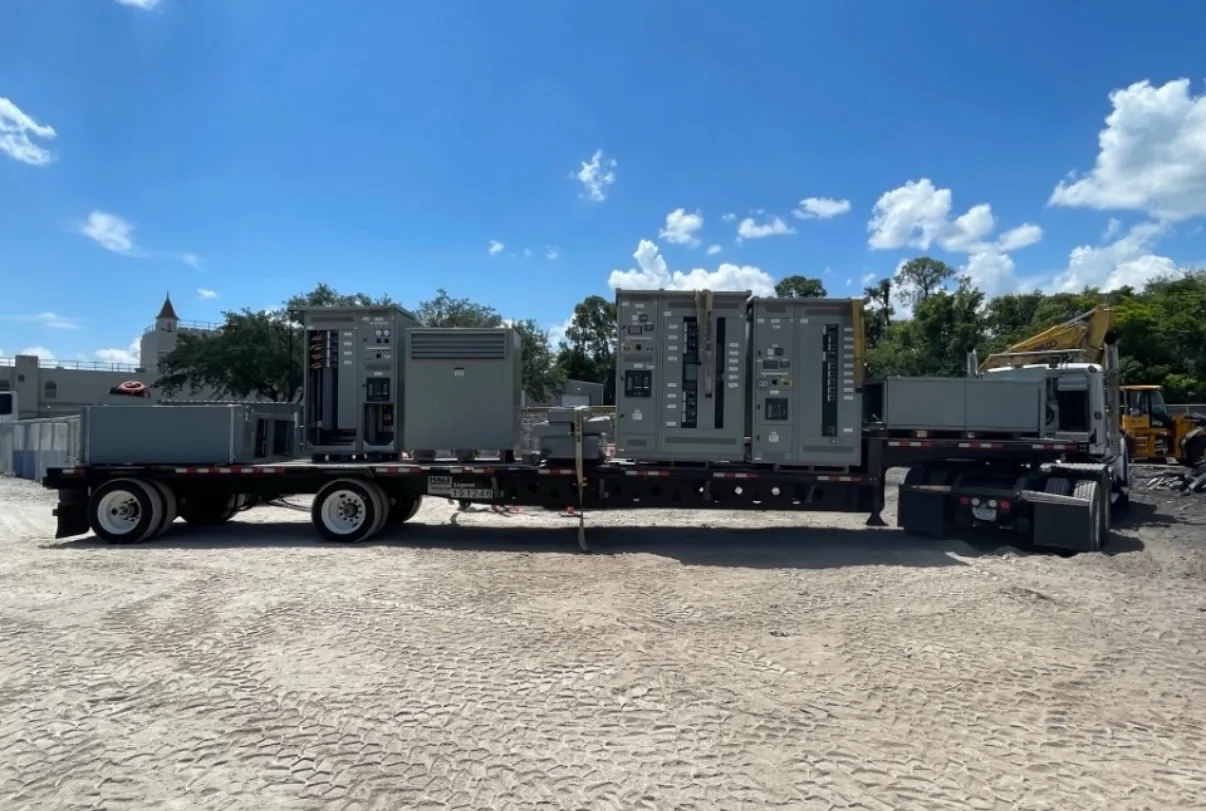
High-Voltage Substation Switchgear for Las Vegas Projects
High-voltage switchgear is part of the substation interface between an incoming power source and the equipment serving a facility. For a Las Vegas project, its configuration must reflect the actual service arrangement—not just the city, nominal system voltage, or a general equipment label. The required main section depends on the source, transformer arrangement, protection scheme, metering location, and the way the utility expects the service to connect. We manufacture new custom switchgear and power-distribution equipment in the United States, using all-American components, and ship nationwide, including to Nevada. The exact high-voltage construction available for a project must be confirmed during engineering review.
Start With Project-Specific Voltage Classification
“High voltage” does not establish a complete equipment specification. The project team must identify the system’s nominal voltage and the applicable equipment voltage class, then establish the required insulation level for the switching and insulating medium under consideration. Those are related but distinct design inputs: system voltage alone does not define all withstand requirements, clearances, or insulation coordination. The specification should also identify frequency, continuous current, short-circuit duty, and any required switching or interrupting duties. Ratings describe equipment capabilities under defined conditions; they do not by themselves confirm compatibility with a particular system or installation.
Insulation requirements may be affected by the system grounding method, expected overvoltages, altitude, pollution exposure, and the project’s grounding and surge-protection design. Las Vegas conditions should be documented rather than assumed. Site elevation, heat, dust, enclosure location, ventilation, and exposure to weather can affect equipment selection and installation provisions. Qualified project engineers should determine which environmental and electrical conditions apply and whether any derating, special insulation coordination, or enclosure measures are necessary.
Define the Substation Arrangement and Available Construction
Substation switchgear can be arranged to suit the source and load topology, but the specific construction must be confirmed for each application. Relevant choices may include the number and function of incoming and outgoing ways, bus arrangement, disconnecting and grounding provisions, and interfaces to transformers or other substation equipment. The project drawings should make clear where the equipment begins and ends, which components are furnished by others, and how control and auxiliary power are provided.
Construction details also depend on the switching technology and installation requirements. Indoor and outdoor applications can impose different enclosure, access, environmental, and connection needs. Before preparing a quotation, identify the intended mounting and cable or bus connections, available space, access constraints, and required interfaces with protection, control, and monitoring systems. Do not assume that a low-voltage switchboard standard or listing applies to high-voltage substation equipment; applicable standards and product scope must be established for the selected design.
Coordinate Utility Interconnection and Metering
Utility interconnection requirements can determine important details of the incoming section. For a Las Vegas project, confirm the serving utility’s service characteristics, point of delivery, fault-duty information, acceptable connection arrangement, and utility metering requirements before sizing the main section. Metering may affect the location and type of instrument transformers, compartments, wiring, seals, and access provisions. The utility’s current service documents and project-specific direction should be reviewed alongside the owner’s electrical design; assumptions about another site or service class are not a substitute.
Early coordination helps avoid mismatches between utility-furnished and customer-furnished equipment. Establish responsibility for instrument transformers, relaying, metering, communication links, terminations, and commissioning interfaces. Confirm applicable clearances and who provides the interconnection studies or approvals. Utility acceptance is separate from equipment design or manufacture and should not be presumed from a general equipment description.
Protection, Coordination, and Applicable Standards
Protection must be developed around the complete power system. Relay functions, instrument-transformer ratios and accuracy, breaker or switch duties, grounding, and trip-circuit interfaces should be evaluated against the system study and operating requirements. Protection coordination with upstream utility devices and downstream transformers or feeders can influence equipment ratings and settings. Arc-flash and other safety assessments likewise require qualified engineering analysis using project-specific system data; they cannot be determined from the switchgear description alone.
Specify the applicable IEEE or IEC requirements in the project documents, including the editions and scope relevant to the equipment. Which requirements apply depends on the selected construction and service conditions. A standards reference should be verified against the design rather than treated as a blanket certification. Ratings, listings, construction details, and compliance documentation require confirmation for the exact quoted assembly.
Information to Prepare for a Nevada Quotation
A useful inquiry includes a one-line diagram, service voltage and equipment class, available fault-current information, grounding method, transformer data, load and duty requirements, site conditions, utility metering criteria, and the applicable project standards. Add equipment layout, connection details, control and protection requirements, and the desired scope split. Incomplete inputs can leave major rating and interface questions unresolved, so an early review can identify what the engineer, owner, or utility still needs to provide.
We build new custom equipment in the USA and support short lead times, with shipping available nationwide. Schedule and shipping details depend on the confirmed design, scope, and project requirements; no exact lead time should be assumed before review. A qualified engineer and the serving utility should confirm system characteristics, interconnection criteria, and final equipment requirements before sizing or release.