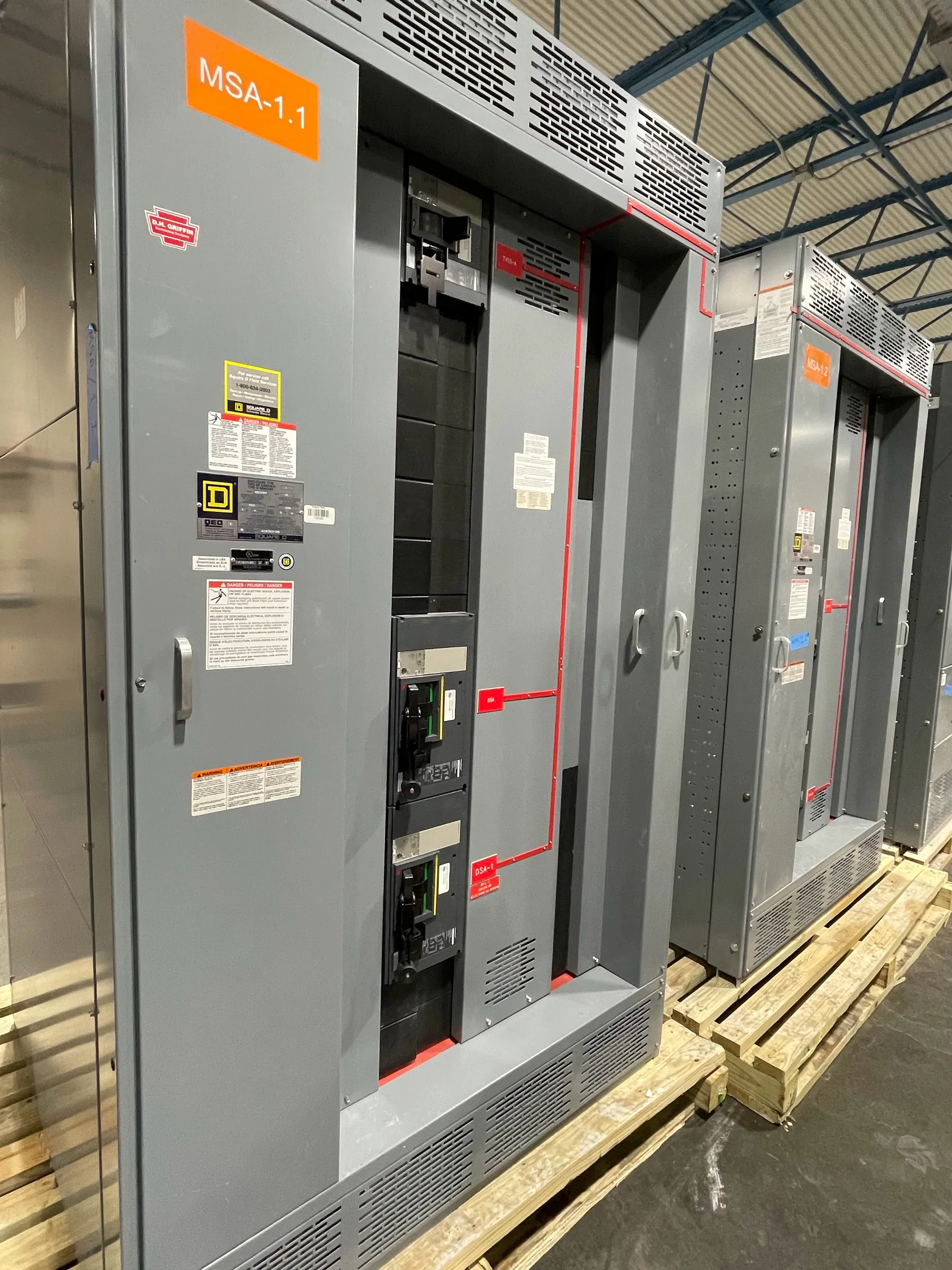
Industrial Switchgear for Hawthorne, Nevada Facilities
Industrial power distribution in Hawthorne begins with the facility’s actual electrical service and operating demands—not a generic equipment schedule. A manufacturing, processing, maintenance, or support facility may have a mix of continuous loads, intermittent machinery, large motors, variable-frequency drives (VFDs), and control systems. Those loads influence switchgear configuration, feeder arrangement, protective devices, and the information needed to develop a sound quotation. We manufacture new custom switchgear and power-distribution equipment in the United States and serve Nevada projects with equipment shipped nationwide.
Start With the Source and Available Fault Current
The source arrangement is a foundational design input. Project teams should identify the service voltage and phase, transformer or other source details, grounding arrangement, available fault current at the proposed equipment location, and whether the installation includes alternate sources, ties, or generator connections. These details affect equipment ratings and protective-device selection; they cannot be inferred from a nominal system voltage alone.
Available fault current must be established for the specific installation and reviewed against the equipment’s applicable ratings. Source changes, transformer substitutions, utility information, conductor lengths, and upstream protective devices can affect the result. For a Hawthorne project, confirm the responsible electrical engineer’s assumptions and the information available from the serving utility or site electrical records before finalizing the equipment scope. The project engineer must verify that the selected equipment is suitable for the installation.
Motor Starting, VFDs, and Load Duty
Motor loads call for more than a count of motors. The design team should provide motor nameplate data, horsepower or other load information, starting method, expected starting frequency, operating sequence, and whether motors may start together. Direct-on-line starting, reduced-voltage methods, and VFD-based control present different demands on feeders and protective devices. The intended duty—such as frequent starts, long operating periods, or changing process loads—also informs the design review.
VFDs add important interface questions. Identify drive locations, input requirements, bypass arrangements if any, and the loads controlled by each drive. Drives can influence upstream protection, power quality, heat, and coordination with downstream equipment. Whether filtering, isolation, or other measures are needed depends on the drive and installation details; these should be evaluated by qualified engineers rather than assumed as standard features. Clear scope boundaries between switchgear, drives, motor control equipment, and field wiring help prevent gaps in responsibility.
Protective Coordination and Equipment Ratings
Protective coordination is a project-specific engineering study, not a setting selected in isolation. Upstream and downstream protective devices need review against the system configuration, fault-current information, load characteristics, and the facility’s desired response to faults. The study may identify tradeoffs between selectivity, equipment protection, and continuity of service. Final device selection and settings require qualified engineering review and must reflect the installed system.
Keep system voltage distinct from equipment ratings. A voltage designation does not, by itself, establish interrupting capability or suitability for available fault duty. Likewise, a rating is not evidence that a particular assembly is listed for a project. UL 891 applies to applicable low-voltage switchboards; it should not be treated as a blanket standard for every switchgear product or voltage class. Applicable ratings, listings, and construction details must be confirmed for the exact equipment and project scope.
Hawthorne Site Conditions and Project Interfaces
Site conditions can shape enclosure, layout, and delivery planning. Provide the intended indoor or outdoor location, environmental exposure, ambient conditions, room dimensions, access route, equipment handling limits, and any site-specific access or scheduling requirements. For a remote or operational industrial site, coordination of receiving, unloading, staging, and installation access deserves early attention. These are planning inputs, not assumptions about a particular Hawthorne facility.
Also identify cable entry direction, conduit or bus connections, grounding interfaces, control power, metering needs, communications requirements, and connections to existing distribution. If equipment must fit a constrained room or align with existing gear, dimensioned drawings and interface data are especially useful. Site review may be needed to verify clearances, routing, and practical installation constraints.
Information for a Custom Switchgear Quotation — Industrial Switchgear in Hawthorne, NV
A useful quotation package typically includes one-line diagrams, load schedules, service and source information, available fault-current data, protective-device requirements or coordination criteria, motor and VFD details, layout constraints, and required interfaces. Note which documents are preliminary and which have been approved by the project engineer. Missing inputs can affect configuration and schedule, so assumptions should be stated and confirmed before release for manufacture.
Our role is to manufacture new custom equipment to the defined project requirements; engineering decisions must be made and reviewed by qualified professionals familiar with the site and applicable requirements. We can work from project documentation to clarify equipment scope, ratings, interfaces, and manufacturing details. U.S.-made assemblies use all-American components, support short lead times, and can ship nationwide. Project timing and final specifications depend on confirmed scope, engineering review, and manufacturing requirements.