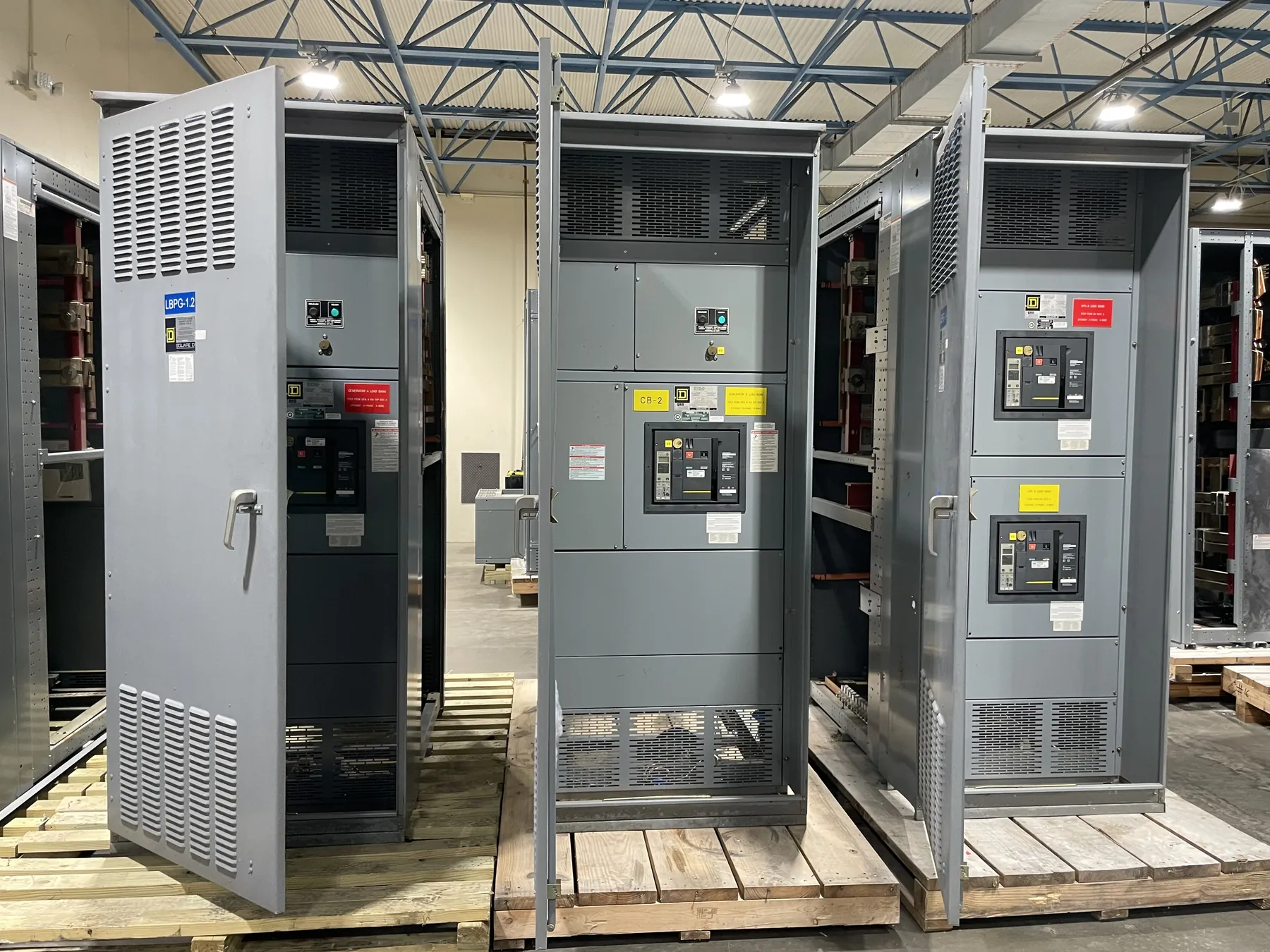
Industrial Switchgear for Carson City Facilities
Industrial electrical distribution in Carson City must be designed around the facility’s actual process, utility service and operating conditions—not just a nominal voltage or a list of connected equipment. A custom switchboard or switchgear assembly can organize incoming power, feeders, motor loads and distribution interfaces, but its configuration depends on the project’s electrical design. Our U.S.-manufactured equipment is built new to project requirements, using all-American components, with nationwide shipping available. Short lead times may be supported, but schedule depends on the confirmed scope, component requirements and engineering review.
Industrial facilities can include production machinery, pumps, fans, compressors, material handling and building loads, each with a different duty cycle and starting behavior. Early coordination helps establish what the assembly must serve, how circuits should be grouped, and what provisions are needed for future changes. Equipment selection and application require review by qualified electrical professionals familiar with the site and applicable requirements.
Motor Starting, Drives and Load Duty
Motor starting can impose demands that differ substantially from steady operating load. The design team should identify motor size and type, starting method, expected frequency of starts, load characteristics and whether multiple motors may start together. Across-the-line starting, reduced-voltage methods and variable-frequency drives (VFDs) affect feeder selection, protective-device behavior and the way upstream equipment experiences starting conditions. The switchgear should be coordinated with the motor-control equipment rather than specified in isolation.
VFD applications also call for attention to the drive manufacturer’s requirements and the installation context. Relevant inputs can include drive ratings, input protection, harmonic considerations, enclosure environment and the relationship between the drive and motor. A switchboard is not a substitute for drive engineering, and no single configuration suits every motor system. Load duty matters as well: continuous operation, intermittent use, cycling and planned expansion can lead to different practical choices for feeder organization and equipment ratings.
Fault Current, Ratings and Protective Coordination — Industrial Switchgear in Carson City, NV
Available fault current at the equipment location is a key design input. The project engineer should establish the applicable value and account for the source, transformer and upstream distribution arrangement. Equipment short-circuit ratings and protective-device interrupting ratings must be suitable for the actual system conditions. A rating is not the same thing as system voltage; each rating must be checked against the system and the specific assembly configuration.
Protective coordination examines how overcurrent devices respond to faults across the distribution system. The intent is to limit the portion of the facility affected where the design and device characteristics permit, while maintaining protection appropriate to the equipment and conductors. Device selection, settings, time-current behavior, motor starting and downstream protection can interact. Qualified engineers should perform the study and confirm the final design; ratings and coordination cannot be determined from a general equipment description alone.
Carson City Site Conditions and Project Interfaces
For a Carson City installation, the project team should verify the actual site conditions rather than assume that facilities share the same service arrangement or environment. Useful information includes available electrical-room space, access and handling constraints, ambient conditions, dust or moisture exposure, ventilation, equipment clearances and the route for incoming and outgoing conductors. These details can affect enclosure selection, assembly layout and installation planning.
Logistics also belong in the schedule discussion. The team should confirm the delivery point, receiving access, unloading arrangements, construction sequence and when approved drawings and final electrical data will be available. Equipment is manufactured in the United States and can ship nationwide; shipping to a Carson City project does not imply a local factory or office. Delivery timing must be confirmed for the specific order rather than assumed.
Permits, Inspection and Utility Review
Permit and inspection steps depend on the installation, project scope and authorities with jurisdiction. Before procurement, the electrical contractor or project representative should identify the applicable permit requirements and confirm which plans, equipment submittals and calculations must accompany the application. The local permitting authority determines the review and inspection process for the specific site; requirements should be verified directly for the project.
Utility review is also project-specific. The serving utility may need to review service characteristics, metering arrangements, service equipment or other interfaces, depending on the proposed work and its rules. Confirm the utility’s submittal requirements and approval sequence before fixing design assumptions. Utility review, permit approval and field inspection are distinct steps and should not be treated as automatic consequences of equipment manufacture.
What to Provide for a Carson City Quotation
A useful quotation package gives the manufacturer enough information to define scope without guessing. Provide the one-line diagram and equipment schedule if available, system voltage and phase, incoming service details, required continuous and short-circuit ratings, available fault-current information, feeder and motor-load data, VFD details, enclosure and environmental requirements, and any required metering or control interfaces. Identify the project’s governing specifications, drawing milestones, delivery constraints and known permit or utility review requirements.
UL 891 applies to applicable low-voltage switchboards; it does not establish coverage for every switchgear assembly or for medium- or high-voltage equipment. Any requested listing, standard, rating and product scope must be confirmed for the specific design. With the project engineer’s review and complete site information, the equipment configuration can be evaluated against the industrial loads, interfaces and installation conditions planned for Carson City.