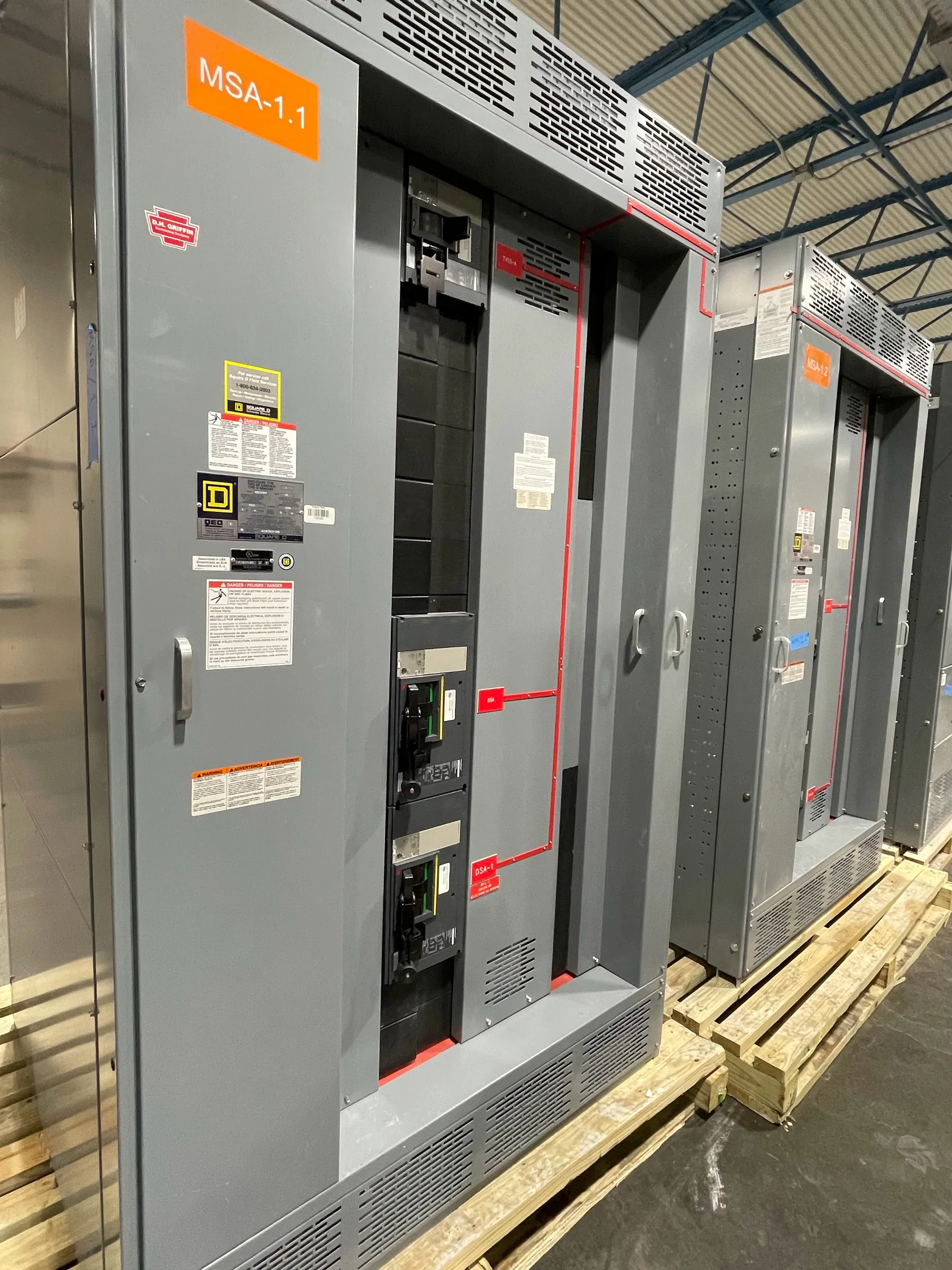
Fault Current and Interrupting Rating Answer Different Questions
For a facility planning new switchgear or power-distribution equipment, these terms describe two related but distinct limits. Available fault current is the current a power system could deliver at a particular point during a fault. A circuit breaker’s interrupting rating is the maximum fault current that breaker is rated to interrupt under specified conditions. The first describes the electrical system; the second describes a component selected for that system.
Neither value, by itself, establishes that a complete switchboard or switchgear assembly is suitable. The assembly’s short-circuit rating must also be considered, along with the equipment voltage, configuration, protective devices, and applicable product requirements. A sound specification checks all three levels rather than treating a breaker rating as an assembly-wide rating.
Available Fault Current Depends on the Location and System
Available fault current is determined by the sources and impedance upstream of the point being evaluated. Utility supply characteristics, transformer size and impedance, conductor length and type, and connected sources such as generators can affect the result. The value can differ between the service entrance, a distribution board, and a downstream panel. It may also change when the system configuration changes, such as when a tie breaker is closed or another source is connected.
For that reason, a value quoted for a facility should identify the location and assumptions behind it. A utility’s information at the service point may be an important input, but it does not automatically establish the fault current at every piece of equipment downstream. The project engineer evaluates the system and determines the applicable value at each location.
A Breaker’s Interrupting Rating Applies to That Breaker
A breaker’s interrupting rating indicates its capability to interrupt a fault current within its specified application conditions. It is not the breaker’s normal load capacity, and it is not the amount of fault current the system will necessarily produce. A breaker can have a high interrupting rating in a system with lower available fault current; conversely, a breaker may be inadequate if the available fault current exceeds its applicable rating.
Ratings can depend on system voltage and the breaker’s specific type and configuration. A rating stated at one voltage should not be assumed to apply at another. When reviewing a submittal or quotation, compare the breaker’s interrupting rating with the engineer-established available fault current at that breaker’s location, using the equipment and system details that govern the rating.
The Complete Assembly Has Its Own Short-Circuit Rating
Switchboards and other assemblies include more than breakers. Bus, supports, joints, enclosure construction, protective devices, and their arrangement all matter to the assembly’s ability to withstand or manage short-circuit conditions. The assembly short-circuit rating therefore cannot be inferred simply by selecting a breaker with a sufficiently high interrupting rating. The specified breaker and any conditions attached to its use must match the assembly’s evaluated design.
For applicable low-voltage switchboards, UL 891 is a relevant product standard; it is not a blanket rating for every type of switchgear or for medium- or high-voltage equipment. Product standards, listings, and short-circuit ratings are specific to equipment scope and configuration. Confirm the exact product, rating, and any required protective-device combination rather than assuming one designation covers an entire distribution system.
Coordination and Protection Choices Must Preserve the Ratings
Engineers consider protective-device coordination so that the intended device responds to a fault while upstream and downstream equipment operate as designed. Selective coordination goals, breaker trip settings, and device choices can influence the design, but adjusting a setting does not increase a breaker’s interrupting rating or an assembly’s short-circuit rating. Likewise, a current-limiting device or a series-rated arrangement is acceptable only when the specific combination is permitted for the application and documented accordingly.
These decisions involve tradeoffs among fault protection, continuity of service, equipment selection, and system constraints. They require qualified engineering review of the one-line diagram, device data, and actual installation conditions; a general rule of thumb cannot settle them.
Information to Provide for a Nevada Equipment Quotation
For a new custom assembly, useful quotation inputs include the one-line diagram, system voltage, service and transformer information, available fault-current study or utility data, and the location where that value applies. Include the required bus and device arrangement, incoming and feeder breaker details, tie or alternate-source configuration, and project specifications. If fault-current calculations or equipment ratings are unresolved, identify them as open engineering items instead of guessing.
A U.S. manufacturer using all-American components can review the requested configuration and identify information needed to confirm ratings, listings, and interfaces before manufacture. Nevada facility conditions—such as available space, access for equipment placement, ambient conditions, and the existing service arrangement—may affect the project details and should be reviewed by the project team. Equipment can ship nationwide, and short lead times may be supported, but actual timing depends on confirmed scope and engineering review. Final suitability must be established for the specific installation.